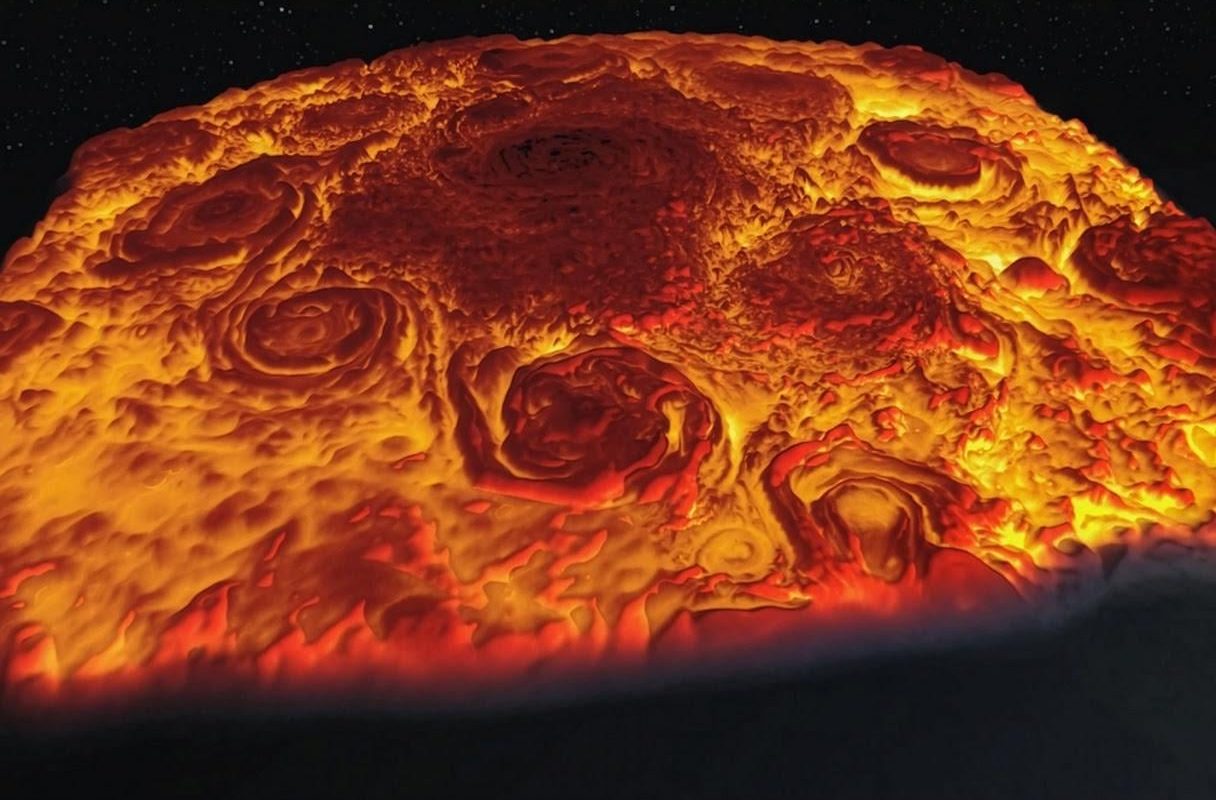
Infrared 3D image of Jupiter’s north pole showing cyclones and anticyclones
Unveiling Jupiter’s Mysterious North Pole: Infrared 3D Image Reveals Stunning Cyclones and Anticyclones
Introduction
Jupiter, the solar system’s largest planet, has long captivated scientists with its tempestuous atmosphere. Recent advances in space imaging have peeled back another layer of its mysteries—using infrared 3D technology to expose the dynamic cyclones and anticyclones swirling at its north pole. This groundbreaking visualization offers unprecedented insights into Jupiter’s chaotic weather systems, providing clues about gas giant dynamics and planetary science at large.
How Did We Capture Jupiter’s Hidden Secrets?
The data behind these captivating images comes from NASA’s Juno spacecraft, which has orbited Jupiter since 2016. Equipped with the Jovian Infrared Auroral Mapper (JIRAM), Juno penetrates Jupiter’s thick cloud cover using infrared light to map atmospheric heat signatures. Unlike visible light, infrared reveals temperature variations linked to storm systems. When stitched into 3D models, this data exposes the vertical structure and behavior of cyclones and anticyclones—features invisible to conventional telescopes.
What Do the 3D Images Show?
The infrared 3D renderings of Jupiter’s north pole reveal a complex geometric arrangement of storms:
- A Central Cyclone: Anchored directly over the pole, this persistent storm spans thousands of miles.
- Polygonal Vortex Patterns: Surrounding the central cyclone are eight smaller cyclones, arranged in a near-octagonal formation. These storms have remained shockingly stable since Juno’s arrival.
- Anticyclones in the Mix: Wedged between cyclonic systems, anticyclones (high-pressure zones with outward-flowing winds) manifest as warmer, darker regions in infrared imagery.
These storms dwarf Earth’s largest hurricanes, with wind speeds exceeding 220 mph (354 kph) and roots extending over 1,900 miles (3,000 km) into Jupiter’s atmosphere.
Why Are These Findings Significant?
- Atmospheric Dynamics: Jupiter’s polar cyclones behave unlike anything on Earth. Their stable polygonal arrangement defies traditional models of fluid dynamics, challenging scientists to refine theories about how planetary atmospheres function.
- Heat and Energy Transfer: The 3D data shows how convection drives these storms. Heat from Jupiter’s core rises to fuel cyclones, while anticyclones may act as atmospheric “sinks.”
- Gas Giant Clues: Studying Jupiter helps us understand exoplanets and other gas giants, where similar storm systems likely exist.
The Technology Behind the Discovery
- JIRAM Instrument: Captures infrared wavelengths to map atmospheric layers down to 30–45 miles (50–70 km) below Jupiter’s clouds.
- 3D Modeling: By combining altitude, temperature, and wind-speed data, scientists reconstruct the storms’ three-dimensional shapes.
- Polar Orbit Advantage: Juno’s unique trajectory over Jupiter’s poles allows unmatched views of these turbulent regions.
Implications for Planetary Science
Understanding Jupiter’s cyclones could reveal:
- How gas giants generate and sustain colossal storms for centuries.
- The role of magnetic fields and planetary rotation in shaping atmospheric patterns.
- Parallels to Earth’s climate systems, albeit at a far more extreme scale.
As Juno’s mission continues until 2025, even clearer models are expected to emerge.
Where Can You See the Images?
NASA regularly releases Juno’s visuals on its official site and social media. Notable infrared 3D renderings can be found in the Journal of Geophysical Research: Planets and via NASA’s Juno Mission Gallery.
FAQs About Jupiter’s Polar Storms
Q: What’s the difference between cyclones and anticyclones on Jupiter?
A: Cyclones (low-pressure systems) rotate counterclockwise in the north pole and suck material inward. Anticyclones (high-pressure) rotate clockwise and push material outward.
Q: Why doesn’t Jupiter’s polar storm system collapse?
A: Scientists speculate that the “ring” of circumpolar cyclones acts as a barrier, preventing mergers and maintaining stability.
Q: How does this relate to Earth’s climate?
A: While scales differ, both planets rely on fluid dynamics and heat transfer—key to improving terrestrial weather forecasting.
Conclusion
The infrared 3D imagery of Jupiter’s north pole is more than just a mesmerizing spectacle—it’s a Rosetta Stone for deciphering the atmospheric choreography of gas giants. As Juno continues its mission, each data transmission brings us closer to answering fundamental questions about planetary formation, climate resilience, and the forces that shape our solar system.
For updates on Jupiter’s stormy drama, follow NASA Juno Mission platforms and dive into the cosmos’ most spectacular weather channel!
SEO Keywords: Jupiter north pole, infrared 3D image, cyclones and anticyclones, NASA Juno mission, JIRAM instrument, Jupiter atmospheric storms, gas giant weather, planetary science, 3D storm modeling, Jupiter polar vortices.