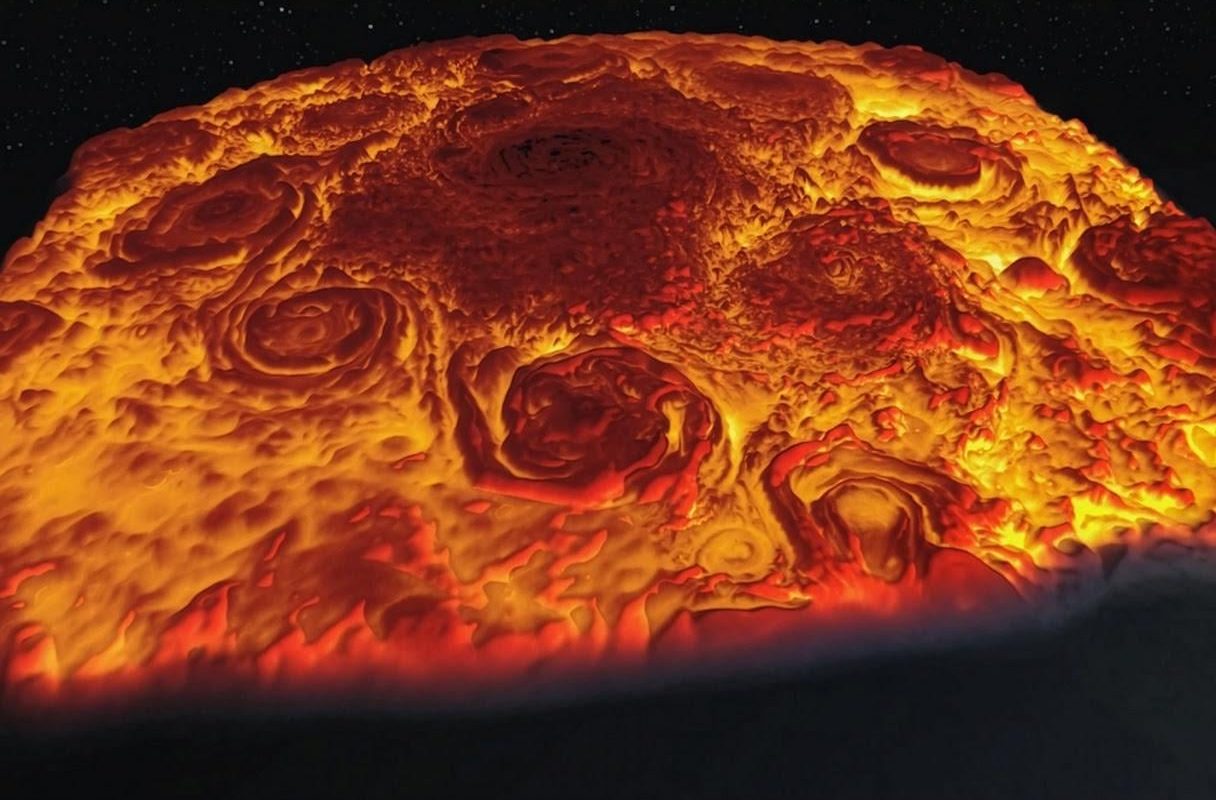
Infrared 3D image of Jupiter’s north pole showing cyclones and anticyclones
Meta Description:
Dive into the mesmerizing infrared 3D imagery of Jupiter’s north pole, revealing a chaotic ballet of cyclones and anticyclones. Discover how NASA’s Juno mission unravels the mysteries of the gas giant’s turbulent atmosphere.
Infrared 3D Image of Jupiter’s North Pole: Unveiling the Chaotic Dance of Cyclones and Anticyclones
Jupiter, our solar system’s largest planet, has long captivated astronomers with its swirling storms and iconic Great Red Spot. But recent infrared 3D imaging from NASA’s Juno spacecraft has uncovered an even more astonishing spectacle at Jupiter’s north pole: a sprawling labyrinth of cyclones and anticyclones, locked in a perpetual and chaotic dance. This groundbreaking discovery offers unprecedented insights into the atmospheric dynamics of gas giants and raises new questions about the forces driving Jupiter’s extreme weather.
Juno’s Infrared Vision: Peering Through Jupiter’s Veil
Launched in 2011, NASA’s Juno mission arrived at Jupiter in 2016 with a primary goal: to map the planet’s gravitational and magnetic fields while studying its turbulent atmosphere. One of its most powerful tools is the Jovian Infrared Auroral Mapper (JIRAM), an instrument designed to capture infrared wavelengths. Unlike visible light, infrared penetrates Jupiter’s upper cloud layers, revealing heat signatures and atmospheric structures invisible to conventional cameras.
In 2022–2023, JIRAM captured high-resolution 3D data of Jupiter’s north polar region. The resulting images show a stunningly complex arrangement of massive storms:
- Central Cyclone: A persistent cyclone spans over 2,000 miles (3,200 km) in diameter, anchored directly over the pole.
- Polygonal Ring: Surrounding it is a ring of eight lesser cyclones, each comparable in size to Earth’s continents.
- Anticyclonic Eddies: Between these cyclones swirl smaller, clockwise-spinning anticyclones.
This geometric pattern—akin to a hurricane-like polygon—defies expectations of how planetary weather systems behave.
Cyclones vs. Anticyclones: The Battle of Atmospheric Titans
Cyclones (Low-Pressure Systems)
- Spin Direction: Counterclockwise in Jupiter’s northern hemisphere.
- Characteristics: Warm cores that rise, feeding energy from Jupiter’s deep atmosphere.
- Behavior: Merging, splitting, and jostling for dominance amid turbulent winds exceeding 220 mph (350 km/h).
Anticyclones (High-Pressure Systems)
- Spin Direction: Clockwise in the north.
- Characteristics: Cool, dense air that sinks, creating clear gaps between clouds.
- Role: Act as “stabilizers,” preventing cyclones from merging—a phenomenon still under investigation.
The infrared data revealed that cyclones extend over 30 miles (50 km) deep—much farther than initially thought—and are flanked by shallow anticyclones.
Why Are Jupiter’s Polar Storms So Stable?
Earth’s hurricanes dissipate after days or weeks. Yet Jupiter’s polar cyclones have persisted since Juno first spotted them in 2017. Scientists propose two theories for their longevity:
- The “Shallow Model”: Storms are powered by atmospheric jets near Jupiter’s cloud tops.
- The “Deep Model”: Energy surges upward from the planet’s interior, possibly driven by internal heat or convection.
The 3D data supports the deep model, showing cyclones rooted in Jupiter’s warmer, lower atmospheric layers—fueled by convection similar to Earth’s thunderstorms but on a planetary scale.
What This Means for Understanding Gas Giants
Jupiter’s polar storms challenge assumptions that planetary weather requires a solid surface (like Earth’s oceans or mountains) to organize. Instead, magnetic fields, internal heat, and fluid dynamics dominate its atmosphere. These findings also hint at how storms behave on other gas giants, such as Saturn and exoplanets.
Key Takeaways
- Infrared 3D Imaging: JIRAM’s technology revolutionized our view of Jupiter’s hidden atmospheric layers.
- Cyclonic Polygon: A stable, geometric arrangement of storms defies conventional meteorology.
- Depth Matters: Cyclones stretch dozens of miles deep, drawing energy from Jupiter’s interior.
- Future Missions: Juno’s extended mission (through 2025) will continue unraveling Jupiter’s secrets.
Conclusion: A Window into Planetary Chaos
The infrared 3D imagery of Jupiter’s north pole elevates our understanding of giant planet atmospheres. These cyclones and anticyclones—locked in a mesmerizing, endless waltz—are a testament to the raw power of nature on a scale unimaginable on Earth. As Juno’s mission continues, astronomers anticipate unlocking more mysteries about not only Jupiter but the fundamental physics governing all fluid systems in the cosmos.
Image Suggestion: Include a composite of Juno’s infrared 3D renderings alongside artist concepts of Jupiter’s polar storm systems.
Target Keywords: Jupiter north pole cyclones, Juno mission infrared 3D, Jupiter atmospheric dynamics, gas giant storms, JIRAM instrument NASA.
SEO Optimization Tips:
- Header Tags: Nest H2 and H3 subheadings to highlight key sections.
- Internal Links: Link to related content about Juno, JIRAM, or the Great Red Spot.
- Image Alt Text: “3D infrared map of Jupiter’s north pole showing giant cyclones.”
- Mobile-Friendly: Use short paragraphs and bullet points for readability.
For scientists and space enthusiasts alike, Jupiter’s polar vortexes are a humbling reminder: even after centuries of study, our solar system still holds wonders beyond imagination.