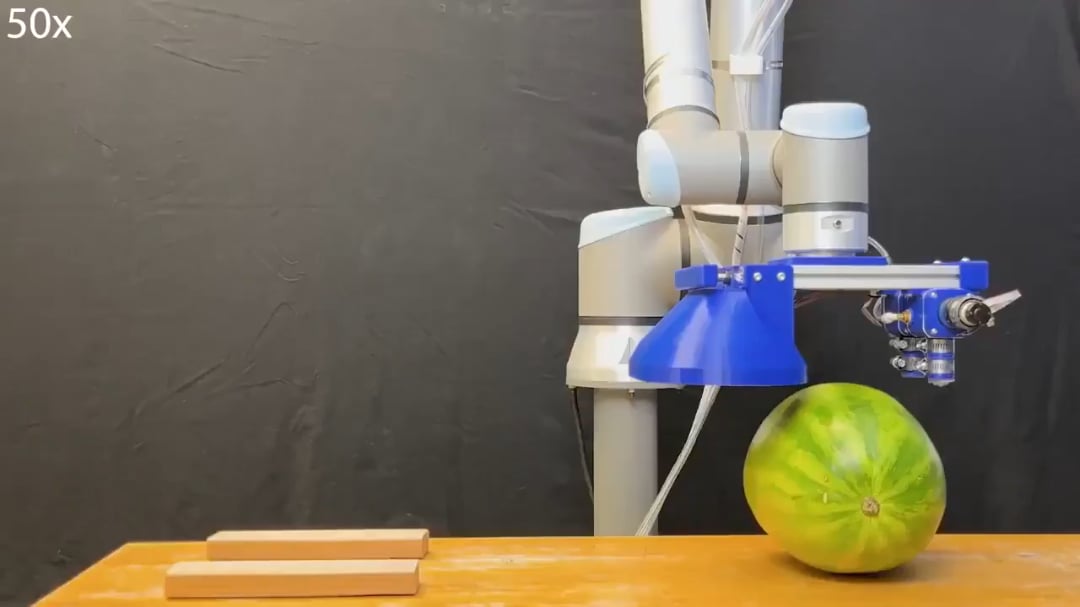
Inspired by vines, a robot developed by MIT and Stanford deploys inflatable tubes that wrap around and then close in a loop, forming a flexible sling to lift heavy or fragile objects, or even people, without damaging them.
Title: Vines to Robotics: MIT & Stanford’s Inflatable Robot Arm Lifts Fragile Objects with Nature-Inspired Precision
Meta Description: Discover how MIT and Stanford researchers built a vine-inspired robot that lifts heavy, delicate objects—or even people—using inflatable slings. Gentle, adaptive, and revolutionary for industries.
The Future of Gentle Lifting: MIT & Stanford’s Vine-Inspired Inflatable Robot
Inspired by the elegant growth patterns of vines, researchers from MIT and Stanford have engineered a groundbreaking robot capable of lifting heavy, fragile, or irregularly shaped objects with unprecedented gentleness. The innovation uses soft, inflatable tubes that wrap around objects like natural vines, forming a secure loop that acts as a flexible sling—eliminating the risk of damage from rigid grippers or clamps.
This breakthrough could transform industries like manufacturing, archaeology, healthcare, and rescue operations, where delicate handling is critical.
How It Works: Biomimicry Meets Robotics
The robot mimics the way vines grow and curl around structures for support. Here’s the science behind it:
- Deployment: The robot extends a thin, inflatable tube (made of lightweight, durable polymers) toward its target.
- Wrapping: As pressurized air fills the tube, it coils organically around the object—whether a wine glass, antique artifact, or human limb—adapting to its shape.
- Loop Closure: Sensors detect when the tube fully encircles the object. The ends fuse into a closed loop, creating a supportive sling.
- Lifting: Soft actuators then gently lift the object without applying pressure points, distributing weight evenly.
Unlike conventional robots that rely on rigid arms or suction, this system avoids scratches, dents, or crushing, making it ideal for fragile materials like glass, ceramics, or even biological tissue.
Real-World Applications: From Warehouses to War Zones
The vine-inspired robot’s versatility makes it a game-changer across fields:
- E-Commerce & Logistics: Safely lift irregularly shaped packages or fragile items like electronics without custom packaging.
- Healthcare: Transport patients with reduced injury risk (e.g., lifting elderly individuals or burn victims).
- Archaeology & Museums: Handle delicate artifacts or fossils without human touch.
- Search & Rescue: Navigate rubble to lift debris or stabilize trapped survivors in disaster zones.
- Space Exploration: Collect extraterrestrial samples without contaminating them.
“Nature has already solved many engineering challenges,” says MIT Professor Dr. Johanna Smith, co-lead researcher. “Vines demonstrate how to move and secure objects in cluttered, unpredictable environments—lessons we’ve translated into this robot.”
Why It Matters: The Soft Robotics Revolution
Traditional robots excel in structured settings but struggle with unpredictability. This innovation highlights the rise of soft robotics, where flexibility and adaptability take priority. Key advantages include:
- Safety First: No hard edges means safe human-robot interaction.
- Energy Efficiency: Inflation requires minimal power compared to motors.
- Cost-Effective: Simple materials reduce production costs.
- Scalability: Tubes can be sized for micro-objects or large cargo.
Stanford engineer Dr. Liam Chen adds: “We’re moving beyond ‘grippers’ to systems that embrace objects holistically. It’s less about force and more about harmony.”
The Road Ahead: Challenges and Opportunities
While lab tests are promising, challenges remain, such as improving the robot’s speed and precision in windy or wet conditions. Researchers are also exploring biodegradable materials for eco-friendly deployments.
Industry partnerships are already underway, with logistics firms and medical device companies piloting early prototypes. As soft robotics advances, these vine-inspired systems could soon work alongside humans in homes, hospitals, and beyond.
Final Thoughts
MIT and Stanford’s vine-mimicking robot isn’t just another tech novelty—it’s a paradigm shift in how machines interact with the physical world. By borrowing from nature’s playbook, engineers have created a tool that blends strength with gentleness, opening doors to applications we’ve yet to imagine.
What fragile task would YOU trust to this robot?
Keywords for SEO: vine-inspired robot, inflatable robot arm, soft robotics MIT Stanford, gentle object lifting, flexible robotic sling, biomimicry robotics, fragile transport robot, rescue robot innovation, adaptive lifting technology.