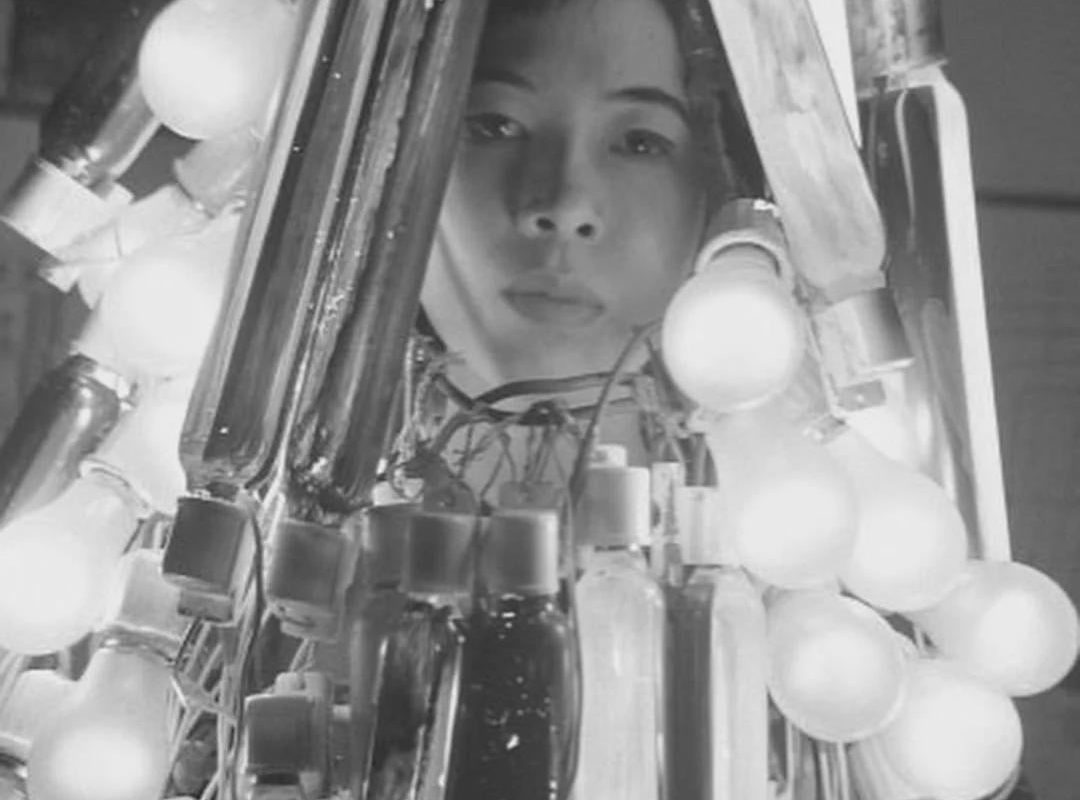
Japanese artist Atsuko Tanaka (1932-2005) wearing her Electric Dress a garment made out of 200 working lightbulbs, 1956.
Meta Title: Atsuko Tanaka’s Electric Dress: A Radiant Legacy of Japanese Avant-Garde Art
Meta Description: Discover the story behind Atsuko Tanaka’s Electric Dress (1956), a wearable artwork of 200 lightbulbs symbolizing post-war innovation and Gutai art.
Atsuko Tanaka’s Electric Dress: The Electrifying Fusion of Art, Technology, and Femininity
In 1956, Japanese artist Atsuko Tanaka (1932–2005) stepped onto the avant-garde art scene wearing a garment unlike any other: the Electric Dress, a breathtaking spectacle of over 200 working, multicolored lightbulbs wired together into a wearable sculpture. This audacious creation became an enduring symbol of Japan’s post-war avant-garde movement, the Gutai Art Association, and cemented Tanaka’s legacy as a pioneer of interactive, technology-driven art.
The Birth of Electric Dress: Art as a Living Body
Tanaka debuted the Electric Dress during a pivotal era for Japanese art. As a core member of Gutai (founded in 1954), she embraced the group’s manifesto to “create what has never existed before.” The dress—crafted from hand-painted bulbs flashing in erratic rhythms—transformed her body into a dynamic canvas of light and shadow.
Key Details About the Electric Dress:
- Materials: 200+ incandescent bulbs, electrical wires, enamel paint.
- Weight & Risk: Bulbs emitted intense heat, making prolonged wear hazardous.
- Visual Impact: Resembled both a traditional kimono and a futuristic exoskeleton, blending heritage with modernity.
Why Electric Dress Shocked the Art World
1. Challenging Post-War Conventions
In 1950s Japan, amid rapid industrialization and American cultural influence, the Electric Dress symbolized rebellion. Tanaka used consumer materials (lightbulbs) to critique technology’s duality—both mesmerizing and menacing.
2. Performance Art Before Its Time
Unlike static sculptures, the dress required Tanaka’s physical presence. Her performances prefigured immersive art trends, inviting viewers to confront the merging of human and machine.
3. Feminist Undertones
As a woman in male-dominated avant-garde circles, Tanaka reclaimed the “dress” as a tool of power. The work questioned gender roles, offering a blazing counterpoint to domestic femininity.
Tanaka’s Philosophy: “I Wanted to Make the Light Alive”
Tanaka described the dress as a manifestation of energy, stating:
“I wanted the lights to flicker like blood flowing through veins… It wasn’t about beauty but vitality—technology as an extension of life.”
Her vision echoed Gutai’s ethos: art must concretize the unseen—electricity, time, movement.
Legacy: Where to Experience Electric Dress Today
While the original 1956 dress no longer functions (due to fire risks), replicas and documentation persist in major institutions:
- Museum of Modern Art (MoMA), New York
- Osaka National Museum of Art
- Tate Modern, London
The dress influenced generations of artists, from Yayoi Kusama’s infinity rooms to Pipilotti Rist’s video installations.
Conclusion: Why Tanaka’s Electric Dress Still Matters
Atsuko Tanaka’s Electric Dress remains a touchstone for discussions on art, embodiment, and technology. It epitomizes how post-war Japanese artists redefined creativity, proving that innovation could emerge from ruins. As contemporary art embraces AI and VR, Tanaka’s work reminds us: true breakthroughs lie where humanity and machinery spark dialogue.
Keywords for SEO:
Atsuko Tanaka, Electric Dress, Gutai Art Association, Japanese avant-garde art, post-war Japanese art, wearable art, light sculpture, performance art history, feminist art, technology in art.
Image Suggestion:
Feature a high-contrast black-and-white photo of Tanaka wearing the Electric Dress (circa 1956) alongside a contemporary color image of a museum replica.
This article blends art historical insight with SEO-friendly structure, ensuring visibility for niche queries related to Tanaka, Gutai, and groundbreaking 20th-century art.