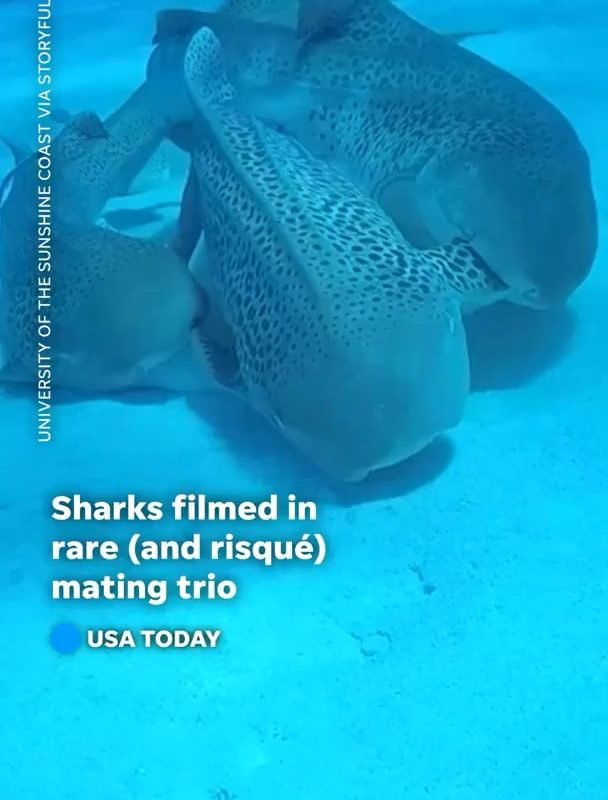
Leopard Sharks mating “Threesome”
Title: Leopard Sharks’ Mating “Threesomes”: A Fascinating Dive into Their Reproductive Behavior
Meta Description: Discover the rare but intriguing mating “threesomes” observed in leopard sharks, their reproductive strategies, and how this behavior benefits their survival. Dive into the science now!
Leopard Sharks’ Mating “Threesomes”: Unraveling the Mystery of Their Unique Reproductive Tactics
Leopard sharks (Triakis semifasciata), known for their striking spotted appearance and docile nature, are a common sight along the Pacific coast of North America. While much of their behavior is well-studied, recent observations have unveiled a rare and fascinating aspect of their mating habits: occasional “threesomes” involving two males and one female. This behavior, while not the norm, offers a captivating glimpse into the evolutionary strategies sharks use to ensure reproductive success.
The Basics of Leopard Shark Reproduction
Leopard sharks are ovoviviparous, meaning females hatch eggs internally and give birth to live pups. Mating typically occurs in shallow bays and estuaries during spring and summer, with males competing fiercely for access to females. Unlike some shark species that rely on biting or coercion, leopard sharks engage in a more synchronized courtship ritual involving close swimming and physical alignment.
What Triggers a Mating “Threesome”?
While leopard sharks usually mate in pairs, “threesomes” (or trio mating) have been documented in the wild and in captivity. This phenomenon involves two males simultaneously pursuing a single female, often nudging her sides or clasping her pectoral fins to position themselves for copulation. These interactions are thought to occur when:
- Competition is high – In dense mating aggregations, males may struggle to monopolize a female.
- Females resist – Females sometimes evade single males, inadvertently attracting additional suitors.
- Sperm competition – Multiple males may attempt to fertilize the same female to increase their genetic legacy.
The Evolutionary Advantage of Multi-Male Mating
For leopard sharks, “threesomes” likely serve two critical purposes:
- Genetic Diversity: Females that mate with multiple males produce litters with higher genetic variability, boosting offspring resilience.
- Male Fitness: Competition drives males to refine their tactics, favoring stronger, faster, or more persistent individuals.
Studies show that up to 82% of leopard shark litters exhibit multiple paternity, proving that females often store sperm from several partners. This underscores the importance of multi-male mating in their reproductive strategy.
Challenges and Risks
While trio mating may boost reproductive success, it’s not without risks:
- Physical Strain: Females may endure injuries from persistent males.
- Energy Costs: Extended courtship depletes energy reserves needed for gestation.
- Confusion: Simultaneous mating attempts can reduce fertilization efficiency.
Conservation Implications
Understanding leopard shark mating behavior is vital for conservation. Their coastal habitats face threats like pollution, habitat loss, and climate change. Protecting their breeding grounds—such as California’s Humboldt Bay or La Jolla Shallow Water Preserve—ensures stable mating aggregations and genetic health.
Key Takeaways
- Leopard shark “threesomes” are rare but highlight complex mating dynamics.
- Multiple paternity is common, enhancing genetic diversity.
- Habitat protection is crucial for sustaining wild populations.
Final Thoughts
While leopard sharks’ mating “threesomes” might sound sensational, they reveal a deeper truth about marine life: even seemingly straightforward behaviors are shaped by millions of years of evolutionary innovation. As research continues, these sharks remind us how much there is still to learn about the ocean’s hidden wonders.
Call to Action:
Love marine mysteries? Share this article to spread awareness about leopard sharks, or support organizations like Shark Trust and Oceana working to protect their habitats!
SEO Keywords:
Leopard sharks mating, shark reproduction behavior, leopard shark threesome, Triakis semifasciata mating, multiple paternity in sharks, shark conservation, marine biology facts.
Optimization Tips:
- Use internal/external links to reputable sources (e.g., scientific studies on multiple paternity).
- Include high-quality images/videos of leopard sharks in mating habitats.
- Update with recent research to maintain topical relevance.
By blending science with engaging storytelling, this article aims to rank for niche queries while educating readers about leopard sharks’ remarkable reproductive world. 🦈💙