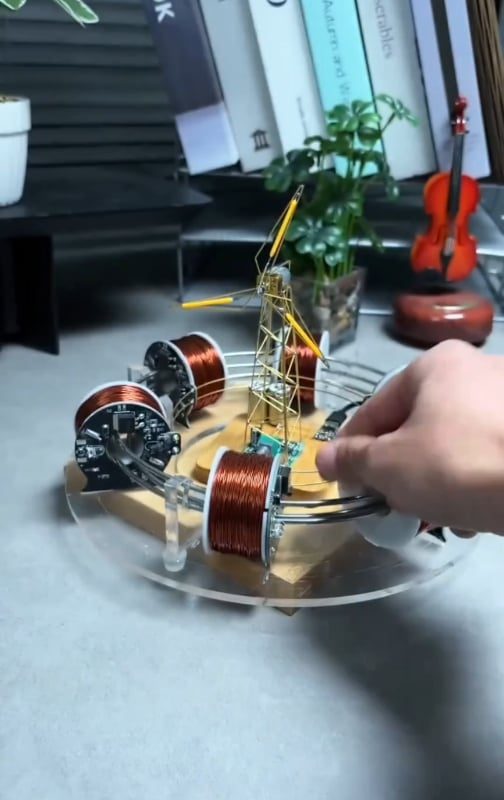
Magnetic Motor powered by magnetic feilds
Title: Magnetic Motor Powered by Magnetic Fields: Separating Fact from Fiction
Meta Description: Explore the science & controversy behind magnetic motors powered by magnetic fields. Learn how they claim to work, why skepticism exists, and their potential to revolutionize energy.
Introduction
Imagine a motor that runs indefinitely without fuel, electricity, or external power—just the invisible force of magnetic fields. The concept of a magnetic motor (also called a “perpetual motion machine” or “free energy device”) has fascinated inventors, engineers, and conspiracy theorists for decades. But is this revolutionary technology possible, or is it a persistent myth?
In this article, we dissect how magnetic motors claim to harness magnetic fields for infinite energy, examine the science behind them, and explain why mainstream physics remains skeptical.
What Is a Magnetic Motor?
A magnetic motor is a theoretical device that purportedly uses permanent magnets’ repulsive and attractive forces to generate continuous motion—and thus “free” energy—without external input. Unlike electric motors (which require electricity) or combustion engines (which burn fuel), it relies entirely on the magnetic field energy of permanent magnets like neodymium.
Key Principles Behind Magnetic Motors:
- Magnetic Repulsion/Attraction: Magnets are arranged to create a rotating motion via alternating push-pull forces.
- Zero-Point Energy Claims: Some theorists argue magnetic fields tap into “cosmic” background energy (a fringe concept not recognized by standard physics).
- Perpetual Motion Promise: If balanced perfectly, the motor would theoretically never stop, violating the Law of Conservation of Energy.
How Do Magnetic Motors Claim to Work?
Most magnetic motor designs follow a similar blueprint:
- Rotor & Stator Setup: Magnets are fixed to a rotor (rotating part) and stator (stationary part).
- Strategic Polar Alignment: Rotor magnets are positioned to repel stator magnets, forcing rotation.
- Timing Mechanism: Shields or switches temporarily block magnetic forces, allowing inertia to carry the rotor past “dead zones.”
Popular designs include:
- The Perendev Motor: A controversial model claiming self-sustaining rotation.
- Quanthor/Lutec Motors: Australian devices promoted in early 2000s (no verifiable success).
- Müller Dynamo: Uses rotating magnets and coils to generate electricity.
The Big Controversy: Why Don’t They Work?
Despite bold claims, no magnetic motor has ever passed scientific peer review or demonstrated net energy gain in controlled tests. Here’s why:
-
Thermodynamics Laws:
- First Law: Energy cannot be created/destroyed. Magnets don’t produce energy; they store it. Their fields weaken over time.
- Second Law: Systems naturally lose energy (e.g., friction, heat). Sustained motion is impossible without input.
-
Practical Limitations:
- Friction: Bearings and air resistance slow rotation.
- Magnetic Drag: Forces counteract motion as magnets realign.
- Energy Drain: Harvesting electricity (via coils) adds load, stopping the system.
-
“Free Energy” Scams: Unproven devices often attract investment fraud (e.g., Steorn’s Orbo, which failed public tests).
Could Magnetic Motors Ever Work?
Mainstream science says no—but research into magnetism continues. Some argue that recent discoveries, like quantum locking or exotic materials (e.g., graphene-based magnets), might enable breakthroughs. However, these focus on efficiency boosts, not infinite energy.
Potential Legitimate Applications Near Term:
- Energy-Efficient Motors: Using magnets to reduce electricity needs (e.g., brushless DC motors).
- Energy Harvesting: Capturing wasted kinetic/magnetic energy from industrial systems.
Pros vs. Cons of Magnetic Motors
| Pros | Cons |
|---|---|
| Zero fuel/emissions (in theory) | Violates fundamental physics |
| Quiet, low-maintenance design | No proven working prototype |
| Revolutionary potential for renewables | Used to promote scams/pseudoscience |
FAQ about Magnetic Motors
Q: Has a magnetic motor ever been built successfully?
A: No. All public demonstrations have either relied on hidden power sources or failed under scrutiny.
Q: Why do people still believe in magnetic motors?
A: Hope for clean, free energy and misunderstanding of magnetism. YouTube videos often showcase staged demos.
Q: Are there real-world uses for related magnetic tech?
A: Absolutely! Magnetic bearings, maglev trains, and efficient generators use magnetic principles—but they require external energy input.
Q: Did Nikola Tesla invent a magnetic motor?
A: No. While Tesla explored wireless energy, his work didn’t include a self-sustaining magnetic motor.
Conclusion: Hope vs. Reality
The concept of a magnetic motor powered by magnetic fields remains a tantalizing yet scientifically implausible idea. While magnets are crucial to modern tech, a truly autonomous motor defies physics as we know it.
Instead, researchers are focusing on realistic advances: better batteries, solar efficiency, and magnetic-assisted motors. For now, the dream of “free energy” stays in the realm of speculation—but the quest for sustainable power continues.
Call to Action:
Stay informed on energy tech breakthroughs! Subscribe to our newsletter for science-backed updates on renewables, magnetism, and more.
Keywords for SEO:
Magnetic motor, perpetual motion machine, free energy device, magnetic field energy, magnetic perpetual motion, neodymium magnet motor, zero-point energy, overunity device, magnet-powered motor.