Source: Kang Zack
Title: The Ultimate Guide to Measuring Wood Curves for Flawless Cuts
Meta Description: Learn foolproof methods for measuring wood curves accurately before cutting. Discover essential tools, step-by-step techniques, and pro tips to elevate your curved woodworking projects.
How to Measure Wood Curves for Perfect Cuts: A Woodworker’s Guide
Whether you’re crafting furniture, decorative trim, or artistic sculptures, cutting smooth, precise curves in wood requires meticulous measurement and planning. A poorly measured curve can lead to wasted material, uneven joints, or wobbly final products. But with the right tools and techniques, you can confidently map any curve and execute flawless cuts.
In this guide, you’ll learn how to measure wood curves like a pro—using simple tools, genius hacks, and best practices to ensure accuracy every time.
Why Measuring Curves Accurately Matters
Curved cuts in woodworking aren’t just aesthetic—they often serve structural or functional purposes, like fitting into existing frameworks or supporting weight distribution. Even a minor measurement error can:
- Cause gaps in joints or trim.
- Throw off symmetry in circular designs.
- Force time-consuming rework.
Precise curve measurement ensures a perfect fit and professional finish.
Tools You’ll Need to Measure Wood Curves
- Flexible Curve Ruler: Contours to any shape for tracing.
- Compass or Trammel Points: For drawing consistent arcs or circles.
- French Curve Templates: Ideal for irregular or complex curves.
- String and Pins/Nails: Low-tech way to map sweeping curves.
- Cardboard or Template Material: Create reusable patterns for repeat cuts.
- Digital Calipers: Measure tight radii down to millimeters.
- Pencil/Marking Knife: For precise transfer lines.
Step-by-Step: Measuring & Transferring Curves to Wood
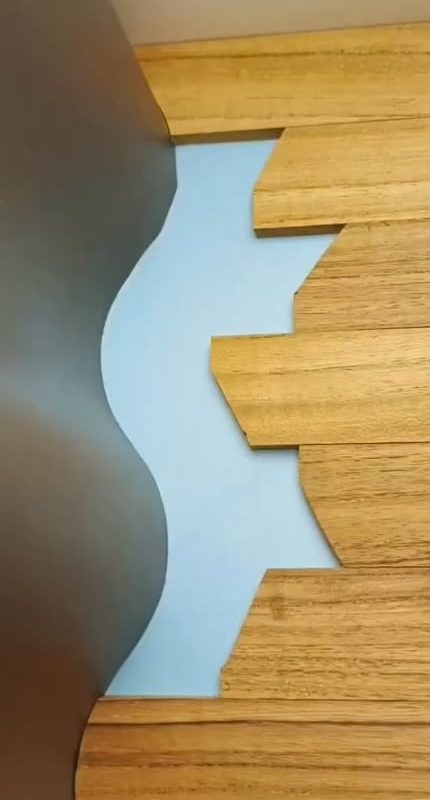
1. Trace Existing Curves (Using a Template or Object)
Best for: Replicating curves from existing furniture, tools, or nature.
- Technique:
- Place flexible curve ruler/cardboard against the curve source.
- Trace the shape, then refine edges with a French curve or sandpaper.
- Cut out the template and use it to mark the wood.
2. Calculate Geometric Curves (Compass/Trammel)
Best for: Consistent arcs (e.g., table edges, archways).
- Technique:
- Determine the radius (distance from center to curve edge).
- Fix a trammel beam or compass to this radius.
- Rotate around the center point to draw the curve.
3. Map Freehand Curves (String Method)
Best for: Organic, sweeping curves (e.g., chair backrests).
- Technique:
- Pin two nails at the curve’s start and end points.
- Tie a string around the nails, creating tension.
- Adjust the string outward to form the desired curve and trace along it.
4. Measure Tight Curves (Digital Calipers)
Best for: Small radii (e.g., guitar inlays, toys).
- Technique:
- Use calipers to measure the curve’s narrowest (inner) and widest (outer) points.
- Transfer these dimensions to a grid paper to sketch the curve to scale.
Cutting the Curve: Key Tips
- Band Saws/Jig Saws: Ideal for rough cuts; stay slightly outside your line.
- Coping Saws: Maneuver tight corners.
- Router with Template Guide: For perfectly duplicated edges using a pattern.
- Sanding: Refine curves with drum sanders, files, or sandpaper wrapped around dowels.
Pro Tip: Cut in stages! Remove bulk material first, then gradually trim closer to your marked line to prevent splintering or errors.
Avoid These Common Mistakes
- Guessing the Curve: Never eyeball—always measure.
- Forgetting Kerf: Account for the blade’s thickness when cutting.
- Ignoring Grain Direction: Cutting against brittle grain can cause tear-out.
- Rushing Sanding: A smooth curve requires progressive grits (80 → 220+).
FAQs About Measuring Wood Curves
Q: How do I measure irregular curves without a template?
A: Use a contour gauge—press it against the curve to copy the shape instantly.
Q: What’s the easiest way to transfer curves to thick wood?
A: Trace onto cardboard first, then use a router or jigsaw with a guide.
Q: How can I ensure symmetrical curves on both sides?
A: Create a half-template, flip it, and trace for mirror-image precision.
Final Thoughts
Measuring wood curves demands patience, but mastering this skill unlocks limitless creative possibilities. Start with simple projects (like rounding table corners) and gradually tackle more intricate designs. Remember: precise measurement + sharp tools = showstopping curves.
Pro Takeaway: Always test cuts on scrap wood first to refine your technique and template.
Keywords for SEO:
measuring wood curves, cutting curves in wood, curved woodworking cuts, how to measure curves for cutting, wood curve templates, DIY curved wood projects, arc measurement for woodworking.
Internal Linking Suggestions:
- “5 Router Techniques for Smooth Wood Edges”
- “How to Choose the Right Saw for Curved Cuts”
Title Tag Suggestion:
Measuring Wood Curves to Cut Out: Tools, Tips & Techniques | [Your Brand]
Meta Description:
Stop guessing curved cuts! Learn how to measure wood curves with templates, strings, and digital tools for flawless DIY projects. Avoid mistakes—read now.