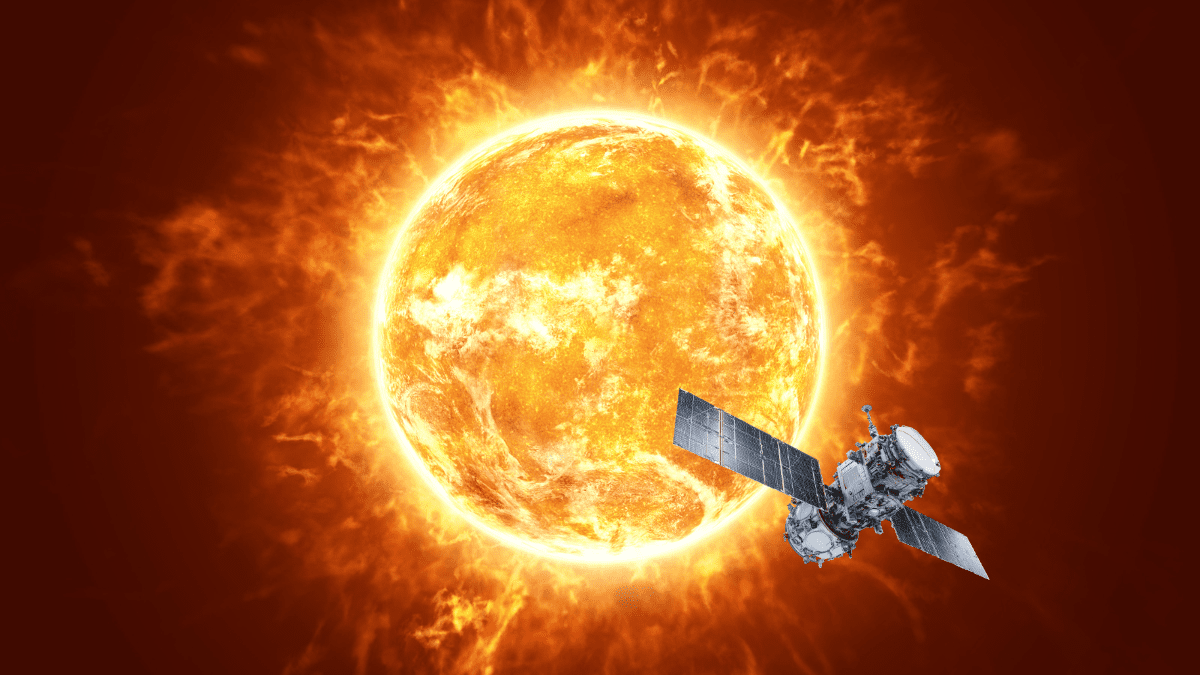
NASA’s Parker Solar Probe catches the Sun throwing fire into space — then pulling it back
NASA’s Parker Solar Probe Witnesses the Sun’s Fiery Plasma Dance: Ejecting Fire into Space—Then Pulling It Back
Groundbreaking Observations Reveal a Cosmic Tug-of-War Between the Sun’s Magnetic Forces and Superheated Plasma
Introduction: A Solar Spectacle Unfolds
For the first time, NASA’s Parker Solar Probe—humanity’s closest spacecraft to the Sun—has captured an extraordinary phenomenon: our star violently expelling superheated plasma into space, only to reel it back moments later like a cosmic fisherman. This discovery not only unveils the Sun’s hidden choreography but reshapes our understanding of solar wind, space weather, and the Sun’s magnetic influence.
The Parker Solar Probe: A Mission of Extreme Science
Launched in 2018, the Parker Solar Probe (PSP) was designed to “touch the Sun,” flying closer to its surface than any previous spacecraft. Protected by a revolutionary carbon-composite heat shield, it endures temperatures exceeding 2,500°F (1,377°C) while studying the Sun’s corona—the million-degree outer atmosphere where solar wind originates.
Key Mission Goals:
- Track how solar wind accelerates to supersonic speeds.
- Unlock mysteries of coronal heating (“Why is the corona hotter than the surface?”).
- Predict solar storms that threaten satellites, astronauts, and power grids.
At just 5.3 million miles from the Sun’s surface—closer than Mercury’s orbit—the PSP is uniquely positioned to witness solar dynamics invisible from Earth.
The Discovery: Fire Erupted, Fire Reclaimed
In 2023, PSP’s high-resolution instruments caught a rare event: the Sun ejecting a massive burst of plasma into space before abruptly yanking it back. This phenomenon, dubbed a “coronal implosion,” reveals the Sun’s magnetic forces overpowering the laws of physics in its outer atmosphere.
What Happened?
- The Eruption: Magnetic reconnection—a sudden snapping and realigning of magnetic field lines—shot a jet of plasma outward at over 100 km/s (62 miles/s).
- The Pullback: Instead of escaping as solar wind, the ejected plasma was magnetically “trapped.” Like a slingshot pulled backward, the Sun’s intense magnetic fields reversed the jet’s momentum, dragging the fiery material back to the surface.
Why This Matters: Solving Solar Mysteries
Solar physicists have long theorized about these magnetic tug-of-wars, but PSP’s observations confirm three critical insights:
1. Magnetic Forces Dominate the Corona
The Sun’s corona is a battlefield where magnetic forces throttle plasma movement. This explains erratic solar wind patterns and why some eruptions collapse back instead of escaping.
2. Implications for Space Weather
Solar flares and coronal mass ejections (CMEs) cause destructive space weather. Understanding magnetic “trap and release” dynamics improves forecasting, shielding astronauts and technology from radiation storms.
3. The Physics of Extreme Environments
The PSP’s data bridges lab experiments and astrophysics, testing how superheated plasma behaves under extreme gravity, heat, and magnetism akin to distant stars.
Behind the Scenes: How Parker Captured the Impossible
The PSP’s FIELDS and SWEAP instruments—which measure magnetic fields and analyze solar particles—recorded every nuance of the implosion.
- SWEAP (Solar Wind Electrons, Alphas, and Protons) detected plasma jets’ speed, density, and direction.
- WISPR (Wide-field Imager) filmed the plasma’s path like a cosmic “high-speed camera.”
“We’re seeing physics we couldn’t observe from afar,” said Dr. Nour Raouafi, PSP Project Scientist. “The Sun’s magnetism is weirder—and stronger—than we realized.”
The Bigger Picture: Protecting Earth and Future Exploration
As solar activity peaks toward its 2025 maximum, PSP’s findings come at a crucial time.
- Satellite Safety: Unpredictable solar flares can cripple GPS and communications satellites. Predictive models now integrate PSP’s magnetic-field data.
- Human Missions: NASA’s Artemis program and future Mars missions rely on shielding astronauts from solar radiation—knowledge powered by PSP.
Dr. Nicola Fox (NASA Heliophysics Director) summed it up: “Every Parker flyby rewrites textbooks.”
What’s Next for the Parker Solar Probe?
By 2025, PSP will dive deeper into the corona, nearing 3.8 million miles from the Sun’s surface at speeds of 430,000 mph (700,000 km/h)—fast enough to fly from D.C. to Tokyo in one minute. Future orbits may capture even more extreme plasma reversals, elucidating how stars across the universe interact with their environments.
Conclusion
The Sun’s fiery plasma dance—ejecting material into the void before pulling it back into its inferno—demonstrates the raw power of cosmic magnetism. NASA’s Parker Solar Probe continues to revolutionize heliophysics, proving that to understand the stars, sometimes you need to fly into the fire.
(For real-time updates on the Parker Solar Probe mission, follow NASA’s Sun Science Division at @NASASun.)
Keywords: Parker Solar Probe, solar plasma, coronal implosion, solar wind, NASA mission, magnetic reconnection, space weather, solar corona, heliophysics, solar storms.
Meta Description: NASA’s Parker Solar Probe captures the Sun ejecting plasma into space before pulling it back—revealing how magnetic forces dominate solar wind and space weather. Explore the science!