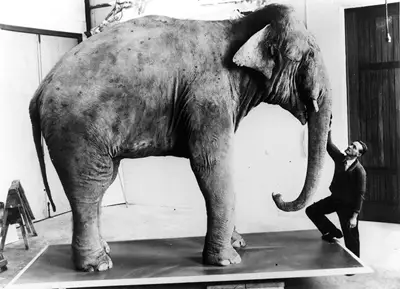
New Zealand Taxidermist Charles Dover with a recreation of an Indian elephant, named Rajah the Elephant, with him entering in the collections of the Auckland Museum, where he’s still displayed to this very day
Title: Rajah the Elephant: Charles Dover’s Taxidermy Masterpiece at Auckland Museum
For over a century, visitors to Auckland War Memorial Museum have marveled at Rajah the Elephant—an awe-inspiring preserved Indian elephant that stands as a testament to the skill of Charles Dover, one of New Zealand’s most accomplished taxidermists. This iconic exhibit, meticulously crafted in the early 20th century, remains a centerpiece of the museum’s natural history collection and a symbol of the artistry and science of historic taxidermy.
The Legacy of Charles Dover: New Zealand’s Pioneer Taxidermist
Charles Dover (1877–1953) was a renowned figure in New Zealand’s natural history scene, celebrated for his uncanny ability to breathe life into animal specimens through taxidermy. Originally from England, Dover honed his craft during the golden age of taxidermy, when museums prized lifelike displays for education and public engagement. After immigrating to New Zealand, he became the Auckland Museum’s first official taxidermist in 1914, a role he held for over three decades.
Dover’s work went beyond mere preservation; he aimed to capture the essence of his subjects. His attention to detail—from the texture of skin to the posture of limbs—made his creations stand out in an era before digital exhibits. Today, his legacy lives on through Rajah, his most ambitious and enduring project.
The Story of Rajah: From Circus Star to Museum Icon
Rajah was no ordinary elephant. Born in India, he toured Australia and New Zealand in the early 1900s as part of a traveling circus, captivating audiences with his size and gentle demeanor. When Rajah died in 1936 on Waiheke Island, Auckland Museum seized the opportunity to immortalize him.
Enter Charles Dover. Tasked with preserving the colossal animal—a 4-ton bull elephant standing over 10 feet tall—Dover faced a monumental challenge. For months, he worked tirelessly, sculpting a steel-and-wood frame to support Rajah’s form, carefully stitching hides, and recreating the elephant’s expressive eyes and wrinkled skin. The result was nothing short of revolutionary: a lifelike recreation that seemed to freeze Rajah mid-stride, trunk aloft and ears flared as though greeting visitors.
Rajah’s Home at Auckland Museum
Since his unveiling in the late 1930s, Rajah has been a star attraction at Auckland Museum, displayed prominently in the Scars on the Heart gallery (previously the natural history wing). For generations, he has served as an ambassador for wildlife conservation, sparking curiosity about elephants and their habitats long before modern awareness campaigns.
The exhibit’s impact is twofold:
- Educational Value: Rajah offers an up-close encounter with one of Earth’s largest land mammals, a rarity in New Zealand.
- Cultural Significance: His story reflects early 20th-century attitudes toward exotic animals, colonialism, and the role of museums in preserving history.
Though modern ethics around taxidermy have evolved—prioritizing conservation over spectacle—Rajah endures as a historical artifact and a testament to Dover’s craftsmanship.
Why Rajah Still Matters Today
Rajah’s display is more than a relic; it’s a conversation starter. In an age of digital immersion, his physical presence reminds us of humanity’s complex relationship with nature. Auckland Museum has balanced this narrative by framing Rajah within discussions about wildlife protection and ethical collection practices, ensuring his story educates as much as it enthralls.
Visiting Rajah in 2024:
- Location: Auckland War Memorial Museum, Domain Dr, Auckland.
- Exhibit Context: Rajah is part of the museum’s natural sciences collection, alongside other historic taxidermy works by Dover.
- Behind the Scenes: Interactive displays now explain the science of preservation and the changing role of museums.
Conclusion: A Timeless Tribute to Art and Nature
Charles Dover’s Rajah the Elephant is a masterpiece frozen in time—a blend of artistry, science, and history that continues to inspire wonder. As visitors circle Rajah’s towering form, they’re not just witnessing a feat of taxidermy; they’re connecting with a story that spans oceans, cultures, and generations.
Whether you’re a history enthusiast, an art admirer, or a family seeking adventure, Rajah’s exhibit at Auckland Museum promises a glimpse into New Zealand’s natural heritage and the unsung heroes like Dover who helped preserve it.
Plan your visit to Auckland Museum to meet Rajah—a gentle giant whose legend lives on.
“Rajah stands as a monument to an era when the world felt vast and mysterious. He invites us to reflect on how far we’ve come—and how much we must still protect.” – Auckland Museum Natural History Curator
SEO Keywords: Charles Dover taxidermist, Rajah the Elephant, Auckland Museum exhibits, Indian elephant taxidermy, historic taxidermy New Zealand, Charles Dover legacy, Auckland War Memorial Museum, Rajah elephant display.
Meta Description: Discover the story of Rajah the Elephant, a 1930s taxidermy marvel by Charles Dover at Auckland Museum. Explore its history, creation, and enduring legacy in NZ’s natural history.