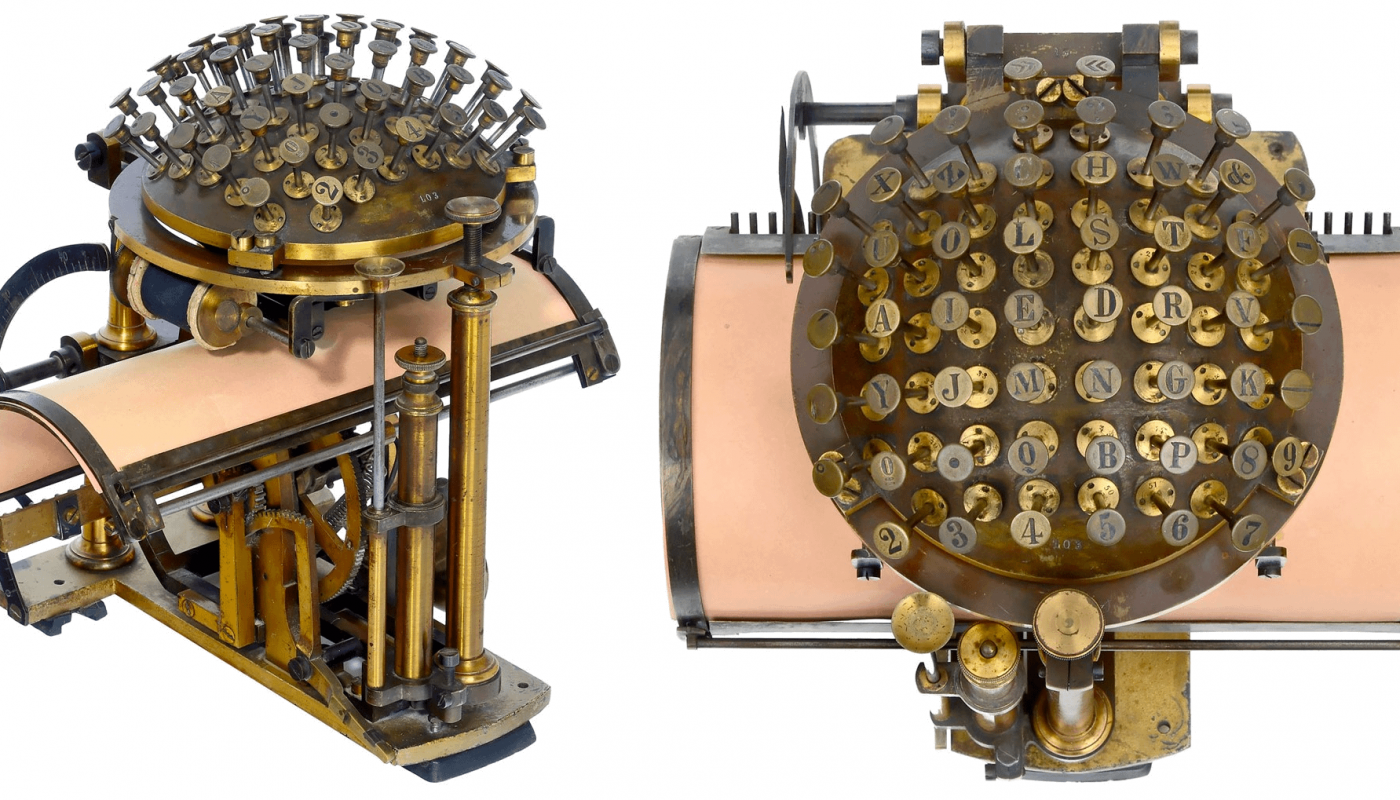
One of the earliest writing machines: Malling-Hansen Typewriter (Writing ball). Made in 1865,
Title: The Malling-Hansen Writing Ball: The Pioneering 1865 Typewriter That Revolutionized Writing
Meta Description: Discover the Malling-Hansen Writing Ball, the groundbreaking 1865 typewriter that reshaped communication. Explore its design, inventor, and legacy in this deep dive into one of history’s earliest typing machines.
Introduction: The Dawn of a Writing Revolution
In the mid-19th century, innovators raced to mechanize writing—a task tightly bound to quills, ink, and painstaking patience. Among these visionaries was Danish pastor and inventor Hans Rasmus Johann Malling-Hansen, who created the Malling-Hansen Writing Ball in 1865. Often overshadowed by later models like the Sholes and Glidden typewriter, the Writing Ball was not only one of the earliest functional typewriters but also a marvel of engineering elegance. This is the story of how this spherical wonder laid the groundwork for modern typing.
Who Was Hans Rasmus Johann Malling-Hansen?
Malling-Hansen (1835–1890) served as the director of the Royal Institute for the Deaf and Mute in Copenhagen, where his work with students inspired him to invent tools for efficient communication. Concerned about the slow pace of handwriting—especially for documenting speeches or teaching the visually impaired—he envisioned a machine that could transcribe thoughts faster. After years of refinement, his Writing Ball debuted in 1865 and was patented in 1870.
Design & Functionality: A Sphere of Innovation
The Writing Ball’s design was unlike anything before or since:
- Hemispherical Key Arrangement: 52 porcelain keys (for letters, numbers, and symbols) protruded from a concave brass hemisphere, resembling a “ball” of keys.
- Electro-Powered Precision: Later models utilized electricity to return the carriage automatically—a stunning innovation in the 1870s.
- High-Speed Typing: Users pressed keys onto paper beneath the sphere, with every keystrike triggering a small inked disc. Its streamlined mechanics allowed typing speeds of 80–120 words per minute, outpacing handwriting by far.
- Portable & Ergonomic: Early adopters praised its compact size (roughly 10 inches tall) and intuitive layout, designed to minimize finger movement.
Why Was the Writing Ball Revolutionary?
- Speed & Accessibility: Institutions for the deaf and blind embraced it for teaching.
- First “Carbon Copy” Machine: It could produce multiple copies using carbon paper—a boon for business documentation.
- Celebrity Users: Philosopher Friedrich Nietzsche owned one in the 1880s to combat worsening eyesight, calling it “a treasure” despite needing training to master it.
The Downfall: Why Didn’t It Dominate?
Despite its brilliance, the Writing Ball faced challenges:
- High Cost: Handmade in Copenhagen, it was priced beyond most individuals.
- Learning Curve: The radial key layout demanded practice.
- Competition: The Sholes and Glidden typewriter (1874) introduced the QWERTY keyboard, which soon became standard despite being slower initially.
By the 1890s, production ceased. Only 180 units were ever made, making surviving models rare collector’s items today.
Legacy: A Stepping Stone to Modern Typing
While short-lived, Malling-Hansen’s invention pioneered concepts still used today:
- Tactile Feedback: The distinct “press-and-return” key mechanism inspired later typewriters.
- Ergonomics: Its focus on efficiency foreshadowed modern keyboard design.
- Cultural Icon: The Writing Ball’s striking look has earned it displays in museums worldwide, including the Copenhagen Technical Museum.
Conclusion: Honoring a Forgotten Giant
The Malling-Hansen Writing Ball may not have achieved commercial immortality, but its ingenuity forever altered how humans interact with machines. Next time you tap a keyboard or swipe a screen, remember the 1865 sphere of keys that dared to reimagine writing—and helped roll the world into a new era of communication.
Keyword Focus:
Malling-Hansen Typewriter, Writing Ball invention, 1865 typewriter, first typewriter, Hans Rasmus Johann Malling-Hansen, 19th-century technology.
Image Alt Text Suggestions:
- “Malling-Hansen Writing Ball, 1865 typewriter with spherical keys”
- “Hans Rasmus Johann Malling-Hansen portrait, inventor of the Writing Ball”
- “Friedrich Nietzsche’s Writing Ball typewriter, 1880s.”
Internal Links (for SEO):
- Link to articles on Sholes and Glidden typewriter, history of QWERTY, or Nietzsche’s life.
- Link to museum collections featuring the Writing Ball.