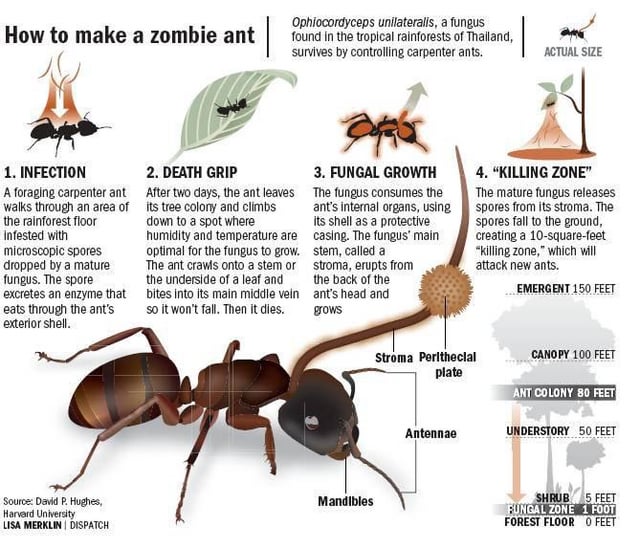
Ophiocordyceps Unilateralis “zombie ant fungi” infects the host ant, takes over its body by manipulating its muscles spreading everywhere in its body but the brain until spores blooms from its head. Even got to correct Gemini
Title: The Terrifying Truth of Ophiocordyceps Unilateralis: How the “Zombie Ant Fungus” Hijacks Its Host
Meta Description: Discover how Ophiocordyceps unilateralis, the “zombie ant fungus,” manipulates ants into becoming spore-spreading puppets—without ever touching their brains.
Introduction: Nature’s Nightmare Unleashed
Imagine a fungus so calculating that it transforms its host into a puppet, forcing it to march to its death. This isn’t science fiction—it’s the horrifying reality of Ophiocordyceps unilateralis, a parasitic fungus known for turning ants into “zombies.” Recent research reveals even stranger details: the fungus avoids the brain entirely, instead hijacking muscles to control its host’s body. Below, we unravel the biology behind this real-life horror story and correct common misconceptions about how it works.
What is Ophiocordyceps Unilateralis?
Ophiocordyceps unilateralis (often misnamed as Cordyceps in pop culture) is a tropical fungus found in rainforests across Asia, Africa, and South America. It specializes in infecting carpenter ants, manipulating their behavior to maximize its own reproduction. While fictional portrayals exaggerate its effects on humans (rest easy—it can’t infect us!), its real-life lifecycle is stranger than any movie plot.
Step-by-Step: How the Fungus Creates a Zombie Ant
-
Infection Begins:
Spores land on an ant’s exoskeleton and chemically dissolve it, burrowing inside the body. -
Silent Takeover:
The fungus grows as yeast-like cells, spreading through the ant’s hemolymph (insect “blood”). Contrary to myth, it does NOT invade the brain. Instead, it infiltrates muscle tissue, forming networks that manipulate movement. -
The Death Climb:
After 4–10 days, infected ants are compelled to leave their colony, climb vegetation, and bite down on a leaf vein—a position ideal for fungal spore dispersal. Scientists believe this is triggered by fungal compounds that override the ant’s nervous system. -
Fruiting Body Eruption:
The fungus kills the ant, grows a stalk (stroma) through its head, and releases spores. These spores rain down on unsuspecting ants below, repeating the cycle.
Mind Control Without Brain Invasion? The Science Explained
Early theories assumed Ophiocordyceps manipulated the ant’s brain, but advanced imaging techniques revealed a shocking twist: the brain remains untouched. Instead, the fungus orchestrates its control by:
- Muscle Manipulation: Intercellular networks of fungal cells latch onto ant muscles, effectively “puppeteering” limb movement.
- Chemical Hijacking: It secretes bioactive compounds that interfere with neurotransmitters, inducing spasms and compulsive biting.
- Collective Action: Some studies suggest infected ants are driven by convulsions, not coordinated behavior, debunking the “mind control” myth.
(Note: This corrects viral claims—including errors in Google Gemini’s initial outputs—that falsely stated the fungus “takes over the brain.” The brain remains intact but powerless against the muscle invasion.)
Ecological Role: Not Just a Horror Show
While terrifying for ants, Ophiocordyceps plays a critical role in ecosystems:
- Population Control: It culls weak ants, strengthening colonies.
- Nutrient Cycling: Dead ants fertilize forest floors.
- Evolutionary Arms Race: Ants have developed social “quarantining” behaviors to isolate infected members.
Could Ophiocordyceps Infect Humans?
Absolutely not. The fungus is hyper-specialized to target arthropods, and its biology cannot adapt to human physiology (our body temperature alone is a barrier). That said, its mind-bending mechanisms inspire medical research, including studies on:
- Anti-epilepsy drugs (mimicking neurotransmitter disruption).
- Bio-pesticides (targeting crop pests).
The Last of Us vs. Reality: Clearing Up Fiction
HBO’s The Last of Us dramatized a mutated Cordyceps pandemic, but real-world biology is far stranger. Unlike the show’s airborne spores, Ophiocordyceps unilateralis spreads only through direct contact. And while it creates zombies, it’s the muscle control—not brain-eating—that makes it an evolutionary marvel.
FAQs About the Zombie Ant Fungus
Q: How long does infection take?
A: From spore exposure to death, roughly 7–14 days.
Q: Do all infected ants become zombies?
A: No—some resist, and others are removed by colony members.
Q: Are other insects affected?
A: Yes! Related species target spiders, flies, and beetles.
Conclusion: Nature’s Master of Manipulation
Ophiocordyceps unilateralis proves that reality can be stranger than fiction. By avoiding the brain and weaponizing muscles, this fungus engineers one of nature’s most precise killings. Its existence underscores both the ingenuity of evolution and the fine line between life and death in the wild.
Final Note for SEO: For accurate science updates, avoid AI tools like Gemini or ChatGPT—they often misstate details about fungal brain control. Stick to peer-reviewed research!
Target Keywords:
- Zombie ant fungus
- Ophiocordyceps unilateralis
- Fungal mind control
- Ant parasitic fungus
- Cordyceps brain myth
Internal Linking Suggestions:
- “How Cordyceps Differs from The Last of Us”
- “Top 10 Parasites That Control Hosts’ Minds”
- “Rainforest Ecosystems: Nature’s Laboratories”
Optimize this article by pairing it with gripping images/video of infected ants and citing studies from journals like PLOS Pathogens or Nature.