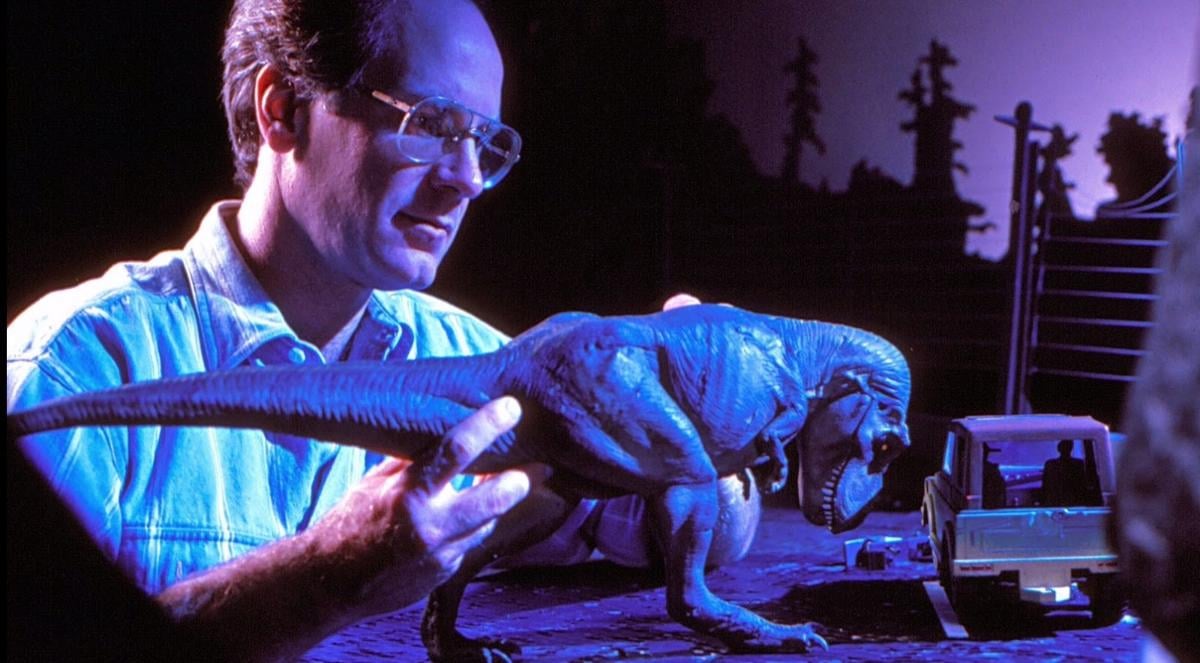
Originally, Jurassic park was going to be stop motion, but was decide to use cgi when the models were seen as ready for the big screen. Here a shot of the stop motion T-Rex 1992
Title: How Jurassic Park Almost Used Stop Motion: The Pivotal Shift to CGI & the 1992 T-Rex Test Shot That Changed Cinema
Introduction
When Jurassic Park roared into theaters in 1993, it didn’t just break box office records—it shattered the boundaries of visual effects forever. But few fans know the film nearly went in a completely different direction: Steven Spielberg’s dino-epic was originally planned as a stop-motion masterpiece, a technique popularized by classics like King Kong and Jason and the Argonauts. It wasn’t until a groundbreaking 1992 test shot of the T-Rex model that the team pivoted to CGI, altering the course of film history. Here’s the untold story behind that fateful decision and the stop-motion relic that almost was.
The Stop-Motion Vision: Spielberg’s Original Plan
In the early stages of Jurassic Park, Spielberg envisioned bringing dinosaurs to life the way legends like Ray Harryhausen had decades earlier—through painstaking stop-motion animation. The legendary effects artist Phil Tippett, known for his work on RoboCop and Star Wars, was tapped to lead the charge with his studio’s proprietary “go-motion” technique, a refined version of stop-motion that added motion blur for realism.
Tippett’s team crafted intricate dinosaur maquettes (miniature models), including a fearsome T-Rex, and shot test footage in 1992. The results were stunning for the time, but Spielberg still harbored doubts. Could these models, even with Tippett’s genius, deliver the lifelike fluidity and scale needed to make audiences believe dinosaurs were truly alive?
The CGI Game-Changer: ILM’s “Dinosaur Input Device”
Enter Industrial Light & Magic (ILM), the VFX wizards behind Terminator 2’s liquid-metal T-1000. ILM had been experimenting with CGI-rendered creatures, and when Spielberg saw early tests of a CGI T-Rex skeleton sprinting, he was floored. The pivot began.
But Spielberg didn’t abandon Tippett—instead, he fused old and new technology. ILM developed a revolutionary tool called the “Dinosaur Input Device” (DID), a stop-motion armature rigged to transfer Tippett’s physical puppet movements directly into CGI models. This hybrid approach preserved Tippett’s artistry while unlocking CGI’s potential for dynamic, realistic movement.
As Spielberg famously recalled:
“When I saw the first CGI test of the T-Rex, I told Phil Tippett, ‘You’re out of a job.’ He laughed and said, ‘Don’t worry—I’m just evolving.’”
The 1992 Stop-Motion Test Shot: A Fossil of Film History
The pivotal moment came when Spielberg reviewed Tippett’s 1992 stop-motion T-Rex test footage alongside ILM’s CGI samples. Though the stop-motion model was meticulously crafted, it lacked the weight, texture, and naturalistic motion CGI could achieve. The choice was clear: CGI wasn’t just an option—it was the future.
Rumors persist that Spielberg kept Tippett’s test footage under wraps, fearing it would disappoint fans. Today, snippets of the 1992 T-Rex animatic occasionally resurface online—a haunting glimpse of what might have been, showcasing rigid movements and stylized textures worlds apart from the visceral thrill of the final film’s CGI.
Why CGI Won: The Legacy of Jurassic Park
Jurassic Park’s leap to CGI wasn’t just about better effects—it was a paradigm shift.
- Realism: CGI dinosaurs interacted seamlessly with actors, rain, and environments.
- Scale: The T-Rex’s 40-foot frame could now tower over jeeps and crush fences with tactile force.
- Emotion: Close-ups of the animatronic raptors blended flawlessly with CGI wide shots.
The gamble paid off. The film’s 63 VFX shots (a fraction of today’s standards) earned ILM an Academy Award, while Phil Tippett shifted roles to become “Dinosaur Supervisor,” ensuring the creatures moved with biological authenticity.
Conclusion: The Stop-Motion That Shaped CGI
Jurassic Park’s abandoned stop-motion test wasn’t a failure—it was the catalyst for one of cinema’s greatest revolutions. Without Tippett’s maquettes and Spielberg’s willingness to embrace the unknown, CGI might have taken years longer to dominate Hollywood. Today, we remember the 1992 T-Rex test shot as the last roar of a bygone era, the moment Hollywood realized: extinct creatures needed living, breathing effects.
SEO Keywords:
- Jurassic Park stop motion vs CGI
- 1992 T-Rex test footage
- Phil Tippett Jurassic Park
- Steven Spielberg CGI decision
- Industrial Light & Magic dinosaurs
- Dinosaur Input Device (DID)
- Go-motion animation
- VFX revolution 1993
- Jurassic Park behind the scenes