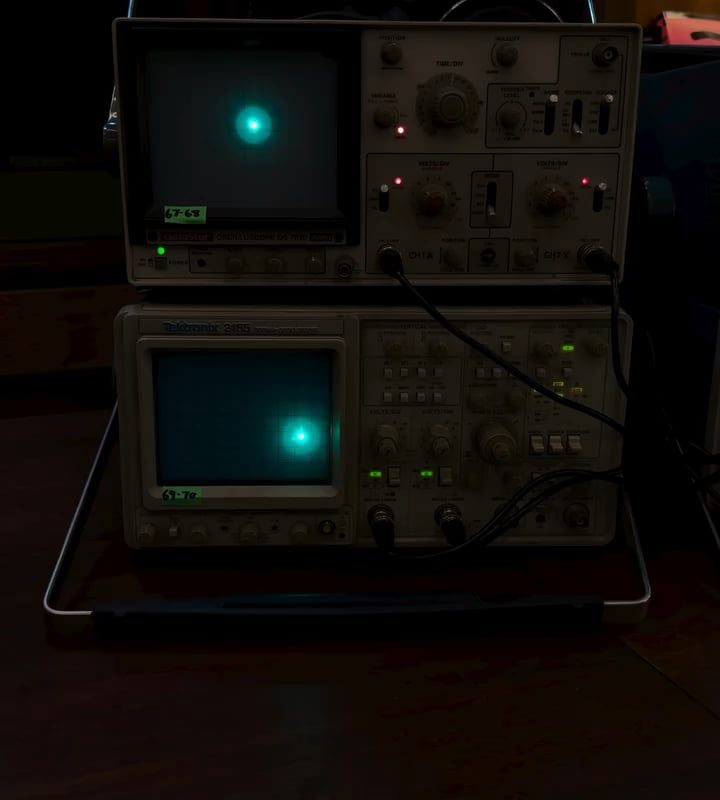
Oscilloscopes playing music
Title: How Oscilloscopes Play Music: Visualizing Sound Waves in Mesmerizing Patterns
Meta Description: Discover how oscilloscopes transform music into stunning visual art. Learn the science behind oscilloscope music, how to create it, and why audiophiles and engineers love this fusion of tech and creativity.
Introduction
At first glance, oscilloscopes—the quintessential tool for engineers to measure electronic signals—might seem worlds apart from music. Yet, these devices can transform sound into breathtaking visual spectacles. By feeding audio signals into an oscilloscope’s inputs, users can “play” music through dynamic, swirling patterns called Lissajous figures or intricate geometric shapes. This blend of science and art turns waveforms into a hypnotic dance of light, offering a unique way to “see” sound.
In this article, we’ll explore how oscilloscopes visualize music, the technical setup required, and the creative possibilities at the intersection of audio engineering and digital art.
What Is Oscilloscope Music?
Oscilloscope music involves routing stereo audio signals (left and right channels) into an oscilloscope’s X and Y inputs. Instead of displaying voltage over time (the default “time domain” mode), the device switches to XY mode, plotting one channel against the other. This creates real-time, responsive visuals that sync with the music’s frequency, amplitude, and phase:
- Lissajous Figures: Classic looping patterns formed when two periodic signals interact (e.g., sine waves).
- Complex Shapes: Music with layered instruments generates evolving fractals, spirals, and symmetrical designs.
- RGB Explorations: Advanced setups use color CRT oscilloscopes or post-processing to add vibrant hues.
Pioneered by artists like Jerobeam Fenderson, this technique gained viral fame for transforming songs into hallucinogenic light shows reminiscent of retro video games or particle physics simulations.
How It Works: The Science Simplified
-
XY Mode Setup:
- X-Axis (Horizontal): Controls the left audio channel.
- Y-Axis (Vertical): Controls the right audio channel.
The oscilloscope’s electron beam moves based on the instantaneous voltage of both signals, drawing shapes instead of waveforms.
-
The Role of Phase & Frequency:
Identical signals in phase create a diagonal line. Shifting phase or altering frequencies between channels warps the line into circles, ellipses, or complex harmonic designs. For example:- A 1:1 frequency ratio with a 90° phase shift creates a perfect circle.
- A 3:2 ratio produces a star-like figure.
-
Audio as Voltage:
Music is an alternating current (AC) signal. Oscilloscopes measure its voltage fluctuations, translating bass notes into slow, wide motions and treble into rapid, jagged movements.
How to Create Oscilloscope Music: Step-by-Step Guide
You don’t need a lab-grade oscilloscope—even basic models or free software emulators (like Soundcard Oscilloscope) can work. Here’s how to get started:
Tools Needed:
- Oscilloscope (analog preferred for aesthetics, but digital works).
- Stereo audio source (phone, computer, synthesizer).
- 3.5mm-to-BNC cables or adapters.
- (Optional) Resistors (1kΩ) to protect the oscilloscope from high voltage.
Steps:
- Switch to XY Mode: Disable the timebase and activate XY mode in your scope’s settings.
- Connect Audio:
- Route the left channel to the X input.
- Route the right channel to the Y input.
- Adjust Voltage Scales: Set both axes to the same voltage range (e.g., 1V/division) to maintain symmetry.
- Play Music: Start with simple tones (e.g., sine waves from a synth app), then experiment with songs having distinct stereo separation.
- Experiment:
- Use a mono-to-stereo splitter to create mirrored effects.
- Add effects like reverb or delay to manipulate shapes.
Creative Applications & Examples
- Live Visual Performances: Artists like Android Jones and Oscillofun use oscilloscopes for immersive concerts, syncing visuals to live music.
- Music Videos: Tool’s “Fear Inoculum” and Coldplay’s “Adventure of a Lifetime” featured oscilloscope-inspired graphics.
- STEM Education: Teachers demonstrate wave interference, harmonics, and electronics concepts in an engaging way.
- Generative Art: Developers code audio-reactive visuals using open-source tools like Processing or p5.js, mimicking oscilloscope behavior.
Famous Tracks for Oscilloscope Experiments:
- Pink Floyd’s “Dark Side of the Moon” (psychedelic stereo effects).
- Daft Punk’s “Giorgio by Moroder” (clean, rhythmic synth lines).
- Aphex Twin’s “Windowlicker” (complex frequency modulations).
Why Engineers and Artists Love It
- Debugging Tool: Audio engineers use oscilloscopes to identify phase issues or distortion in recordings.
- Nostalgic Appeal: Retro tech meets modern music, evoking mid-20th-century sci-fi aesthetics.
- Limitless Creativity: Every genre produces unique patterns—an algorithmically generated IDM track will look vastly different from a classical symphony.
Safety Tips & Limitations
- Avoid Loud Signals: High voltages can damage oscilloscope inputs. Use attenuators or lower audio volume.
- Analog vs. Digital:
- Analog scopes offer smoother, glowing visuals but require maintenance.
- Digital scopes provide precision and freezing/capture features.
- Not for Hi-Fi Analysis: Oscilloscopes lack the frequency resolution of dedicated audio analyzers.
Conclusion: Where Science Meets Art
Oscilloscope music is more than a party trick—it’s a poetic demonstration of how vibrations in the air become electricity, then morph into ethereal shapes. Whether you’re a musician, engineer, educator, or digital artist, this fusion of disciplines inspires wonder and unlocks new ways to experience sound.
Grab an oscilloscope, plug in your favorite song, and watch as the hidden geometry of music comes alive!
Keywords for SEO:
Oscilloscope music, visualizing sound, XY mode oscilloscope, Lissajous figures, audio art, sound waves on oscilloscope, Jerobeam Fenderson, STEM audio projects, DIY oscilloscope music.
Additional Resources:
- Jerobeam Fenderson’s YouTube Channel
- Oscillofun Live Performances
- Free Oscilloscope Emulator: XyScope
By blending technical know-how with artistic experimentation, oscilloscope music turns waveforms into a canvas—proving that even the most utilitarian tools can create magic.