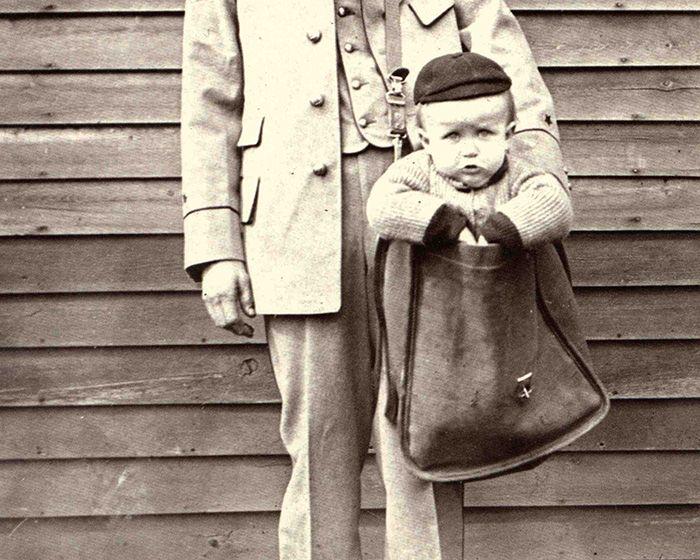
Prior to 1920, it was still legal to mail children in the US – generally speaking it was less costly than travelling by train as a passenger. Kids were required to have stamps affixed to them and weigh less than 50 pounds.
Meta Title: Before 1920, You Could Mail Children in the US: The Shocking True Story
Meta Description: Discover the unbelievable history of mailing children in America. Before 1920, USPS allowed kids to be shipped as “human packages” with postage stamps—here’s why and how it happened.
When Mailing Children Was Legal: America’s Bizarre Postal History
Imagine a time when parents could slap postage stamps on their kids and ship them across the country with the mail. Sounds like folklore, right? Yet, before 1920, mailing children in the United States was not only possible—it was legal. Fueled by loopholes in postal regulations and driven by economic necessity, families exploited this unconventional method to save money on travel. Here’s the fascinating (and unsettling) story of how America once treated children as literal parcels.
Why Would Anyone Mail a Child?
In the early 20th century, rural train travel was expensive. For struggling families—especially farmers or low-income households in remote areas—paying full passenger fares was often unaffordable. Meanwhile, the U.S. Postal Service (USPS) offered a cheaper alternative: mailing packages through Railway Mail Service (RMS).
Parents realized they could send children as “live cargo” for just 15 cents in postage—far less than a $5–10 train ticket. Postal workers, bound to deliver all “packages” regardless of contents, reluctantly accepted these pint-sized parcels.
The Rules of Mailing Kids
While no official law explicitly permitted mailing children, postal regulations allowed for “unusual” deliveries if they met criteria:
- Weight Limits: Children had to weigh under 50 pounds (23 kg) to qualify as “Parcel Post.”
- Stamps Affixed: Parents placed postage stamps on clothing (e.g., a coat) to prepay delivery.
- No Insurance: Unlike livestock, children couldn’t be insured—an obvious risk.
Most mailed children were infants or toddlers, entrusted to mail carriers for short rural routes. Postal staff would personally carry the child, often delivering them to relatives’ doorsteps.
Famous Incidents of Mailed Children
Charlotte May Pierstorff (1914)
The most infamous case involved 5-year-old May Pierstorff, mailed 73 miles from Idaho to her grandparents’ home for 53 cents in stamps. She traveled safely in a mail train compartment, escorted by her mailman relative.
The 1913 Policy Shift
When USPS expanded Parcel Post services in 1913 (allowing heavier packages), opportunistic parents pushed boundaries. In one case, a 6-year-old boy was mailed to his grandmother in Florida—weighing in at 48.5 pounds, just under the limit!
Media Frenzy and Public Outrage
Newspapers sensationalized these stories, with headlines like “Child Sent by Mail” or “Baby Rides with Letters.” While some saw it as a harmless cost-saving hack, critics blasted the practice as reckless and dehumanizing.
How the Era of Mailing Children Ended
By 1920, USPS cracked down. Postmaster General Albert S. Burleson banned the mailing of humans, declaring it “non-mailable matter” under revised regulations. Key reasons included:
- Safety concerns (e.g., children misplaced in mailbags).
- Rising public discomfort with treating people as packages.
- Pressure from railroad companies losing passenger revenue.
Urbanization and improved transportation later made child mailing obsolete—but its legacy remains a jaw-dropping footnote in U.S. history.
FAQs About Mailing Children in the US
Q: Was mailing children really legal?
A: Technically, no explicit law allowed it, but lax enforcement of parcel rules let it slide until 1920.
Q: How much did it cost to mail a child?
A: Rates varied by weight. A 30-pound child cost ~15 cents to mail locally (equivalent to $5 today).
Q: Were children harmed during delivery?
A: No documented injuries exist—carriers often treated kids as precious cargo!
Conclusion: A Surprising Slice of Postal History
The bizarre era of mailing children reflects early America’s pragmatic—and sometimes ethically questionable—innovations. While shocking today, this practice underscores how postal systems once blurred lines between logistics and human needs. Thankfully, modern USPS rules prioritize safety over savings, ensuring kids stay in mailboxes—not as mail.
Curious about more odd historical facts? Explore our deep dives into forgotten laws, vintage travel, and USPS evolution!
SEO Keywords: mail children in US, mailing kids history, USPS child mailing, 1920 postal laws, mailing babies, parcel post children, railway mail service, odd American history.
Optimized for search queries like “Was it legal to mail children?” and “Why did USPS allow mailing kids?”