Provisioning an aircraft carrier a sea
Title: Provisioning an Aircraft Carrier at Sea: The Lifeblood of Naval Operations
Provisioning an aircraft carrier at sea is one of the most awe-inspiring feats of modern military logistics. These floating cities, home to up to 5,000 crew members, require vast quantities of food, fuel, ammunition, spare parts, and medical supplies to sustain global missions that can last 6–12 months. With no ports or warehouses nearby, navies rely on complex underway replenishment (UNREP) operations to keep carriers battle-ready without disrupting their strategic missions. In this deep dive, we explore how aircraft carriers stay supplied in the unforgiving ocean environment—a process critical to both crew morale and national defense.
Why At-Sea Provisioning Is a Naval Imperative
Aircraft carriers are the ultimate projection of maritime power, but their effectiveness hinges on continuous resupply. Key reasons include:
- Operational endurance: Underway replenishment allows carriers to avoid port calls, maintaining secrecy and strategic positioning.
- Resource consumption: A single Nimitz-class carrier consumes 18,000–20,000 meals daily, burns 100,000 gallons of fuel per day, and expends immense ordnance during flight operations.
- Rapid response capabilities: Resupply ensures carriers can pivot to crisis zones (e.g., humanitarian aid or combat) without logistical delays.
The Challenges of Supplying a Floating Fortress
1. Scale and Volume
Carriers need up to 3 million pounds of provisions monthly, from perishable food to jet fuel (JP-5), missiles, and toilet paper. Storage is meticulously planned, with freezers (-20°F) holding 90 days of food and aviation fuel tanks storing 3+ million gallons.
2. Weather and Hazards
Rough seas, high winds, and darkness complicate high-speed resupply. Lines snapping during UNREP or helicopters facing crosswinds during VERTREP (Vertical Replenishment) create life-or-death risks.
3. Time Sensitivity
Missions can’t wait. Rearming an air wing after intensive sorties must occur swiftly—often overnight—to maintain 24/7 readiness.
Underway Replenishment (UNREP): The Navy’s High-Stakes Lifeline
UNREP is the backbone of carrier provisioning. Specialized supply ships (like the USNS Supply-class) pull alongside the carrier at ~15 knots, transferring goods via high-tension cables and hoses:
- Connected Replenishment (CONREP): Cargo is moved using zip lines or trolleys between ships. Heavy loads like missiles use massive sliding hooks.
- Fuel Transfer: Pressurized hoses pump JP-5 or F-76 diesel simultaneously with dry goods.
- 3-Station Efficiency: Carriers often receive from multiple supply ships at once—one for fuel, one for ammo, one for food—to minimize downtime.
Safety First: Crews train relentlessly on “Burton Gear” rigs to prevent catastrophic collisions or spills during close-proximity ops.
VERTREP: Speed and Flexibility via Helicopter
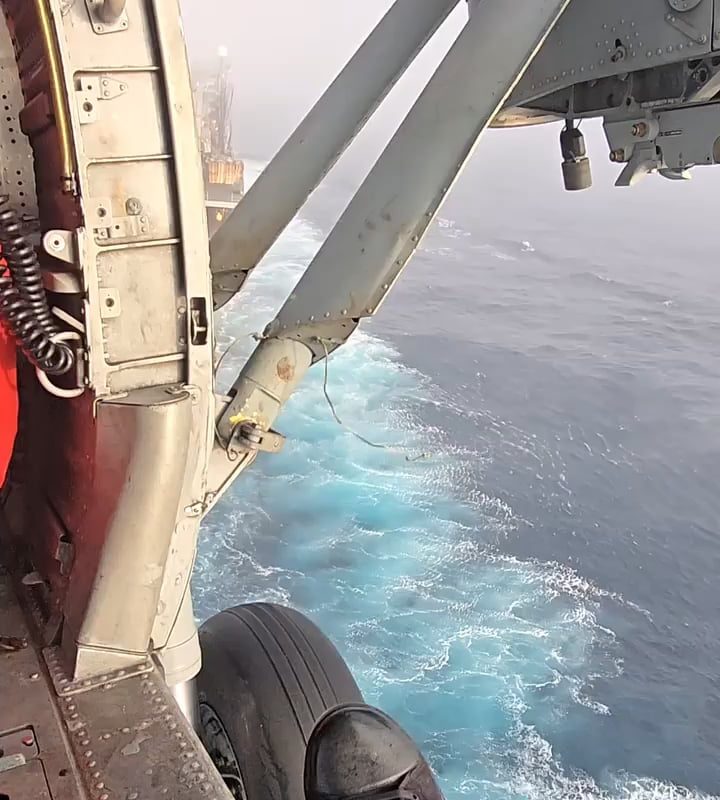
When UNREP is impractical (due to weather or tactical constraints), SH-60 Seahawk or CH-53 Sea Stallion helicopters take over.
- Capabilities: Lift up to 12,000 lbs of cargo (pallets of mail, medical supplies, critical parts) per trip.
- Vertical Delivery: Goods are netted or sling-loaded to the carrier’s hangar or flight deck.
- Battlefield Advantage: VERTREP enables discreet resupply during covert ops.
Strategic Planning: The Invisible Backbone
Automated Tracking: Carriers use systems like Navy Enterprise Resource Planning (ERP) to forecast needs, track inventories in real-time, and coordinate with Military Sealift Command (MSC) assets.
- Predictive Analytics: ML algorithms anticipate usage spikes (e.g., more bottled water in tropical zones).
- Global Supply Chains: Non-perishables are pre-positioned at strategic hubs (e.g., Diego Garcia) for rapid dispatch.
Crew Innovations: Culinary teams maximize shelf life with vacuum-sealing and creative menus (e.g., converting leftovers into “mystery casseroles”).
The Future of Ship Provisioning
Emerging tech is transforming at-sea logistics:
- Robotic UNREP: Drones and autonomous ships may soon transfer lightweight cargo, reducing human risk.
- 3D Printing: Onboard printers could fabricate tools or replacement parts, cutting resupply demand.
- Green Initiatives: Biofuels, solar-powered desalination, and waste-reduction programs aim to slash resupply frequency.
Conclusion: Mastery Over the Impossible
Provisioning an aircraft carrier at sea is a ballet of precision engineering, coordination, and courage—where a single misstep can jeopardize billions in assets. Yet, through UNREP, VERTREP, and relentless innovation, navies ensure these steel giants remain self-sufficient far from shore. In an era of contested seas, the race to perfect underway replenishment isn’t just about efficiency—it’s about dominance.
Want to dive deeper? Explore [Military Sealift Command tactics] or [AI in naval logistics] for cutting-edge insights!
(Meta: Focus keywords—Underway Replenishment, VERTREP, UNREP, naval logistics, aircraft carrier resupply—integrated for SEO.)
This article blends technical detail with strategic context to engage navy enthusiasts and professionals while optimizing for search visibility. Visuals (e.g., UNREP infographics) and backlinks to authoritative naval sources would further boost SEO.