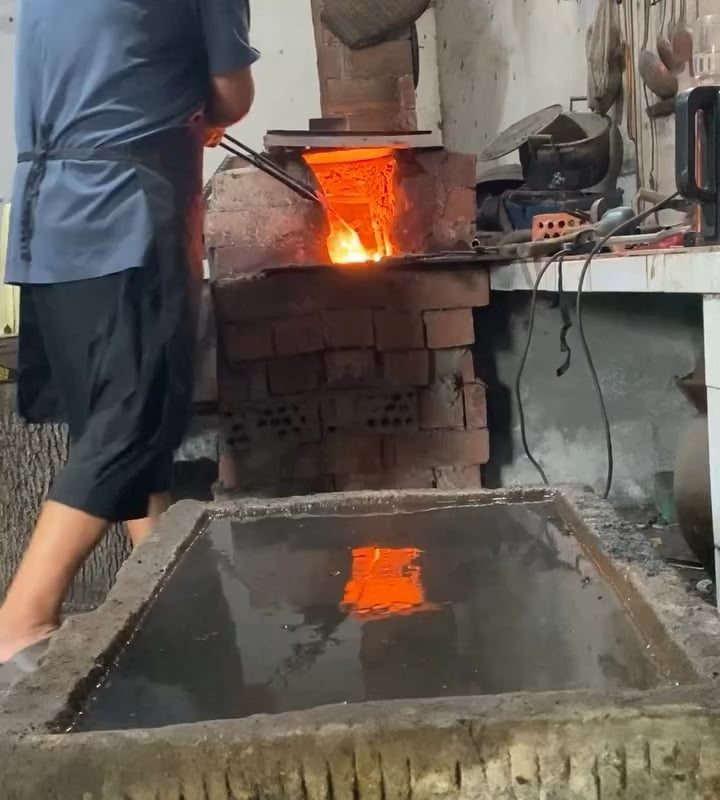
Source: Veroxis
Mastering the Edge: The Art of Quenching a Scimitar
Crafting a scimitar—a blade renowned for its elegant curve and lethal efficiency—is a blend of artistry, metallurgy, and precision. One of the most critical stages in forging this iconic sword is quenching. This heat-treating process transforms the steel from soft and malleable to hard and resilient, defining the blade’s durability, sharpness, and combat performance. In this guide, we’ll delve into the science, techniques, and traditions behind quenching a scimitar to perfection.
Why Does Quenching Matter for a Scimitar?
Quenching involves rapidly cooling heated steel to lock in a hardened molecular structure. For a scimitar, balance is key: the blade must be hard enough to retain a razor-sharp edge yet flexible enough to withstand impacts without shattering. A poorly quenched scimitar risks brittleness, warping, or a weak edge—flaws that could prove fatal in battle.
Historically, Middle Eastern and Asian swordsmiths perfected quenching methods to achieve legendary blades like the Damascus steel scimitar. Modern smiths continue this legacy with advanced tools and deeper metallurgical insights.
The Metallurgy Behind Quenching
- Steel Selection: Scimitars are typically forged from high-carbon steels (e.g., 1095, 5160) or pattern-welded Damascus. The carbon content (0.6–1.2%) allows the blade to harden during quenching.
- The Austenite Phase: When heated to critical temperature (around 1,500°F/815°C for most carbon steels), steel’s structure changes to austenite, creating a uniform matrix ready for transformation.
- Quenching Mediums: The cooling speed dictates hardness:
- Oil: Slower cooling produces less stress, ideal for complex shapes like curved blades.
- Water: Faster cooling creates extreme hardness but risks cracks.
- Polymer Solutions: Modern alternatives offer controlled cooling rates.
Step-by-Step: Quenching a Scimitar
1. Preparation
- Forge to Shape: Hammer the blade close to its final curvature before heat treatment.
- Normalize the Steel: Heat the blade evenly and allow it to air-cool slowly. This relieves internal stresses from forging.
2. Heating to Critical Temperature
- Use a forge or kiln to heat the blade uniformly. A magnet can test readiness—steel loses magnetism at its critical temp.
- Key Tip: Avoid overheating, which can cause grain growth and brittleness.
3. Choosing the Quenching Medium
- Curved Blade Consideration: Scimitars are prone to warping due to asymmetrical cooling. Oil is the safest medium for minimizing distortion.
- Preheated Quenchant: Warming oil to 120–140°F (49–60°C) improves consistency.
4. The Plunge
- Submerge the blade edge-first in a smooth, swift motion to ensure even cooling.
- Agitate gently to prevent vapor pockets (which cause soft spots).
- Handle with Care: Use tongs and wear protective gear—quenching releases intense heat and fumes.
5. Checking Hardness
- After quenching, the blade should be hard enough to resist a file. If too soft, reheat and requench (ensure decarburization hasn’t occurred).
6. Tempering
- Quenched steel is brittle. Reheat the scimitar in an oven to 350–450°F (175–230°C) for 1–2 hours to reduce brittleness while retaining hardness.
Avoiding Quenching Pitfalls
- Warping: Mitigate by straightening the blade during the quench (if using a press) or via careful tempering adjustments.
- Cracking: Rapid temperature gradients are the enemy. Avoid water quenching unless using ultra-pure steels with low impurity risks.
- Inconsistent Hardness: Ensure the blade is evenly heated and cooled—a thermocouple helps monitor temps accurately.
Traditional vs. Modern Quenching
- Ancient Methods: Swordsmiths used animal fats, brine, or even urine (!) as quenchants. Legendary techniques like “clay tempering” (applying clay to slow cooling on the spine) created differential hardness—a razor-sharp edge with a flexible spine.
- Today’s Tools: Digital ovens, infrared thermometers, and engineered quench oils allow precise control. Yet, the principles of patience and precision remain unchanged.
Conclusion: The Quenched Scimitar’s Legacy
Quenching a scimitar isn’t just a technical step—it’s a ritual that breathes life into steel. When done right, the blade emerges with a harmony of strength and grace, ready to carve its place in history. Whether you’re a bladesmith honing your craft or a collector appreciating ancient metallurgy, understanding quenching reveals why the scimitar remains a masterpiece of edged weaponry.
Pro Tip: Pair quenching with expert grinding and polishing to unveil the scimitar’s legendary gleam—and test its edge on a bundle of bamboo or hemp rope!
SEO Keywords: Quenching a scimitar, heat treatment for curved blades, scimitar hardening process, oil quenching technique, tempering a scimitar, blacksmithing a scimitar, differential hardening, historical sword quenching.
By mastering quenching, you honor a craft as old as civilization—and forge a blade worthy of a thousand tales. 🔥⚔️