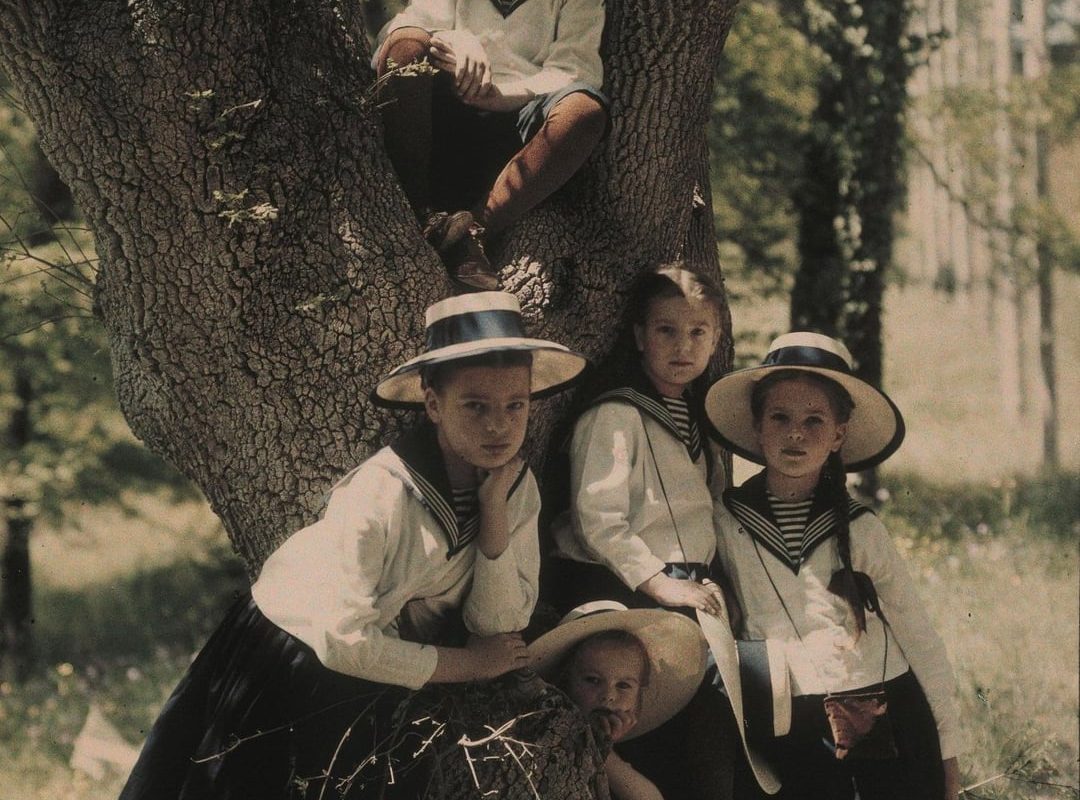
Sharp Autochrome shot of Russian kids in 1910s. By Piotr Ivanovich Vedenisov
Title: Capturing Childhood in Color: Piotr Vedenisov’s Rare Autochrome of 1910s Russian Children
Meta Description: Explore Piotr Ivanovich Vedenisov’s vivid autochrome photograph of Russian children in the 1910s—a groundbreaking fusion of art, history, and early color photography.
A Glimpse into the Past: Vedenisov’s Autochrome Mastery
In the early 20th century, as the Russian Empire stood on the brink of revolution, photographer Piotr Ivanovich Vedenisov captured a fleeting moment of childhood innocence using one of history’s most pioneering technologies: the autochrome. His striking image of Russian children, taken in the 1910s, offers a vibrant portal into a vanishing world—preserving intricate details of clothing, expressions, and daily life with astonishing clarity for its time.
What Makes Autochrome Photography Revolutionary?
Invented by the Lumière brothers in 1907, autochrome was the first widely accessible color photography process. Unlike black-and-white images, autochromes used microscopic grains of dyed potato starch to act as color filters, layered over a glass plate. The results were ethereal, painterly images with a soft yet luminous quality.
For Vedenisov, mastering autochrome required exceptional skill:
- Long exposure times (several seconds) meant subjects had to hold perfectly still.
- Scarcity of materials made each plate costly and labor-intensive.
- Vibrant hues relied on natural light and careful composition.
Vedenisov’s work stands out for its sharpness and rich color saturation, defying the technical limitations of his era. His image of Russian children is a testament to both his artistry and the autochrome’s capacity to immortalize texture—from the weave of woolen coats to the glow of youthful cheeks.
Decoding the 1910s Russian Context
The photograph offers more than aesthetic wonder—it’s a historical artifact of pre-revolutionary Russia. Vedenisov’s subjects, likely from a rural or small-town setting, are dressed in traditional attire:
- Girls in jewel-toned sarafans (pinafore dresses) and embroidered headscarves.
- Boys in simple linen shirts and caps, reflecting peasant or merchant-class life.
- Background details hint at wooden architecture and sparse landscapes, grounding the scene in everyday reality.
The image subtly contrasts the serenity of childhood against the turbulence of the era—the Russian Revolution would erupt in 1917, upending the social order these children inhabited.
Piotr Ivanovich Vedenisov: Russia’s Forgotten Autochrome Pioneer
Little is known about Vedenisov himself—a common fate for early photographers outside Europe’s artistic hubs. Yet his autochromes reveal a deep empathy for his subjects and mastery of light. Unlike many contemporaries who focused on elites, Vedenisov often highlighted ordinary people—peasants, craftsmen, and families—imbuing them with dignity.
His work aligns with Russia’s broader “Picturesque Movement”, blending realism with lyrical charm. Other pioneers like Sergey Prokudin-Gorsky captured imperial grandeur with similar technology, but Vedenisov’s focus on youth feels uniquely poignant.
Why This Image Resonates Today
- Technical Brilliance: The autochrome’s fragility makes surviving examples rare. Vedenisov’s sharp composition defies the process’s reputation for soft focus.
- Humanizing History: The children’s unguarded expressions bridge a century, reminding viewers of shared humanity.
- Cultural Preservation: Traditional garments and settings documented here have largely faded from memory.
Where to Find Vedenisov’s Autochromes
While Vedenisov’s archives remain fragmentary, his photographs occasionally surface in:
- Russian museum collections (e.g., the State Russian Museum, St. Petersburg).
- Early photography exhibitions focused on color pioneers.
- Digital archives like the RGB Library or regional historical databases.
Conclusion: A Legacy in Color
Piotr Vedenisov’s autochrome of Russian children transcends its time, merging technical innovation with emotional storytelling. In their vivid hues and arresting clarity, these young faces challenge our perception of history as a monochrome past—reminding us that the world of the 1910s was as alive with color as our own.
For historians, photographers, and art lovers alike, Vedenisov’s work is a rediscovered treasure: a sharp, soulful window into a lost Russia.
Keywords: Piotr Vedenisov autochrome, 1910s Russian photography, early color photography, autochrome process, Russian Empire children, Lumière brothers technique, pre-revolution Russia, historical autochrome photos.