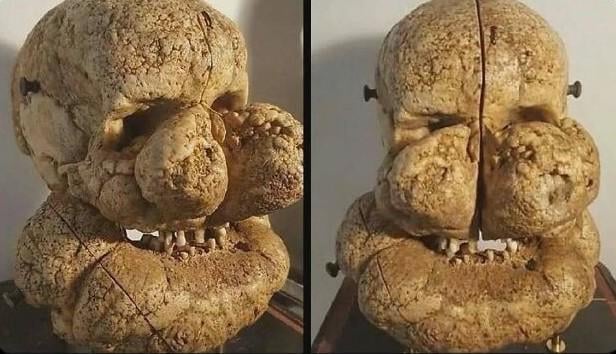
Skull of a man with Proteus syndrome.
Title: Unraveling the Mystery: The Skull of a Man with Proteus Syndrome
Meta Description: Explore the rare cranial deformities caused by Proteus syndrome, including insights into Joseph Merrick’s story and modern diagnostic advancements.
Introduction
Proteus syndrome is an exceptionally rare genetic disorder characterized by asymmetrical, disproportionate overgrowth of bones, skin, and other tissues. One of its most striking manifestations occurs in the skull, leading to severe deformities that challenge medical understanding. This article delves into the skeletal impact of Proteus syndrome, the story of history’s most famous case, and the science behind diagnosis and treatment.
What Is Proteus Syndrome?
Proteus syndrome affects fewer than 1 in 1 million people worldwide. Caused by a sporadic mutation in the AKT1 gene, it triggers uncontrolled tissue growth, often beginning in early childhood. The condition varies widely in severity, with common features including:
- Asymmetric limb enlargement
- Thickened skin lesions
- Connective tissue tumors
- Cranial deformities (skull overgrowth, hyperostosis)
The Skull in Proteus Syndrome: A Window into Complexity
The skull is frequently impacted due to rapid, irregular bone growth. Key characteristics include:
- Cranial Hyperostosis: Thickening of skull bones, creating asymmetry.
- Frontal Bossing: Pronounced forehead protrusion.
- Orbital Deformities: Eye socket misalignment, potentially impairing vision.
- Mandibular Overgrowth: Enlarged jawbone, causing dental and respiratory issues.
These changes not only affect appearance but can compress nerves or blood vessels, leading to neurological symptoms like headaches or seizures.
The Elephant Man: Joseph Merrick’s Legacy
The most well-known case of Proteus syndrome is Joseph Merrick (1862–1890), famously called the “Elephant Man.” Although initially misdiagnosed with neurofibromatosis, modern genetic analysis suggests Merrick’s skull deformities, twisted spine, and skin growths align with Proteus syndrome. His skull exhibited:
- Extreme frontal and parietal bone thickening
- A massively enlarged jaw
- Asymmetric facial features
Merrick’s remains, housed at the Royal London Hospital, continue to inform research on rare skeletal disorders.
Diagnosing Skull Deformities in Proteus Syndrome
Early detection is critical for managing complications. Diagnostic tools include:
- MRI/CT Scans: Visualize bone structure and soft tissue involvement.
- Genetic Testing: Identifies AKT1 mutations.
- 3D Imaging: Creates models for surgical planning.
Unlike conditions like craniosynostosis, Proteus-related skull changes evolve unpredictably, requiring lifelong monitoring.
Treatment Options and Innovations
While there’s no cure, interdisciplinary care helps manage symptoms:
- Surgery: Debulking excess bone or reconstructing facial symmetry.
- Medication: Miransertib (an AKT inhibitor) shows promise in clinical trials.
- Supportive Care: Physical therapy and pain management.
Recent studies (2023) highlight gene-targeted therapies as potential game-changers.
Living with Proteus Syndrome: Challenges & Support
Patients often face social stigma due to disfigurement. Advocacy groups like the Proteus Syndrome Foundation provide resources for:
- Psychological support
- Adaptive devices for daily living
- Connecting families with specialists
FAQs About Proteus Syndrome and Skull Abnormalities
Q: Is Proteus syndrome hereditary?
A: No—it results from random AKT1 mutations after conception.
Q: Can skull deformities be reversed?
A: Surgery can improve function but not fully “normalize” anatomy.
Q: How common is cranial involvement?
A: Over 70% of patients experience skull or facial overgrowth.
Conclusion
The skull of a man with Proteus syndrome represents one of medicine’s most complex challenges. Through advances in genetics and patient-centered care, researchers are unlocking hope for better management of this enigmatic condition. By understanding its impact—from Joseph Merrick’s era to modern science—we move closer to improving lives affected by rare skeletal disorders.
Focus Keywords: Proteus syndrome skull, cranial hyperostosis, Joseph Merrick, AKT1 gene mutation, rare bone disorders.
Call to Action:
Stay informed! Follow the Proteus Syndrome Foundation or subscribe to rare disease updates for breakthroughs.