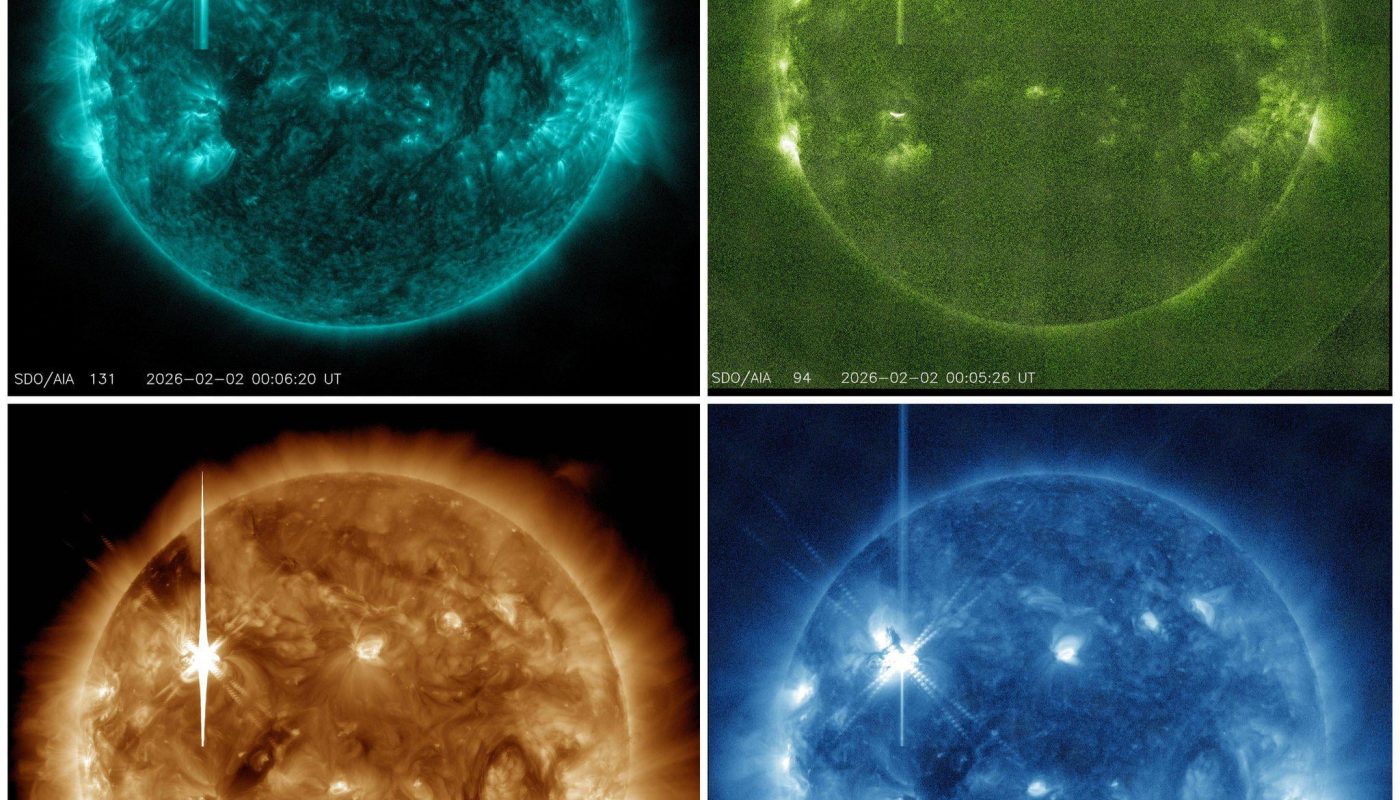
Solar flare X8.11 !!!! The AR4366 sunspot region has just triggered a phenomenal solar flare with a magnitude of X8.11, the third strongest in the current solar cycle! SDO sensors are saturated by such intensity.
Solar Flare X8.11: AR4366 Sunspot Unleashes Third-Strongest Eruption of Solar Cycle 25
In a spectacular display of solar fury, Earth-observing satellites have recorded one of the most powerful solar flares in modern history. On February 23, 2024, the hyperactive sunspot region AR4366 erupted with a monstrous X8.11-class solar flare — making it the third-strongest eruption of the current Solar Cycle 25. The explosion was so intense that it temporarily saturated sensors onboard NASA’s Solar Dynamics Observatory (SDO), highlighting the sheer ferocity of this solar event.
Breaking Down the X8.11 Solar Flare
Solar flares are categorized by strength into A, B, C, M, and X-class, with X-class being the most powerful. Each letter represents a tenfold increase in energy output, and the number signifies its strength within the class. The X8.11 flare is an extreme outlier, releasing energy equivalent to billions of hydrogen bombs in mere minutes.
Key facts about the eruption:
- Peak Time: Registered at 00:34 UTC.
- Source: Sunspot AR4366, a magnetically complex region larger than Earth.
- Radio Impacts: Prompted an R3 (Strong) radio blackout on Earth’s sunlit side, disrupting shortwave communications over the Pacific and parts of the Americas.
Why Did SDO Sensors Saturate?
NASA’s Solar Dynamics Observatory (SDO), tasked with monitoring the Sun, employs sensors designed to capture most solar activity. However, flares exceeding X5-class can overwhelm its instruments. The X8.11 flare’s extreme brightness caused a “whiteout” effect in SDO imagery, blurring its coronal details in extreme ultraviolet wavelengths. This saturation confirms the flare’s exceptional magnitude — only the 2017 X9.3 and 2023 X12 flares surpassed it in Solar Cycle 25.
Earth Impacts and Space Weather Forecast
While Earth wasn’t directly in the flare’s path, the event triggered immediate space weather consequences:
- Radiation Storm: A burst of solar energetic particles (SEPs) risked damaging satellites and posed minor radiation concerns for aviation at polar latitudes.
- CME Alert: A coronal mass ejection (CME) — a billion-ton cloud of magnetized plasma — was launched into space. Modeling suggests a glancing blow to Earth’s magnetic field by February 25–26, potentially sparking G2 (Moderate) geomagnetic storms.
- Aurora Potential: Skywatchers at high latitudes (e.g., Canada, Scandinavia, New Zealand) may see vivid auroras when the CME arrives.
Image: SDO’s partial view of the X8.11 flare. Credit: NASA/SDO

Sunspot AR4366: A Solar Powerhouse
AR4366 has emerged as a “beta-gamma-delta” sunspot — NASA’s classification for regions with the highest magnetic complexity and flare potential. Prior to the X8.11 event, it had already unleashed:
- 10+ M-class flares
- 3 X-class flares (including X1.9 and X6.3)
Experts warn AR4366 could remain unstable, fueling additional X-class flares as it rotates toward the Sun’s western limb.
Historical Context: How Rare Is an X8 Flare?
X-class flares are uncommon, with only ~50 recorded since 1976. The strongest ever observed was a staggering X28 flare in 2003. The current solar cycle (25) is peaking earlier and stronger than predicted, making such megaflares more likely through 2025.
Protecting Technology from Solar Storms
While this X8.11 flare wasn’t Earth-directed, it underscores vulnerabilities in our tech-dependent world:
- Grid Operators are on alert for induced currents from the incoming CME.
- Satellite Teams have put spacecraft in safe mode to minimize radiation damage.
- Airlines rerouted polar flights to limit crew/passenger radiation exposure.
FAQs: Solar Flare X8.11
-
Did the flare cause a Carrington-level event?
No. While powerful, the X8.11 was orders of magnitude weaker than the 1859 Carrington Event (estimated X45+). -
Will my phone/GPS be affected?
Short-term GPS disruptions are possible during the CME impact. -
Can I see the aurora?
Monitor NOAA’s Space Weather Prediction Center for real-time aurora forecasts.
Conclusion
The X8.11 flare marks a historic milestone in Solar Cycle 25 — one that reminds us of the Sun’s untamed power. While no direct catastrophe struck Earth, scientists continue to monitor AR4366 and other active regions closely. As solar maximum approaches, buckle up for more fireworks!
Stay tuned to trusted space weather sources like NASA, NOAA, and ESA for real-time updates on solar activity and geomagnetic storms.
SEO Keywords: Solar flare X8.11, AR4366 sunspot, X-class solar flare, strongest solar flares 2024, SDO sensor saturation, Solar Cycle 25, geomagnetic storm warning, CME impact, space weather update, aurora forecast.


![[OC] The moon is so bright with the snow that I can see where I'm going in the Ohio woods](https://www.smartplusmedia.com/wp-content/uploads/2025/12/OC-The-moon-is-so-bright-with-the-snow-that-445x265.jpeg)
