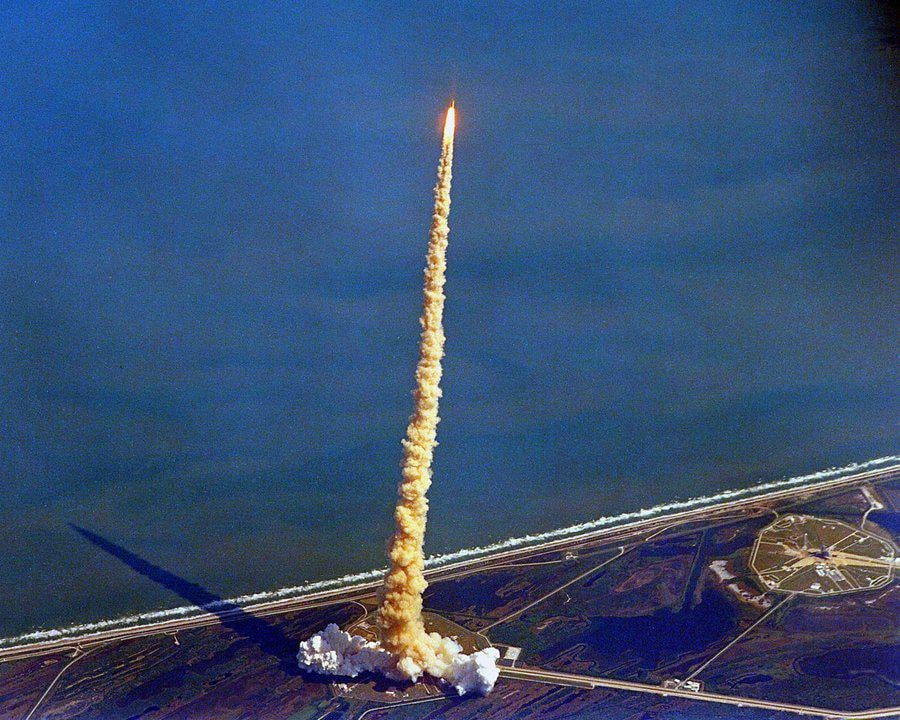
One of ten missions flown by the four space shuttles that year, this one carried the LAGEOS-2 satellite, which is a precisely orbiting laser reflector that's used to determine the exact shape of the Earth and the movement of the continents. It's expected to be up there for another 8 million years.
Title: The Historic 1992 Launch of Space Shuttle Columbia STS-52: Pioneering Science from Kennedy Space Center
Meta Description: Explore the historic October 1992 launch of Space Shuttle Columbia (STS-52) from NASA’s Kennedy Space Center, its groundbreaking payloads, and lasting impact on space exploration.
Space Shuttle Columbia Soars into History: STS-52’s October 1992 Launch from Kennedy Space Center
On October 22, 1992, NASA’s Kennedy Space Center (KSC) in Florida witnessed the thunderous liftoff of Space Shuttle Columbia on mission STS-52. This mission marked the 13th flight of Columbia and the 52nd of the Space Shuttle Program, continuing NASA’s legacy of innovation and microgravity research. The launch not only symbolized technological prowess but also advanced critical scientific experiments and satellite deployments that shaped future space endeavors.
Mission STS-52: Fast Facts
- Launch Date: October 22, 1992, at 1:09 p.m. EDT
- Launch Site: Kennedy Space Center, Launch Complex 39B
- Orbiter: Space Shuttle Columbia (OV-102)
- Crew: Commander James Wetherbee, Pilot Michael Baker, Mission Specialists Charles Veach, William Shepherd, Tamara Jernigan, and Steven MacLean (Canada)
- Duration: 9 days, 20 hours, 56 minutes
Mission Objectives: Science Takes Center Stage
STS-52 aimed to deploy a landmark satellite and conduct experiments in microgravity—a cornerstone of NASA’s long-term vision for space exploration.
1. Deployment of LAGEOS-2 Satellite
Columbia’s payload bay carried the Laser Geodynamics Satellite II (LAGEOS-2), a passive spacecraft designed to map Earth’s gravitational field and tectonic movements. Launched via an Italian-built IRIS (Italian Research Interim Stage) upper stage, LAGEOS-2 joined its predecessor (LAGEOS-1) in boosting global efforts to study:
- Plate tectonics and earthquake risks
- Earth’s rotational irregularities
- Precise measurements of ground station positions
Fun Fact: The aluminum-coated satellite, studded with 426 retroreflectors, remains in orbit today—still aiding geophysical research!
2. USMP-1: Microgravity Research Platform
The United States Microgravity Payload-1 (USMP-1) housed in Columbia’s cargo bay hosted four experiments focused on materials science in near-zero gravity conditions. Key investigations included:
- MEPHISTO: A French/U.S. study of metal alloy solidification.
- Lambda Point Experiment: Measuring helium’s behavior near absolute zero.
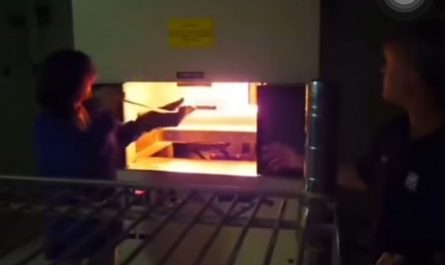
- AADSF (Advanced Automated Directional Solidification Furnace): Improving semiconductor manufacturing.
These experiments later influenced advancements in metallurgy, electronics, and energy technologies.
Life Onboard Columbia: Crew Activities & Earth Observations
Beyond technical tasks, STS-52’s crew documented Earth’s landscapes, conducted medical tests, and tested the Canadian Target Assembly (CTA), a device to refine Space Vision System technology critical for future robotic missions like the Canadarm2 on the ISS.
The Return: A Safe Landing at KSC
Columbia returned to Kennedy Space Center’s Shuttle Landing Facility on November 1, 1992, wrapping up a flawlessly executed mission.
Legacy of STS-52
- Scientific Impact: LAGEOS-2 data continues to support geodetic research, while USMP-1 insights refined industrial processes.
- Space Shuttle Program: Columbia’s success paved the way for 11 more missions before its tragic loss in 2003.
- Kennedy Space Center Pride: The launch reaffirmed KSC’s role as NASA’s premier launch site for human spaceflight.
FAQs About STS-52
Q1: What made STS-52’s launch window unique?
A: October launches from Florida often target optimal orbital inclinations for satellite deployments.
Q2: How did STS-52 contribute to the ISS?
A: Its CTA experiments improved docking technology later used on the International Space Station.
Q3: Are any STS-52 artifacts on display today?
A: Yes! Visit the Kennedy Space Center Visitor Complex to see exhibits honoring Columbia’s missions.
Conclusion: A Launch That Advanced Humanity’s Reach
STS-52’s 1992 flight epitomized NASA’s dual goals of discovery and practicality. From geophysics to advanced materials, Columbia’s journey underscored the value of space as a laboratory—a legacy still celebrated at Kennedy Space Center today.
Explore Further: Plan a trip to Kennedy Space Center or dive into NASA’s archives to relive the STS-52 mission!
Target Keywords:
Space Shuttle Columbia STS-52, NASA Kennedy Space Center 1992, LAGEOS-2 satellite, US Microgravity Payload-1, October 1992 space launch, NASA shuttle mission history
Optimize Your Content: Add images of Columbia’s launch, crew photos, or LAGEOS-2 diagrams to boost engagement!