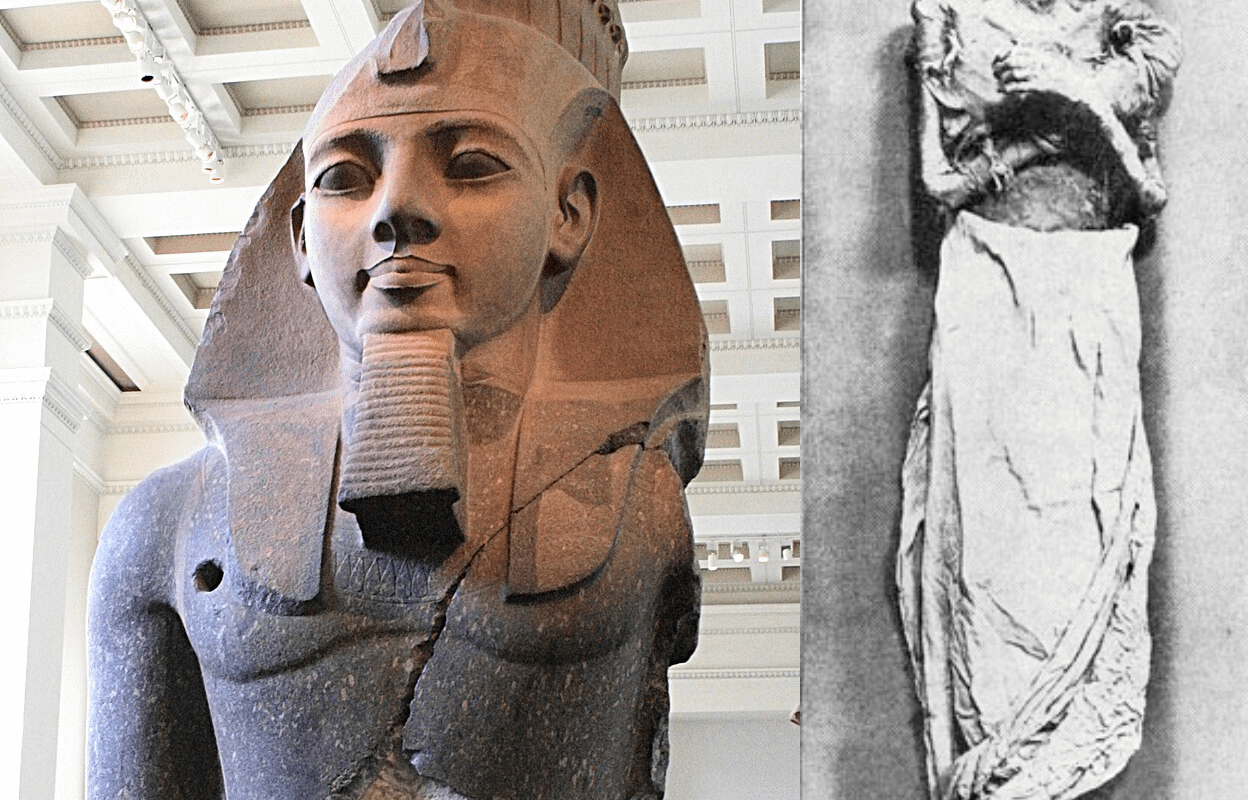
Statue (Left) and Real body (Right) of Ramesses II, One of the Greatest Pharaoh in entire Ancient Egyptian History who lived over 3,200 years ago during the 13th Century BCE
Title: Ramesses the Great: Exploring the Iconic Statue and Mummy of Egypt’s Most Powerful Pharaoh
Meta Description: Uncover the legacy of Ramesses II through his awe-inspiring statue and remarkably preserved mummy. Discover the man behind the myth, who ruled Egypt over 3,200 years ago.
Introduction
Ramesses II, known as Ramesses the Great, ruled Egypt for 67 years during the 13th century BCE (1279–1213 BCE). Often hailed as ancient Egypt’s most powerful and influential pharaoh, his legacy lives on through colossal monuments and his strikingly preserved mummy. This duality—divine statue (left) versus mortal remains (right)—provides a fascinating glimpse into how Ramesses II was immortalized in both art and history.
The Immortal Pharaoh: The Symbolism of Ramesses II’s Statue
Ramesses II commissioned hundreds of statues depicting himself as a god-king, merging human rulership with divine authority. The most famous statue, now housed in the Egyptian Museum in Cairo (originally from Thebes), captures him seated with a commanding gaze, wearing the double crown of Upper and Lower Egypt.
- Power in Stone: Carved from granite or limestone, these statues emphasized eternal strength. From the temples of Abu Simbel to Luxor, Ramesses used art to proclaim his dominance.
- Symbolic Features: Many statues show him with a nemes headdress, a ceremonial beard, and a shendyt kilt. His posture—arms crossed, holding a crook and flail—symbolized control over chaos and life itself.
- Architectural Grandeur: The famed temples at Abu Simbel, featuring four 20-meter-tall statues of Ramesses II, were designed so sunlight illuminated the inner sanctum on his birthday and coronation day—an engineering marvel.
The Mortal Man: The Mummy of Ramesses II
While statues celebrated Ramesses’s godlike image, his well-preserved mummy reveals the human behind the legend. Discovered in 1881 at the Deir el-Bahri Royal Cache (hidden to protect it from tomb robbers), his remains tell a story of longevity, health, and the realities of age.
What the Mummy Reveals
- Height and Build: Ramesses stood around 5’7″ (1.7 meters) tall—tall for his era. His mummy shows a prominent nose, strong jaw, and high forehead.
- Health Insights: Advanced CT scans revealed arthritis, dental abscesses, and hardened arteries, suggesting he suffered chronic pain in his later years.
- Red Hair Clues: His mummy retains traces of reddish hair, a trait linked to the god Seth and royalty in Egyptian culture.
Preservation of a Legend
The mummy was moved to Cairo’s Egyptian Museum, where it remains a testament to ancient embalming techniques. In 1976, it was flown to Paris for restoration—issued an Egyptian passport listing his occupation as “King (Deceased).”
Statue vs. Mummy: Contrasting Idealism and Reality
- The Idealized God-King: Statues portrayed Ramesses as eternally youthful and muscular, embodying ma’at (cosmic order).
- The Aging Ruler: His mummy shows a man who lived into his 90s—a rare feat in antiquity—with signs of battle injuries and age-related ailments.
Both representations highlight the Egyptian belief in duality: the immortal ka (soul) versus the mortal khat (body). Ramesses ensured his divine image endured through art, while his mummy secured his place in the afterlife.
Why Ramesses II Still Captivates Us Today
- Military Prowess: His victory at the Battle of Kadesh (against the Hittites) was immortalized in temple reliefs as a triumph—though it ended in a stalemate.
- Builder of Egypt: He commissioned more monuments than any other pharaoh, including the Ramesseum (his mortuary temple) and expansions at Karnak.
- Cultural Icon: Modern films, books, and even Percy Bysshe Shelley’s Ozymandias poem were inspired by his legacy of power and impermanence.
Conclusion: The Eternal Legacy of Ramesses the Great
Ramesses II mastered the art of legacy-building. His statues carved his godhood into the desert stone, while his mummy—now resting in Cairo—offers a poignant reminder of human fragility. Together, they immortalize a ruler who shaped Egypt’s golden age and whose name still resonates millennia later.
For history enthusiasts, archaeologists, and travelers, Ramesses II remains a bridge between myth and reality—proving that even in death, true greatness never fades.
Keywords for SEO: Ramesses II, Pharaoh of Egypt, Ramesses statue, mummy of Ramesses, Ancient Egyptian history, Egyptian Museum Cairo, Abu Simbel, 13th century BCE, Egyptian pharaohs, ancient Egypt archaeology, Ramesses the Great.
Internal Links Suggestion: Link to related articles on “Abu Simbel Temples,” “Egyptian Mummification Process,” and “Battle of Kadesh.”
Image Caption: Left: The iconic statue of Ramesses II in the Egyptian Museum, Cairo. Right: The mummy of Ramesses II, clearly showing his facial structure and preserved red hair.
Engagement Prompt: What fascinates you most about Ramesses II—his monumental statues or the insights from his mummy? Share your thoughts below!