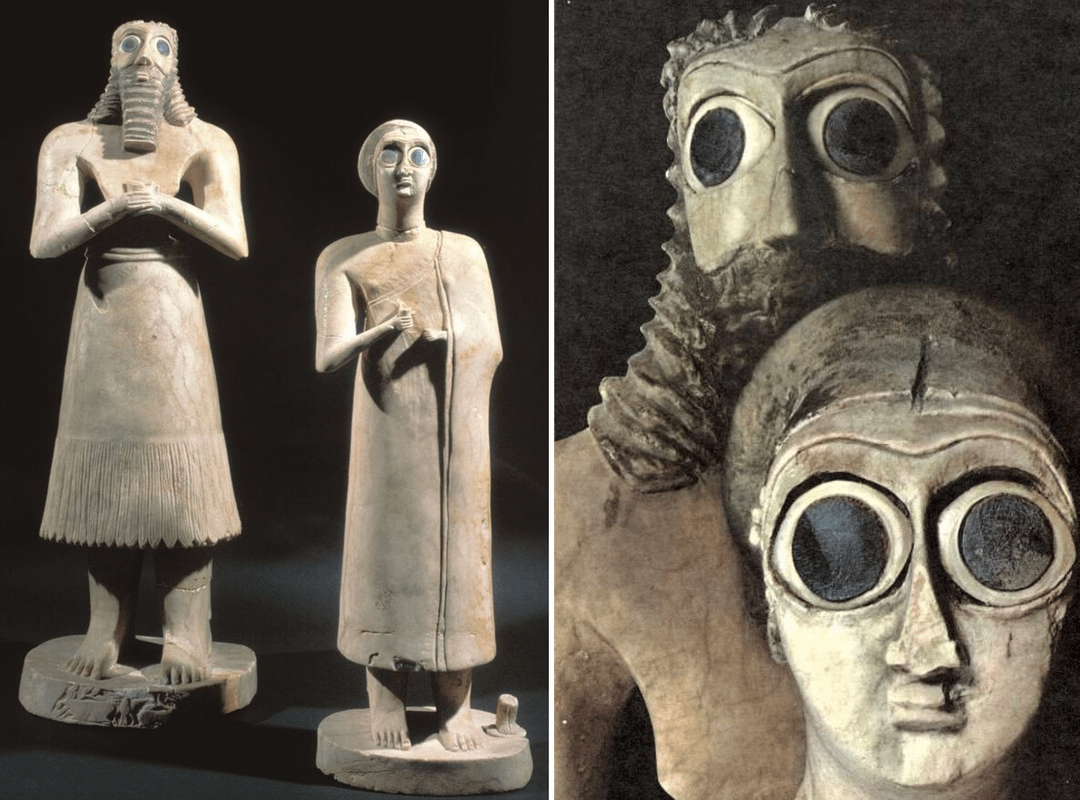
Sumerian statues of a male and female worshipper found at the Abu Temple in Tell Asmar modern day iraq. (2900-2450 BCE)
Title: The Ancient Gaze: Unveiling the Sumerian Statues of Worshippers from Tell Asmar’s Abu Temple (2900-2450 BCE)
Meta Description: Discover the captivating story of the Sumerian male and female worshipper statues from Abu Temple in Tell Asmar, Iraq. Explore their history, symbolism, and significance in ancient Mesopotamian religion.
Introduction
In the heart of modern-day Iraq lies Tell Asmar, the ancient city of Eshnunna, where one of the most iconic artifacts of early Mesopotamian civilization was uncovered: a collection of votive statues known as the “Tell Asmar Hoard.” Among these, the pair of male and female worshipper statues stands out as a timeless testament to Sumerian artistry, spirituality, and social structure. Dating back to the Early Dynastic Period (2900–2450 BCE), these statues offer a glimpse into the devotional practices of one of history’s earliest urban societies.
Historical Context: The Abu Temple and Sumerian Devotion
The statues were excavated in the 1930s by archaeologists from the Iraq Expedition of the Oriental Institute of Chicago at the site of the Abu Temple, dedicated to Abu, a Sumerian god associated with vegetation and fertility (later syncretized with the deity Adad). Tell Asmar, situated in the Diyala River valley, was a thriving urban center in ancient Mesopotamia, and its temple complex served as a focal point for religious and communal life.
During this era, Sumerians believed that physical representations of worshippers could serve as eternal stand-ins to pray to the gods on their behalf. Wealthy patrons commissioned these statues to be placed in temples, ensuring their perpetual presence before the divine.
Description of the Statues: A Study in Form and Symbolism
The male and female worshipper statues from Abu Temple are masterpieces of Early Dynastic Sumerian art, characterized by their stylized proportions, piercing eyes, and hieratic poses.
-
Material and Craftsmanship:
Carved from gypsum and limestone, the statues range from 1 to 2.5 feet in height. Details such as hairstyles, jewelry, and clothing were meticulously incised or inlaid with materials like shell and black limestone. -
Key Features:
- Androgynous Faces: Both statues feature large, almond-shaped eyes (inlaid with lapis lazuli or shell) symbolizing attentiveness to the divine. Their expressions are serene yet intense, capturing the Sumerian ideal of piety.
- Attire and Status:
- The male figure wears a kilt and a belt, his hands clasped in reverence. His beard and shoulder-length hair reflect Sumerian conventions of masculinity.
- The female figure dons a long robe, with intricate patterns suggesting woven fabric. Her hands are similarly clasped, and her hair is styled in tight curls or braids, possibly adorned with a headband.
-
Poses and Purpose:
Both statues stand rigidly upright, their oversized eyes lifted in eternal worship. This posture reinforces their role as intermediaries between humans and gods.
Significance in Sumerian Religion and Society
The statues reveal much about Sumer’s spiritual and social fabric:
- Votive Offerings: They were not mere decorations but sacred objects meant to channel prayers to Abu.
- Social Hierarchy: The quality of materials and craftsmanship suggests the patrons belonged to the elite, possibly rulers or high priests.
- Gender Roles: The equal presence of male and female statues hints at shared religious participation, though their attire and poses reflect distinct societal expectations.
Artistic Legacy: Bridging Humanity and the Divine
These statues exemplify the “Sumerian Style” of the Early Dynastic Period, marked by geometric abstraction and spiritual intensity. Their exaggerated eyes and simplified forms influenced later Mesopotamian art, including Akkadian and Babylonian sculptures.
Today, they are celebrated for humanizing an ancient civilization often shrouded in myth. Unlike the monumental ziggurats or royal tombs, these modest figures represent the everyday (yet profound) act of worship.
Rediscovery and Preservation
The Tell Asmar Hoard, including the male and female pair, was rediscovered during excavations led by Henri Frankfort in 1934. Most artifacts are now housed in the Iraq Museum in Baghdad and the Oriental Institute Museum in Chicago. Despite wartime losses, these statues remain iconic symbols of Iraq’s cultural heritage.
Conclusion: Echoes of Ancient Piety
The Sumerian worshipper statues from Tell Asmar bridge millennia, offering a tangible connection to humanity’s earliest quest for meaning. They remind us that in the dusty plains of ancient Iraq, ordinary people sought communion with the divine through art—a universal impulse still resonating today.
For historians, art lovers, or spiritual seekers, these silent sentinels of stone are a must-study. Their legacy endures not just in museums but in our understanding of civilization’s infancy.
Keywords for SEO:
Sumerian statues, Abu Temple Tell Asmar, Mesopotamian art, Sumerian worshippers, Early Dynastic Period, ancient Iraq artifacts, votive offerings, Tell Asmar Hoard, Sumerian religion.
Internal/External Links (Optional for SEO):
- Oriental Institute Museum Collection
- Iraq National Museum
- Ancient Mesopotamia: An Overview (Met Museum)
Image Alt Text Suggestions:
- “Sumerian male worshipper statue with clasped hands, Tell Asmar, 2500 BCE.”
- “Ancient Sumerian female votive figure from Abu Temple, Iraq.”
By weaving ancient history with modern SEO best practices, this article aims to engage readers while honoring the timeless legacy of Sumer’s artistic genius.