T-26 Pershing vs Panther (6 March 1945) “Köln”
Title: T-26 Pershing vs. Panther: The Legendary Tank Duel in Köln (6 March 1945)
Meta Description: Discover the intense WWII tank battle between the US M26 Pershing and German Panther in Köln, a clash that tested America’s newest heavy tank against Germany’s fearsome armor.
Introduction: The Showdown in Köln
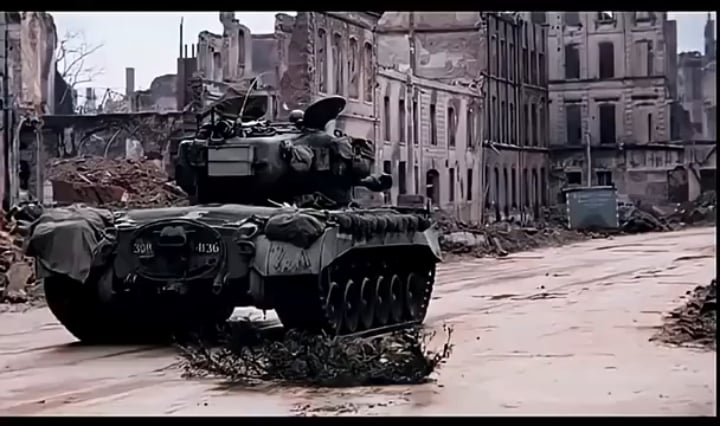
On 6 March 1945, as Allied forces pushed into the ruins of Köln (Cologne, Germany), one of World War II’s most dramatic tank duels unfolded. A single U.S. M26 Pershing — codenamed “Fireball” — faced off against a German Panther Ausf. G in a close-quarters street battle. This encounter became legendary, not only for its cinematic brutality but also as a test of American engineering versus German armored superiority late in the war.
The Combatants: M26 Pershing vs. Panther Ausf. G
1. The M26 Pershing: America’s Answer to German Big Cats
- Role: Heavy tank/medium tank (reclassified post-war).
- Armament: 90mm M3 cannon (effective range: 1,900+ meters).
- Armor: 102mm frontal hull, 76mm turret face.
- Speed: 25 mph (40 km/h).
- Deployment: Rushed to Europe in early 1945 to counter Panther and Tiger threats.
The Pershing, though slower than the Sherman, offered superior firepower and protection. Its 90mm gun could penetrate up to 132mm of armor at 1,000 meters—enough to challenge a Panther’s frontal plate under ideal conditions.
2. The Panther Ausf. G: Germany’s Deadly Workhorse
- Role: Medium tank (designed as a counter to the Soviet T-34).
- Armament: 75mm KwK 42 L/70 cannon (superior muzzle velocity, deadly accuracy).
- Armor: 80mm sloped hull (equivalent to ~140mm effective), 110mm turret front.
- Speed: 34 mph (55 km/h).
The Panther combined mobility, a devastating gun, and superb frontal armor, making it one of WWII’s most balanced tanks. However, its side armor (40–50mm) and reliability issues were critical weaknesses.
The Battle of Köln: Urban Warfare at Its Most Brutal
The Stage
Köln, a key industrial city on the Rhine, was defended by scattered German units, including elements of Panzer Brigade 106. The U.S. 3rd Armored Division spearheaded the assault, deploying its newly arrived Pershings.
The Duel: “Fireball” vs. The Panther
- Spotting the Threat: A Panther advancing down Köln’s rail yard was spotted by the crew of “Fireball” (M26 Pershing, commanded by Sgt. Bob Earley).
- First Shot Misses: The Pershing fired first but missed. The Panther returned fire, hitting a nearby building.
- Kill Shot: With the Panther exposing its weaker side armor while turning, the Pershing’s gunner, Cpl. Clarence Smoyer, fired three AP rounds into the tank’s hull and turret. The Panther erupted in flames, its ammunition cook-off captured in iconic footage.
Outcome: The Panther was destroyed; its crew killed. The Pershing survived unscathed, proving it could duel Germany’s best on equal footing.
Tactical Analysis: Why the Pershing Prevailed
- Urban Terrain: In Köln’s cramped streets, mobility mattered less than quick reactions. The Panther’s superior speed was nullified.
- Ammunition Choice: The Pershing used AP rounds, targeting the Panther’s vulnerable side armor (just 45mm thick).
- Surprise Factor: The Panther crew misjudged the Pershing’s capabilities, assuming it was a Sherman.
What If It Was a Frontal Engagement?
Had the tanks met head-on, the outcome might have differed. The Panther’s sloped 80mm front hull could deflect the Pershing’s 90mm rounds at range. However, the Panther’s gun could penetrate the Pershing’s frontal armor at 1,500+ meters.
Aftermath and Historical Significance
- Propaganda Victory: Newsreels of the Köln duel boosted Allied morale, showcasing the Pershing as a worthy Panther rival.
- Pershing’s Impact: Though only 200 saw combat in WWII, the M26 laid groundwork for postwar U.S. tanks like the M46 Patton.
- Panther’s Legacy: Despite flaws, the Panther influenced Cold War tank design (e.g., Soviet T-54).
Conclusion: A Microcosm of WWII Armored Warfare
The Köln duel symbolized the broader technological race of WWII. While the Panther excelled in design, the Pershing’s late-war debut showed the U.S. could adapt quickly. For tank enthusiasts, this clash remains a gripping study of strategy, firepower, and the fog of war.
Keywords for SEO:
T-26 Pershing vs Panther, Köln tank battle, M26 Pershing, Panther Ausf. G, WWII tank duel, Battle of Cologne 1945, Fireball Pershing, Clarence Smoyer, German tanks vs American tanks, 3rd Armored Division.
Optimization Tips:
- Link to archival footage of the duel (e.g., U.S. Army Signal Corps video).
- Include internal links to articles on the Panther, Sherman, or Rhine Offensive.
- Use alt tags like “M26 Pershing firing in Cologne” for images.
This tank-versus-tank moment remains a defining chapter in military history—one where precision, timing, and steel determined the victor.