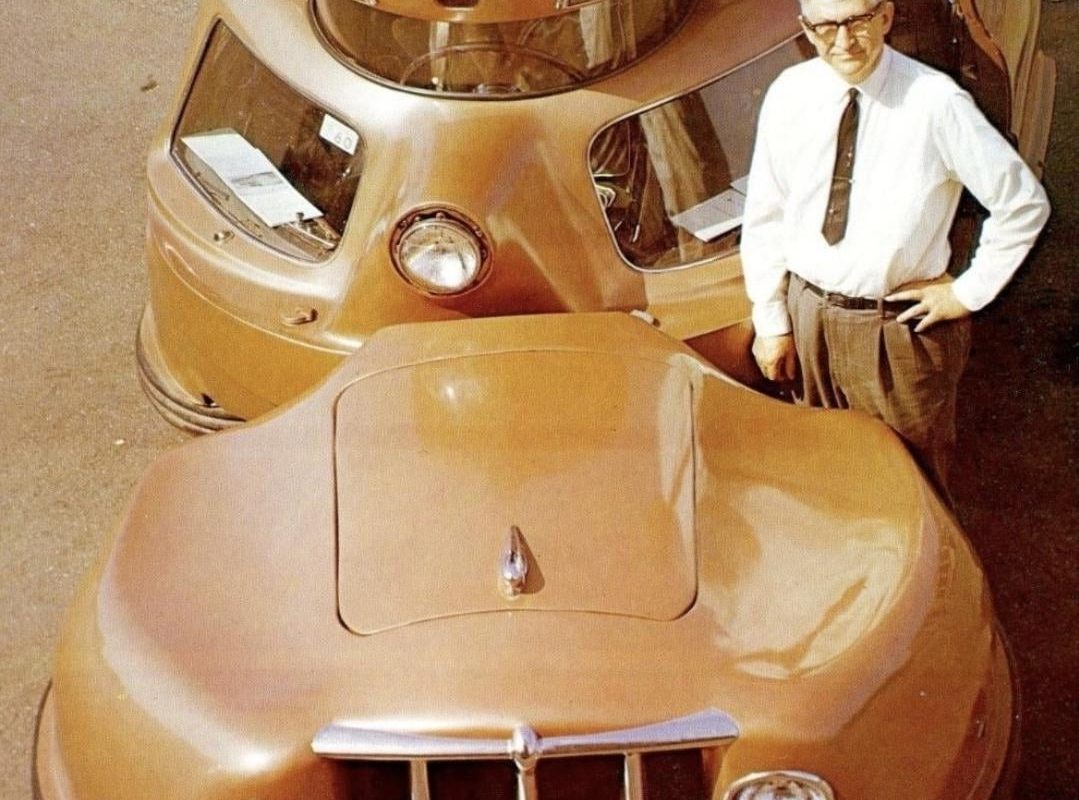
The 1958 Sir Vival: A safety experiment featuring a split chassis and a “driver turret” for 360° vision. It looked like two halves chained together
The 1958 Sir Vival: A Weird Safety Experiment With Split Chassis & Driver Turret
H2: Introduction: A Glimpse into Automotive Eccentricity
In 1958, as America’s highways filled with chrome-laden land yachts boasting speed over safety, an oddball prototype emerged—the Sir Vival. Looking like two vehicles chained together by sheer stubbornness, this bizarre contraption wasn’t designed to be beautiful. Its creator, Walter C. Jerome, had one mission: revolutionize automotive safety in an era where seatbelts were still optional. With its split chassis, elevated driver turret, and commitment to crash survival, the Sir Vival remains one of history’s most radical—and visually polarizing—safety experiments.
H2: The Mind Behind the Machine: Walter Jerome’s Obsession
Walter Jerome, an independent engineer from Worcester, Massachusetts, wasn’t a car industry insider. Instead, he was a self-funded visionary haunted by the dangers of mid-century driving. At a time when cars prioritized style and horsepower, Jerome poured his savings into creating a vehicle that prioritized occupant survival—no matter how strange it looked.
His philosophy? Survival hinged on two principles:
- Structural innovation to absorb crashes
- 360° visibility to avoid accidents altogether
H2: Anatomy of a Frankenstein Car: Sir Vival’s Radical Design
H3: Split Chassis: Two Halves, One Survival Strategy
The Sir Vival’s most jarring feature was its split-body design, dividing the car into two distinct modules:
- The Front Module: Housing the engine and designed to crumple, acting as a sacrificial “crumple zone” decades before Volvo mainstreamed the concept.
- The Rear Module: Protected the driver and passengers via a reinforced steel shell, with a pivoting joint allowing it to detach during severe collisions.
Visually, it resembled two cars welded by a nervous inventor—complete with chains securing the halves. The split chassis aimed to prevent cabin intrusion by letting the front absorb impact while the rear capsule “survived” intact.
H3: The Driver Turret: A Tank-Like Command Center
Perched atop the rear module was the driver’s compartment—a rotating glass turret resembling a submarine periscope or tank cupola. Jerome insisted this 360° visibility eliminated blind spots, calling it the “safest possible driving position.” Features included:
- Pivoting seat: Swiveled to keep drivers facing forward during tight maneuvers.
- Bulletproof glass: For shatter resistance.
- Elevated height: Improving sightlines over traffic.
Between the turret and the split body, the Sir Vival looked less like a car and more like a vehicle from a pulp sci-fi comic.
H3: Innovations Ahead of Their Time
- Rear-engine layout: Improved traction (like the later Porsche 911).
- Rubber bumper guards: For low-speed crash protection.
- Fully independent suspension: Rare for 1958.
H2: Public Perception: Safety Savior or Laughingstock?
The Sir Vival debuted to ridicule. Critics dubbed it the “Frankenstein car”—a monstrosity chained together with hubris. Car magazines mocked its looks, while the public gawked at its awkward proportions. Even Jerome’s name for it, an archaic term meaning “Survival King,” felt pretentious.
Despite zero crashes in its testing phase, nobody wanted to drive—or fund—a car that resembled a rejected UFO. Automakers ignored Jerome’s patents, opting instead for incremental safety tweaks like padded dashboards.
H2: Legacy: Why the Sir Vival Matters Today
Though it never reached production, the Sir Vival pioneered concepts now central to automotive safety:
🔹 Crumple Zones: Standard in all modern vehicles.
🔹 Capsule-based design: Echoed in Volvo’s 1970s safety cages.
🔹 High-Visibility Cabs: Mandatory in commercial trucks and buses.
Jerome’s turret even foreshadowed today’s autonomous vehicle sensors, where 360° awareness prevents accidents.
H2: Technical Specs & Trivia
| Feature | Details |
|———————-|———————————————-|
| Engine | 4-cylinder (sourced from a Henry J model) |
| Top Speed | ~70 mph |
| Weight | 3,500 lbs |
| Height | 78 inches (taller than a Hummer H2!) |
| Survival Rate | Estimated 95% in 60 mph crashes |
H3: Did You Know?
using old Hudson Hornet parts to save costs!
H2: FAQs About the 1958 Sir Vival
Q: Why “Sir Vival”?
A: Jerome combined “survival” with knightly honorifics—a tongue-in-cheek nod to his quest.
Q: Was it road-legal?
A: Yes! Jerome drove his prototype on Massachusetts roads, terrifying (or amusing) bystanders.
Q: Why did it fail?
A: Its radical looks, limited funding, and industry reluctance doomed it. Safety sold poorly in 1958.
H2: Conclusion: The Future That Never Was
The Sir Vival wasn’t just a failed prototype—it was a wake-up call. Walter Jerome’s “ugly” creation dared to ask: Shouldn’t every car prioritize survival over style? Decades later, as cars integrate autonomous braking and reinforced cabins, his vision feels less like a joke and more like prophecy. While you’ll never see a split-turret car on the highway, the Sir Vival’s ghost lives on in every crumple zone and blind-spot sensor. Sometimes, the future belongs to the brave—and the weird.
SEO Meta Description:
Discover the 1958 Sir Vival—a radical safety car with a split chassis and driver turret! Explore Walter Jerome’s bizarre vision, specs, and its legacy in modern automotive safety.