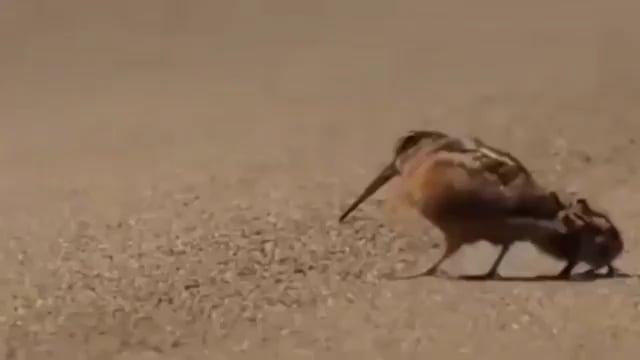
The American Woodcock bobs and dances on the soil with babies in tow – this behavior creates vibrations in the ground, causing earthworms to move and reveal themselves to the hungry birds
Title: The American Woodcock’s Secret Vibration Trick: How Bobbing & Dancing Lures Earthworms for Hungry Babies
Introduction
The American Woodcock (Scolopax minor), often dubbed the “timberdoodle” for its quirky charm, is a master of subterranean deception. This secretive shorebird, found in forests and moist thickets of eastern North America, has evolved a hunting strategy so ingenious it borders on magical: a rhythmic bobbing dance that sends vibrations through the soil, fooling earthworms into surfacing for an easy meal. When nesting season arrives, this behavior becomes critical to feeding their fast-growing chicks. Let’s explore how this peculiar dance works and why it’s vital to the species’ survival.
The Bobbing Dance: Nature’s Worm-Charming Ritual
At dusk or dawn, the American Woodcock transforms into a living metronome. Standing motionless at first, it suddenly begins rocking its body up and down, shifting weight from one leg to the other in a silent, hypnotic rhythm. While researchers once debated the purpose of this dance, studies now confirm its brilliance:
- Vibrations mimic rainfall: The foot-tapping creates subtle ground tremors resembling a downpour, tricking earthworms into surfacing to avoid drowning.
- Worm detection: Woodcocks use their extraordinarily long, sensitive bills (up to 3 inches!) to probe the softened soil and snatch exposed prey.
- Efficiency for nesting season: During spring and summer, parents perform this dance near nests or while guiding chicks, maximizing food intake for their young.
Why Earthworms Fall for the Vibration Trap
Earthworms sense vibrations as a survival instinct – rising to escape flooded soil during storms. The woodcock exploits this reflex with surgical precision. Research shows that:
- A single woodcock can eat its weight in worms daily (up to 200+ earthworms!).
- Chicks follow adults within hours of hatching, learning to detect vibrations and probe for worms themselves.
- The dance is 2x more effective in moist soils, where vibrations travel faster.
Parental Wisdom: Feeding Chicks in a High-Stakes Environment
American Woodcock chicks are born precocial – ready to move, but wholly dependent on parents for food. To protect their young from predators like foxes and owls, adults:
- Lead chicks to worm-rich clearings at night under low-light cover.
- Use rapid bobbing bursts to trigger worm movement while chicks watch and mimic.
- Prioritize protein: Earthworms provide 90% of chicks’ diet, fueling rapid growth (chicks fledge in just 4–5 weeks!).
Conservation Challenges: A Species in Quiet Decline
Despite their clever tactics, American Woodcock populations have declined by ~1% annually since the 1960s due to:
- Habitat loss from urbanization and reforestation (they thrive in young, shrubby forests).
- Pesticides reducing earthworm availability.
- Climate change altering soil moisture cycles.
Efforts like the American Woodcock Conservation Plan aim to restore habitats through controlled burns and timber harvesting, ensuring these “dancing birds” have stages to perform on for generations.
How to Spot the Timberdoodle Dance
If you’re in their range (eastern U.S. and Canada), look and listen for:
- Habitat: Overgrown fields, moist forests, or alder thickets near water.
- Timing: Dawn or dusk in spring (peak mating season features male sky-dances!).
- Signs: Distinctive “peent” calls followed by aerial spirals.
Conclusion
The American Woodcock’s vibration dance isn’t just a quirky spectacle – it’s a survival innovation honed by evolution. By turning the earth itself into a dinner bell, these birds ensure their chicks grow strong while hiding in plain sight. Protecting their habitats guarantees that this silent symphony of soil, worms, and life continues to thrive.
SEO Keywords: American Woodcock behavior, timberdoodle dance, bird vibration hunting, earthworm hunting birds, woodcock feeding chicks, bird parental care, ground vibration birds.
Meta Description: Discover how the American Woodcock’s bobbing dance creates ground vibrations to lure earthworms, a vital strategy for feeding their chicks. Explore the science, conservation, and how to spot this behavior!