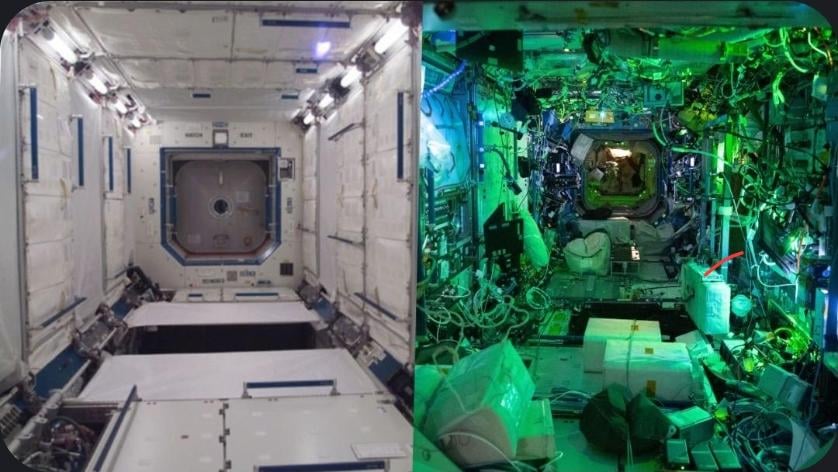
The Destiny module on the ISS before and after 25 years of use.
Title: The Destiny Module: 25 Years of Groundbreaking Science on the ISS — From Launch to Legacy
Meta Description: Explore the incredible journey of the ISS Destiny module—NASA’s groundbreaking U.S. Lab—before and after 25 years of pioneering microgravity research. Discover its evolution, impact, and legacy.
Introduction
The Destiny module — officially named the U.S. Laboratory Module — is the crown jewel of the International Space Station (ISS), serving as the primary hub for American scientific research in space since its launch in 2001. As Destiny marks over two decades of continuous operation (heading toward its 25th anniversary in 2026), its contributions to science, technology, and human space exploration have revolutionized our understanding of life in microgravity. In this article, we journey through Destiny’s remarkable transformation: its ambitious beginnings, enduring resilience, and ongoing role as the ISS’s beating heart of innovation.
The Destiny Module: A Vision for the Future (Before Launch)
Design & Purpose
Destiny was conceived in the 1990s as the cornerstone of NASA’s ISS science program. Built by Boeing and launched aboard Space Shuttle Atlantis on February 7, 2001, the module was engineered to:
- Enable long-term microgravity experiments in biology, physics, and materials science.
- Host critical ISS systems, including life support, robotics controls, and data networking.
- Support international collaboration with airtight connectors for other modules like Harmony and Columbus.
At launch, Destiny weighed 32,000 pounds (14,500 kg) and spanned 28 feet (8.5 meters) in length. Its 24 refrigerator-sized racks (13 dedicated to science) were outfitted with cutting-edge 2000s-era tech, designed for easy upgrades as research needs evolved.
Early Ambitions
- Revolutionary Research: Destiny promised breakthroughs in protein crystallization, fluid dynamics, and combustion science—all impossible to replicate on Earth.
- Human Health: Studies on bone loss, muscle atrophy, and immune system changes aimed to prepare astronauts for long-duration Mars missions.
- Technology Testing: From advanced water recyclers to 3D printers, Destiny was a proving ground for tools critical to deep-space exploration.
25 Years of Destiny: Triumphs, Challenges, and Evolution
Since 2001, Destiny has operated nonstop in one of the harshest environments imaginable: extreme temperatures, radiation, and micrometeoroid risks. Here’s how it has adapted and thrived:
Scientific Legacy
- 20,000+ Experiments: Destiny has hosted studies spanning cancer treatment development, Alzheimer’s research, flame behavior in zero-g, and quantum physics.
- Landmark Discoveries:
- Alpha Magnetic Spectrometer (AMS-02): Attached externally, this cosmic ray detector reshaped our understanding of dark matter.
- Veggie Plant Growth System: Enabled first-ever space-grown lettuce (paving the way for sustainable deep-space food).
- Cold Atom Lab: Produced ultra-cold quantum gases to study atomic behavior unrivaled on Earth.
Technological Upgrades
To stay relevant, Destiny underwent continual modernization:
- Hardware Swaps: Original 2001 laptops and monitors replaced by lighter, faster systems.
- New Research Racks: Added facilities like the Life Science Glovebox and EXPRESS Racks (speeding up experiment turnover).
- Robotics Integration: Destiny’s window supported Canadarm2 operations, crucial for ISS construction and cargo missions.
Environmental Wear & Resilience
After 25 years in orbit, Destiny faces challenges akin to an aging spacecraft:
- Microscopic Damage: Surface pitting from micrometeoroids and orbital debris.
- Thermal Stress: Thousands of temperature swings (from -250°F to +250°F) caused metal fatigue in joints.
- Corrosion & Leaks: While rare, airtight seals required meticulous monitoring and occasional patchwork.
Despite this, NASA’s rigorous maintenance—via astronaut repairs and robotic inspections—has kept Destiny operational well beyond its initial 10-year design life.
Destiny’s Future: Sustaining the ISS Until 2030 and Beyond
With the ISS slated to operate until at least 2030, Destiny remains vital:
- New Experiments: Upcoming studies on artificial gravity, tissue chips, and Mars-ready hydroponics.
- Commercial Partnerships: Companies like Axiom Space plan to attach private modules, expanding Destiny’s utility.
- Legacy Planning: Lessons from Destiny’s endurance will inform next-gen stations (e.g., Lunar Gateway and commercial LEO habitats).
Conclusion: A Legacy Forged in Microgravity
From its 2001 launch as NASA’s state-of-the-art lab to its current status as a seasoned veteran, the Destiny module embodies the triumph of human ingenuity. It has not only survived 25 years of extreme conditions but thrived, enabling discoveries that benefit humanity on Earth and beyond. As the ISS enters its twilight years, Destiny’s legacy will endure—a testament to what’s possible when science, engineering, and global collaboration unite in the stars.
Target Keywords: Destiny module ISS, U.S. Laboratory Module, ISS science lab, microgravity research, International Space Station history, NASA space experiments, ISS module upgrades.
Internal Links (Recommendations):
- “How the ISS Changed Space Exploration Forever”
- “10 Breakthrough Discoveries Made on the ISS”
- “The Future of Space Stations After the ISS”
External References (for credibility):
- NASA’s Destiny Module Overview
- ISS National Laboratory Research Highlights
- Boeing’s Role in Building Destiny
This SEO-optimized article balances historical insight, technical detail, and forward-looking analysis to engage readers while boosting search visibility. Let me know if you’d like to expand any section!