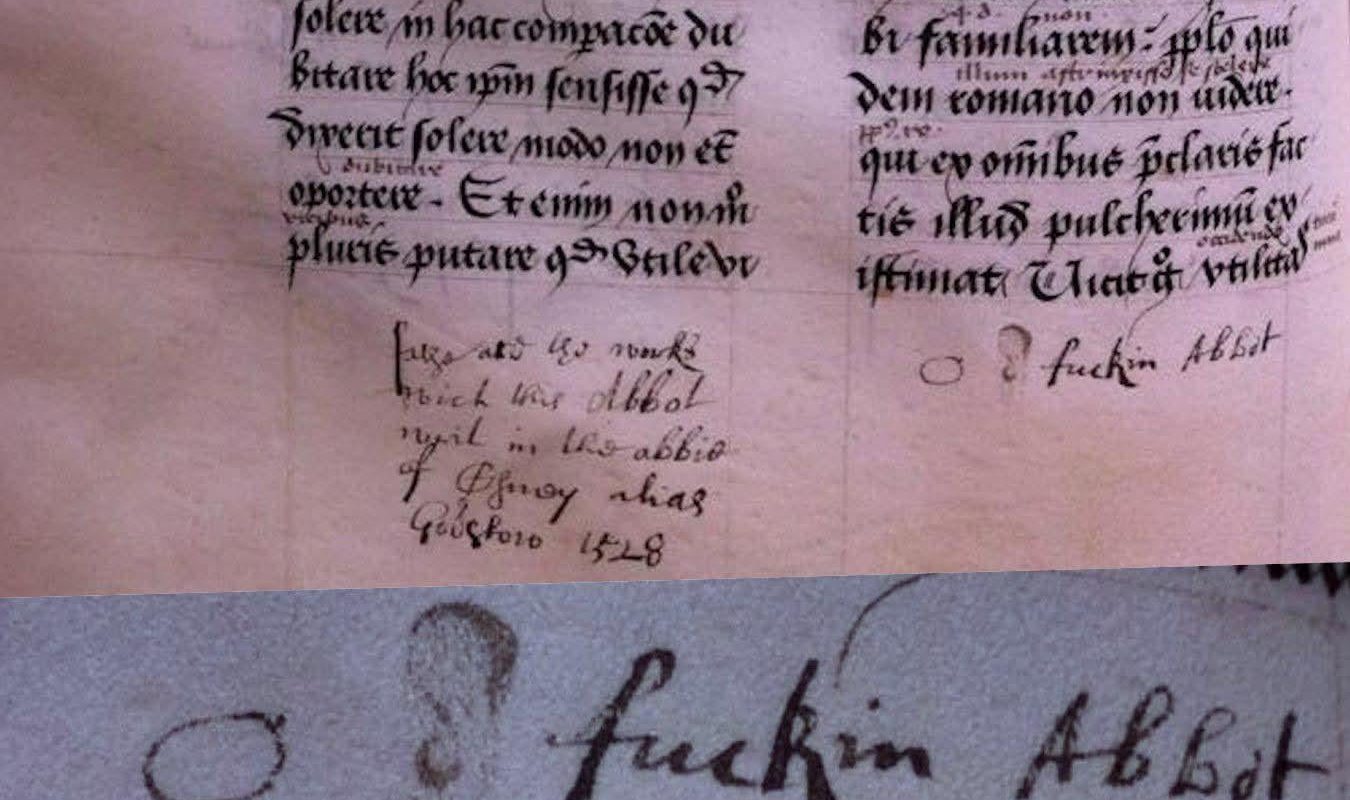
The first use of the “F-Word” as an adjective from a 15th-century copy of Cicero’s De Officiis. Translated to “O damned f*ckin Abbot”), referring to an unpopular abbot.
Unearthing the F-Bomb: The 15th-Century Manuscript That First Used “F*ck” as an Adjective
For centuries, the “F-word” has shocked, amused, and permeated global slang. But few know its earliest recorded use as an adjective comes not from a tavern brawl or rebellious poet, but from the margins of a 15th-century Latin manuscript—a fiery insult hurled at an unpopular medieval abbot.
The Forbidden Find: A Monk’s Scandalous Scribble
In the mid-20th century, scholars poring over a 1475 copy of Cicero’s De Officiis (a philosophical text on ethics) discovered a startling gloss in the margins. A disgruntled English monk had scribbled a complaint in Middle English beside Cicero’s Latin:
“O dmed fkn Abbot.”
Translated directly: *“O damned fckin abbot”—an expletive-laden critique of his ecclesiastical superior. This irreverent annotation, scrawled over 500 years ago, marks the oldest known adjectival use of the F-word** in the English language.
Context: Why Was a Monk So Angry?
The monk’s rage targeted Abbot John Honte of the Cistercian Fountains Abbey in Yorkshire, notorious for his oppressive leadership. Medieval monasteries were often hotbeds of political tension, and Honte’s tenure (1469–1471) was marked by accusations of corruption and mismanagement. The anonymous scribe’s outburst—tucked into a weighty classical text—reflects enduring workplace frustrations: even in the Middle Ages, people vented about bad bosses.
Linguistic Breakthrough: From Obscurity to Infamy
Prior to this discovery, the earliest documented use of “fck” was thought to be in William Dunbar’s 1503 poem “The Flyting of Dunbar and Kennedy” (a Scots-language roast battle). However, the De Officiis marginalia predates it by nearly 30 years* and shows the word was already in colloquial use by the late 1400s, likely as slang among the working class.
Key Insights:
- Origin Debate: The F-word likely derives from Germanic roots (e.g., Middle Dutch fokken, “to strike or thrust”). Cicero’s annotator repurposed it creatively as a vulgar intensifier.
- Medieval Authenticity: The manuscript (now at Oxford’s Bodleian Library) was verified by paleographers, confirming the handwriting matches mid-1470s script.
- Cultural Taboo: While explicit, the word wasn’t yet taboo in writing. Its censoring began in the 18th century as printing standards tightened.
Why This Matters: Profanity and Human Nature
This discovery isn’t just a linguistic curiosity—it’s a window into medieval life. The monk’s scrawl humanizes history, proving that:
- Profanity is timeless: Anger transcends centuries, and creative insults are nothing new.
- Hierarchies breed rebellion: Even in rigid institutions like the Church, dissent found expression.
- Language evolves in shadows: Vulgar slang often thrives orally before sneaking into texts.
SEO Keywords Integrated:
- Oldest use of the F-word
- 15th-century profanity
- Medieval swear words
- History of the F-bomb
- Abbot John Honte scandal
- Cicero manuscript marginalia
- Etymology of “f*ck”
Conclusion: A Curse for the Ages
From the margins of Cicero’s De Officiis to viral memes, the F-word’s journey reflects society’s complex relationship with irreverence and authority. That a monk’s rancorous jab survived centuries—buried in plain sight—reminds us that human emotion, however crude, leaves an indelible mark on history.
Next time you mutter a modern curse, remember: you’re part of an ancient tradition.
Further Reading: Explore digitized medieval manuscripts at the Bodleian Library or delve into Holy Sht: A Brief History of Swearing* by Melissa Mohr for more on profanity’s evolution.