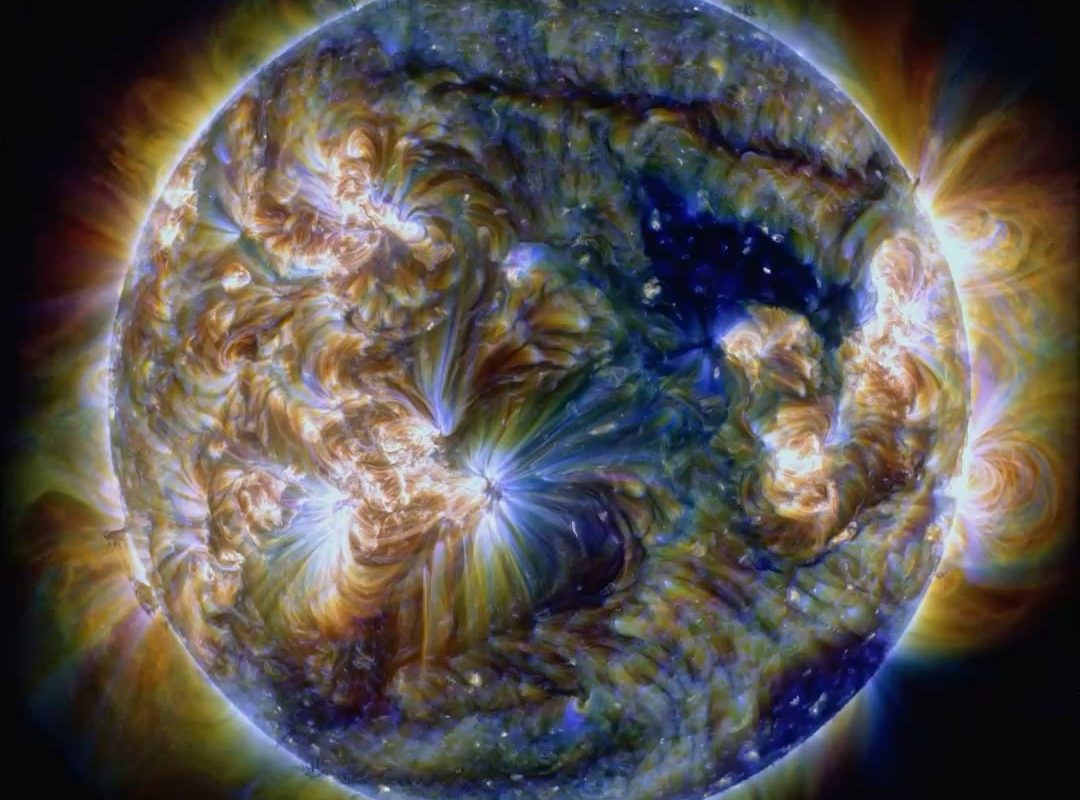
The most recent footage of the sun. Using different combinations of wavelengths from SDO
Unlocking the Sun’s Secrets: The Latest Footage in Stunning Multi-Wavelength Detail
NASA’s Solar Dynamics Observatory (SDO) continues to revolutionize our understanding of the Sun, capturing its violent beauty in unprecedented detail. The most recent footage, processed using different combinations of wavelengths, reveals hidden structures, solar flares, magnetic loops, and other phenomena invisible to the naked eye. Here’s what you need to know about these stunning images and what they tell us about our dynamic star.
The Science Behind SDO’s Multi-Wavelength Imaging
Launched in 2010, SDO orbits Earth and studies the Sun’s atmosphere using the Atmospheric Imaging Assembly (AIA), a suite of telescopes that capture images in 10 distinct ultraviolet (UV) and extreme ultraviolet (EUV) wavelengths. Each wavelength corresponds to different temperatures and layers of the solar atmosphere:
- 94 Ångströms (Å): Highlights extremely hot material (6.3 million °C), often linked to flares and active regions.
- 193 Å: Captures a slightly cooler corona (1.25 million °C), revealing coronal holes and solar eruptions.
- 304 Å: Focuses on the chromosphere (50,000–100,000 °C), showcasing prominences and filaments.
- 171 Å: Shows the quiet corona (600,000 °C), emphasizing magnetic loops and the Sun’s surface patterns.
By combining these wavelengths, scientists create false-color composites that disentangle complex processes, like energy transfer during solar storms or the birth of sunspots.
What the Latest Footage Reveals
Recent SDO imagery focuses on:
-
Active Regions (AR 3751 & 3753):
Composite images combining 171 Å, 193 Å, and 94 Å wavelengths expose turbulent magnetic fields near sunspots. These regions—hotspots for solar flares—appear as tangled ribbons of plasma, hinting at impending eruptions. -
Solar Flares in 131 Å:
Recent X-class flares (the strongest category) were captured in 131 Å light, which isolates material heated to 10 million °C during explosive magnetic reconnection events. -
Coronal Loops in 211 Å:
Stunning “roses” of plasma—visible in 211 Å—trace the Sun’s magnetic architecture. The latest clips show loops expanding and collapsing in real-time. -
Full-Disk Views in 1700 Å:
Using a near-UV filter (1700 Å), SDO reveals the photosphere’s granular texture—the bubbling “surface” where convection cells transport heat.
Why Wavelength Combinations Matter
Single wavelengths only reveal part of the story. For example:
- Combining 304 Å + 211 Å highlights filament channels—cool, dense plasma suspended above the Sun’s surface, often precursors to coronal mass ejections (CMEs).
- Merging 171 Å + 193 Å emphasizes coronal holes, where fast solar winds escape into space, influencing Earth’s geomagnetic weather.
These hybrids allow researchers to track energy flow and predict space weather events that could disrupt satellites, power grids, and communications.
How to Access the Latest Footage
NASA’s SDO data is publicly available in near-real-time:
- Explore the Gallery: View daily imagery on SDO’s official site.
- NASA’s Social Media: Follow @NASASun on Twitter/X for clips of solar flares, eclipses, and CMEs.
- Data Tools: Use the Helioviewer platform to layer wavelengths and create custom solar videos.
The Bigger Picture
The Sun is entering Solar Cycle 25’s peak (2025–2026), with activity ramping up. SDO’s multi-wavelength footage is crucial for forecasting space weather and understanding the Sun’s influence on Earth’s climate systems. Upcoming missions, like ESA’s Solar Orbiter, will complement SDO—ushering in a golden age of solar science.
Key Takeaways:
- SDO’s latest multi-wavelength images expose the Sun’s hidden dynamics.
- Each wavelength combination tells a unique story about solar magnetism and eruptions.
- Access real-time data via NASA’s platforms to witness our star’s ever-changing face.
Stay tuned: With solar maximum approaching, SDO’s footage will only get more dramatic!
Meta Description: Discover the latest footage of the Sun from NASA’s SDO, showcasing powerful solar flares, magnetic loops, and eruptions in multi-wavelength UV detail. Learn how different wavelengths unlock solar secrets.
Keywords: Latest sun footage, SDO wavelengths, NASA solar images, recent solar activity, solar dynamics observatory, ultraviolet sun images, space weather, solar flares, coronal loops.
By blending cutting-edge science with public accessibility, SDO ensures that humanity remains connected to the star that sustains life—and shapes our future in space.