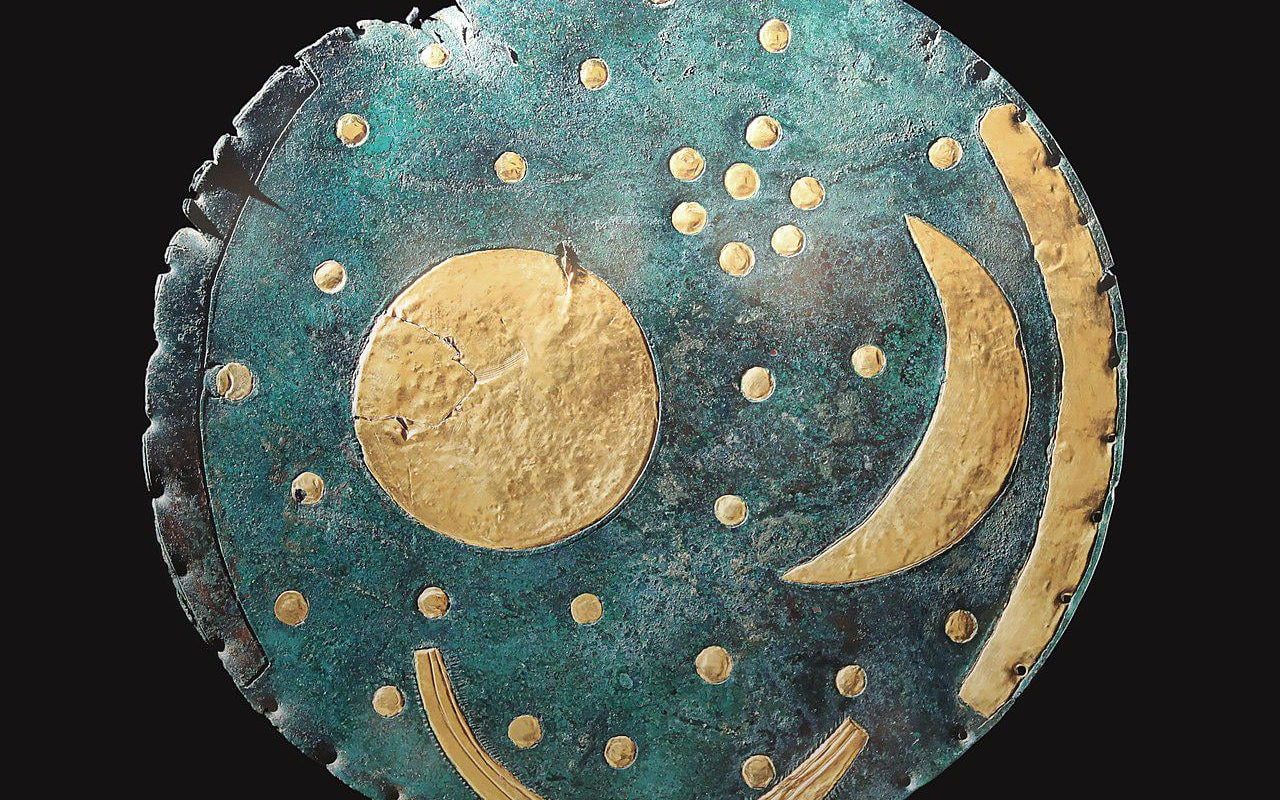
The Nebra sky disc, a bronze disc of around 30 cm from early bronze age Europe. The disc features the oldest concrete depiction of astronomical phenomena known from anywhere in the world.
Meta Description: Discover the Nebra Sky Disc, an astonishing Bronze Age artifact that holds the title of the world’s oldest known concrete depiction of the cosmos. Explore its history, symbolism, and cultural significance.
The Nebra Sky Disc: Decoding the Oldest Known Map of the Stars
The Nebra Sky Disc is one of the most extraordinary archaeological discoveries of the 21st century. Unearthed in Germany in 1999, this Bronze Age masterpiece is not only a triumph of ancient craftsmanship but also the oldest concrete representation of astronomical phenomena ever found, predating written records of celestial observations by centuries. This enigmatic bronze disc, roughly 30 centimeters (12 inches) in diameter, offers a rare glimpse into the sophisticated understanding of the cosmos held by Europe’s early civilizations over 3,600 years ago.
Let’s journey back in time to explore the Nebra Sky Disc’s origins, symbolism, and enduring mysteries.
A Chance Discovery: The Disc’s Controversial Origins
The Nebra Sky Disc was discovered illegally by treasure hunters near the town of Nebra, Saxony-Anhalt, Germany. Alongside Bronze Age swords, axes, and jewelry, the disc was looted from a forested site atop Mittelberg Hill—a location later proven to be an ancient ceremonial enclosure. After a dramatic police sting in 2002, the disc and accompanying artifacts were recovered and authenticated. Radiocarbon dating of materials found with the disc places its creation around 1600 BCE, during Europe’s Early Bronze Age (Unetice culture).
What Does the Nebra Sky Disc Depict?
The disc is crafted from bronze inlaid with gold symbols, which modern researchers interpret as celestial bodies and cosmological markers. Its imagery includes:
- Sun and Crescent Moon: A golden circular sun (or full moon) nestled beside a crescent moon.
- Stars: A cluster of 32 gold dots, including a distinctive group of seven representing the Pleiades constellation—a key celestial marker for Bronze Age agricultural and ritual calendars.
- Solar Barge: Two golden arcs along the edges symbolize boats believed to carry the sun across the sky (a motif seen in Egyptian and Nordic mythology).
- Horizon Arcs: Added later, these frames suggest solstice sunrise and sunset positions.
Astronomical Significance
- The Pleiades cluster’s position between the sun and moon likely signaled optimal times for planting and harvest in ancient agrarian societies.
- The horizon arcs align with solar alignments at Mittelberg Hill, suggesting the disc functioned as a portable astronomical calendar.
A Window into Bronze Age Cosmology
The Nebra Sky Disc challenges assumptions about prehistoric Europe’s intellectual capacity. Its creators demonstrated advanced knowledge of:
- Cyclical Time: Tracking lunar months and solar years.
- Mythology: Blending celestial patterns with spiritual beliefs.
- Metalwork: Using complex techniques to solder gold onto bronze.
This object likely served both practical and ritual purposes, guiding seasonal ceremonies and reinforcing the power of elites who “controlled” cosmic knowledge.
Controversies and Authenticity
Initial skepticism arose due to the disc’s unprecedented artistry. However, extensive scientific analysis—including patina studies and trace-element tests—confirmed its antiquity. Today, it’s widely celebrated as a pillar of archaeoastronomy and a UNESCO-listed “Memory of the World” artifact.
Where Is the Nebra Sky Disc Today?
The disc resides in the State Museum of Prehistory in Halle, Germany, where it anchors exhibitions on Bronze Age Europe. Its discovery site now features a visitor center and stargazing platform, inviting modern audiences to ponder the same skies that inspired its creators.
Conclusion: A Timeless Legacy
The Nebra Sky Disc is more than an ancient artifact—it’s a testament to humanity’s eternal fascination with the heavens. As the earliest known celestial map, it bridges science, art, and spirituality, proving that our ancestors looked to the stars not just for navigation, but for meaning. For historians, astronomers, and dreamers alike, the disc remains a shimmering link to our shared cosmic heritage.
Keywords: Nebra Sky Disc, Bronze Age astronomy, oldest star map, Unetice culture, archaeoastronomy, Pleiades constellation, ancient artifacts, Bronze Age Germany, celestial symbolism.