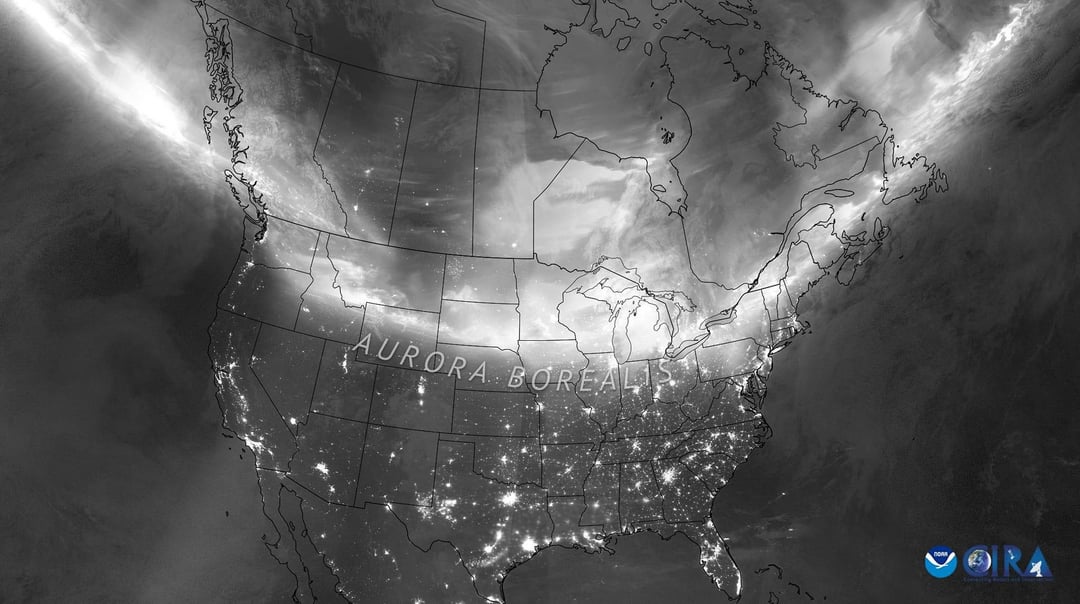
The Northern Lights over the United States from May 10-11, 2024. This was the first G5 (Extreme) geomagnetic storm in over 20 years and the most powerful since March 1989. It produced one of the most intense aurora displays seen in the last 500 years, visible as far south as Hawaii.
Title: A Celestial Spectacle: The Historic G5 Geomagnetic Storm That Lit Up the U.S. with Northern Lights
Meta Description: In May 2024, the U.S. witnessed the most powerful Northern Lights display in decades—a rare G5 geomagnetic storm visible as far south as Hawaii. Discover the science, spectacle, and significance.
The Night the Sky Turned Magical: G5 Geomagnetic Storm Unleashes Historic Northern Lights Over the U.S.
From May 10–11, 2024, millions of Americans gazed upward as a once-in-a-generation celestial phenomenon painted the skies with vivid hues of green, purple, pink, and red. For the first time since 2003, Earth was struck by an extreme G5 geomagnetic storm, the strongest category on NOAA’s space weather scale—and the most intense solar event since the historic March 1989 storm that caused blackouts across Quebec. This rare solar outburst triggered auroras so brilliant they were visible in all 50 U.S. states, including Hawaii, Puerto Rico, and Mexico. Scientists later confirmed it was one of the most intense aurora displays in the last 500 years.
What Caused the 2024 Extreme Solar Storm?
The event began when a massive sunspot cluster, 15 times wider than Earth, unleashed multiple X-class solar flares and coronal mass ejections (CMEs). These solar outbursts launched a barrage of charged particles toward Earth at over 1.5 million mph. When the particles collided with Earth’s magnetosphere, energy was funneled toward the poles, overloading the atmosphere and sending the Northern Lights (aurora borealis) cascading far beyond their usual Arctic domain.
Key factors behind the storm’s intensity:
- Multiple Earth-directed CMEs merged en route, creating a “cannibal CME” effect.
- A rare alignment of the sun’s magnetic field intensified the impact.
- The storm peaked at G5-level intensity for over 12 hours—twice as long as the 1989 event.
How Far South Did the Northern Lights Appear?
This storm shattered expectations:
- 🌌 Hawaii: Auroras dazzled over Maui’s Haleakalā volcano (20°N latitude)—a sight unseen since 1859’s “Carrington Event.”
- 🌃 Southern U.S.: Crimson and emerald waves illuminated skies in Florida, Texas, and Arizona.
- 🗽 Major Cities: New York, Chicago, and Los Angeles saw vivid displays, with social media erupting with #AuroraBorealis trends.
Unlike typical aurora sightings limited to Alaska or northern Canada, this event transformed the entire continent into a front-row seat for nature’s greatest light show.
Comparing the 2024 Storm to Past Solar Events
- March 1989: The last G5 storm before 2024 caused a 9-hour blackout in Canada. Auroras reached Florida but not Hawaii.
- October 2003: The “Halloween Storms” produced G5 conditions but lasted only 3 hours.
- September 1859 (Carrington Event): The only stronger storm in recorded history; auroras were visible near the equator.
The May 2024 storm stands as the most widespread U.S. aurora event of the modern era, rivaling pre-industrial celestial phenomena.
Stunning Photos and Eyewitness Reactions
Social media exploded with viral photos of landscapes bathed in otherworldly light:
- 📸 California’s Yosemite Valley: Purple ribbons framed Half Dome.
- 🌆 New York City: Rare views of the aurora danced behind the Statue of Liberty.
- 🌺 Honolulu: Beachgoers watched magenta waves ripple above palm trees.
“It looked like the sky was breathing,” said one viewer in Oklahoma. Astronomers noted STEVE (Strong Thermal Emission Velocity Enhancement)—a rare pink aurora-like ribbon—appearing alongside traditional displays.
The Science Behind the Fury
Solar Cycle 25 (2020–2031) is proving stronger than predicted, with sunspot activity nearing the 1859 Carrington Event’s intensity. The 2024 storm highlighted vulnerabilities in power grids and satellites—some Starlink satellites experienced orbital decay. However, it also gave scientists unparalleled data to improve space weather forecasting.
Will This Happen Again Soon?
While G5 storms occur roughly once per solar cycle (11 years), their reach depends on timing and magnetic alignment. As Solar Cycle 25 peaks in 2024–2025, experts warn of more severe space weather, though auroras may not match this event’s scale.
Conclusion: A Warning and a Wonder
The May 2024 G5 geomagnetic storm rewrote the rules of aurora visibility, proving even modern societies remain at the mercy of the sun’s power. For those who witnessed it, the dazzling colors weren’t just a scientific curiosity—they were a humbling reminder of Earth’s place in a dynamic cosmos.
Tips for Future Aurora Chasers:
- Follow NOAA’s Space Weather Prediction Center for real-time alerts.
- Use long-exposure camera settings to capture faint auroras.
- Light pollution maps can help find optimal viewing spots.
The night of May 10–11, 2024, will forever be remembered as the time the heavens staged a rebellion—and humanity stopped to watch in awe.
Keywords for SEO:
Northern Lights USA 2024, G5 geomagnetic storm, Aurora borealis Hawaii, May 2024 solar storm, Extreme aurora event, Northern Lights visibility map, Solar storm 2024 photos, Space weather predictions, Coronal mass ejection 2024, Historic Northern Lights.