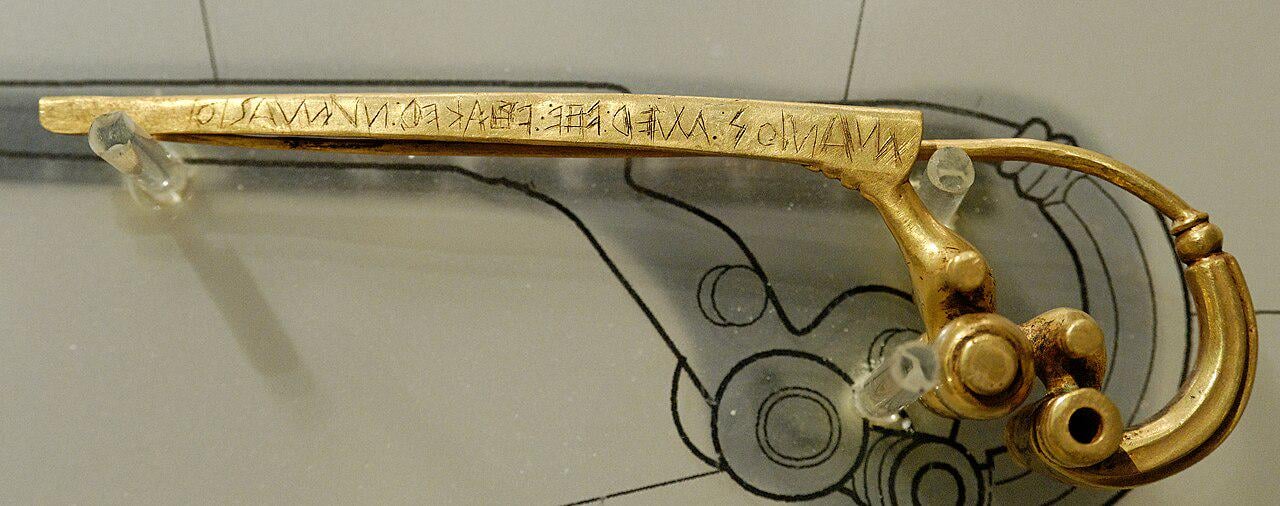
The Praeneste fibula, a golden fibula from 7th century BC Italy bearing the oldest known writing in the latin language.
Meta Description: Discover the Praeneste Fibula, a 7th-century BC golden brooch inscribed with the oldest known Latin text. Explore its history, linguistic significance, and the controversy that once shrouded this iconic artifact of ancient Rome.
Unveiling the Praeneste Fibula: The Golden Key to Latin’s Ancient Origins
H2: Introduction – A Glimpse into the Birth of Latin
Buried for millennia beneath the soil of ancient Italy, the Praeneste Fibula isn’t just a golden brooch—it’s a time capsule preserving the oldest known inscription in the Latin language. Dating back to the 7th century BC, this artifact bridges the gap between prehistoric Italy and the rise of Rome’s literate civilization. For linguists, archaeologists, and history enthusiasts alike, the fibula offers a rare window into how Latin evolved from a regional dialect to the lingua franca of an empire.
H2: The Historical and Archaeological Context
H3: Discovery and Location
The fibula was unearthed in 1871 by archaeologist Wolfgang Helbig at Praeneste (modern Palestrina), a town southeast of Rome renowned for its Sanctuary of Fortuna Primigenia. Praeneste was a thriving Etruscan-influenced settlement in the Orientalizing period (720–580 BC), making it a cultural hotspot where early Latin speakers interacted with neighboring Etruscan and Greek communities.
H3: Description of the Artifact
Crafted from gold and measuring 10.7 cm long, the fibula (a decorative clasp for clothing) features a quadrilateral bow and a curved pin. Its design reflects sophisticated Etruscan metalworking techniques, highlighting the cultural exchange in pre-Roman Italy.
H2: The Inscription That Rewrote History
H3: The Controversial Text
Along the fibula’s pin runs an inscription etched in Old Latin, written right-to-left in a primitive script resembling early Etrusco-Greek letters:
MANIOS MED FHEFHAKED NVMASIOI
Translated: “Manius made me for Numerius.”
Though only 7 words, this text provides unprecedented insight:
- Dated linguistically to 650–600 BC, it predates Rome’s legendary foundation (753 BC).
- Features archaic spellings like FHEFHAKED (later fecit, “made”) and MED (me, “me”), showcasing Latin’s Proto-Italic roots.
- Uses digamma (F) for the /f/ sound, later dropped in Classical Latin.
H3: The Forgery Debate and Modern Authentication
For decades, scholars questioned the fibula’s legitimacy, arguing the inscription was a 19th-century hoax. In 2011, scanning electron microscopy by linguist Margherita Guarducci confirmed micro-wear patterns consistent with ancient engraving tools, silencing skeptics and solidifying its status as authentic.
H2: Why the Praeneste Fibula Matters
H3: Linguistic Significance
- Oldest Evidence of Latin: The inscription predates the Duenos Vase (6th century BC) and Forum Inscription (550 BC).
- Proto-Latin Evolution: Features like -ED endings (fhefhaked) reveal ties to Indo-European verb conjugations.
- Cultural Hybridity: The mix of Latin grammar with Etruscan-style letters reflects Italy’s multicultural Iron Age.
H3: Historical Implications
The fibula suggests Latin was written earlier than previously thought, likely for elite prestige. Its context—buried in a wealthy woman’s tomb—hints at literacy among Praeneste’s aristocracy decades before Rome’s dominance. Some link its style to Rome’s sixth king, Servius Tullius, who promoted Etruscan influences.
H2: Legacy and Preservation
Today, the fibula resides at Rome’s Museo Nazionale Preistorico Etnografico Luigi Pigorini. Its survival underscores Italy’s role as the cradle of Romance languages, from Spanish to French. For modern linguists, it remains a Rosetta Stone of Latin, proving even the mightiest tongues began humbly.
H2: Conclusion – Unlocking Rome’s Linguistic Roots
The Praeneste Fibula isn’t merely a relic; it’s a testament to human ingenuity. In seven short words, it captures the dawn of a language that shaped empires, literature, and law. As research continues, this golden brooch reminds us that history’s smallest artifacts can hold its grandest secrets.
Call to Action:
Interested in ancient languages? Explore our deep dive into the Etruscan influence on Latin or the Rosetta Stone’s role in deciphering Egyptian hieroglyphs!
SEO Keywords:
Praeneste Fibula, oldest Latin inscription, 7th century BC Italy, Latin language history, ancient Roman artifacts, Old Latin writing, Proto-Italic, Etruscan influence on Latin, archaeological discoveries in Rome.