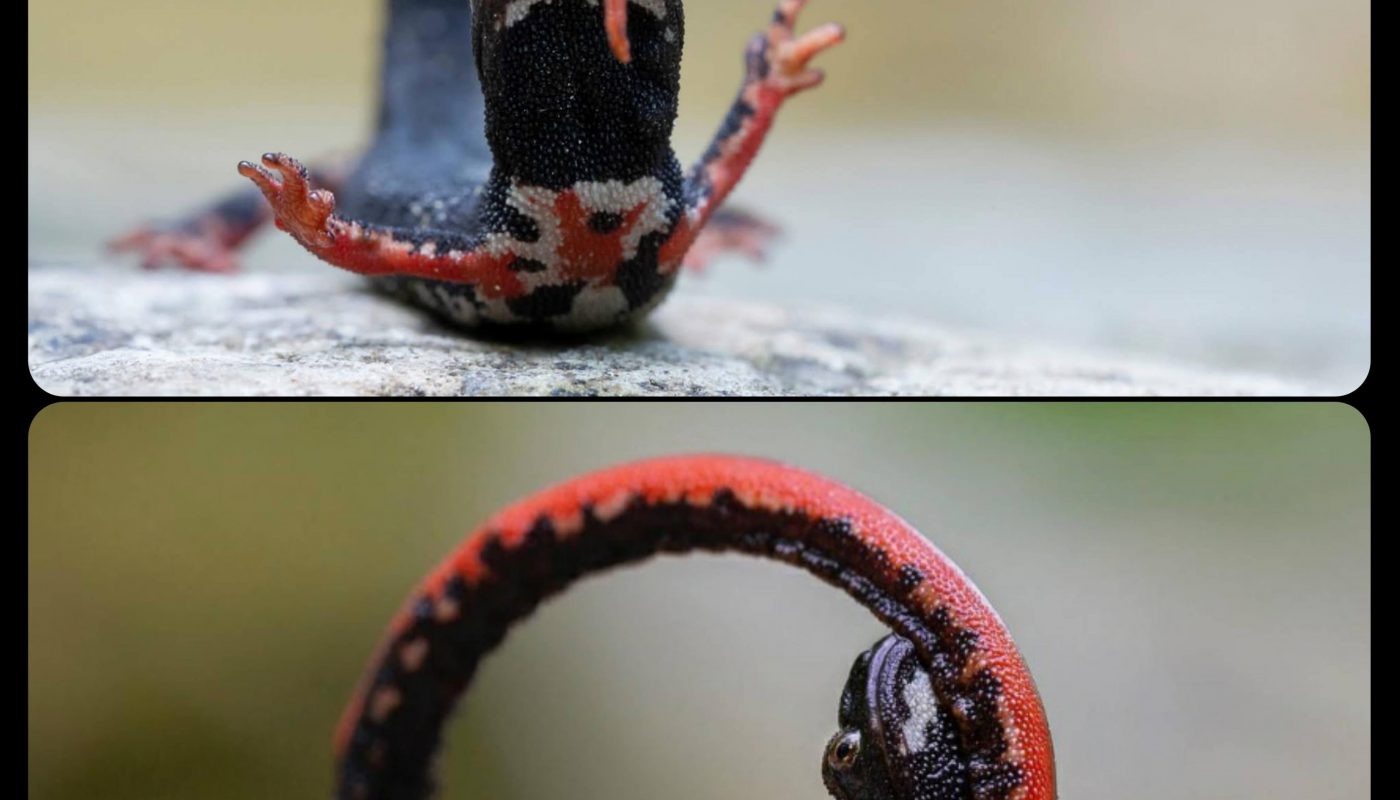
The Spectacled Salamander: when threatened, this salamander will often curl its body into a defensive position that displays the aposomatic markings on the underside of its tail and legs
The Spectacled Salamander: Nature’s Colorful Defender with a Dramatic Warning Display
The animal kingdom brims with ingenious survival strategies, but few are as visually captivating—or scientifically fascinating—as the defense mechanism of the Spectacled Salamander (Salamandrina terdigitata). This elusive amphibian native to Southern Europe doesn’t rely on speed or camouflage when danger looms. Instead, it performs a startling defensive ballet, curling its body to reveal striking aposematic markings beneath its limbs and tail—a vivid “don’t eat me!” signal to would-be predators. In this article, we’ll explore the biology, behavior, and remarkable adaptations of this pint-sized protector.
Meet the Spectacled Salamander: An Overview
The Spectacled Salamander, also called the Spectacled Newt or Italian Salamander, belongs to the family Salamandridae. It’s one of Europe’s most distinctive amphibians, easily identified by:
- Small size: Adults rarely exceed 11 cm (4.3 inches).
- Drab dorsal appearance: A dark brown, gray, or black back that blends into forest floors.
- Signature “spectacles”: Bright white or yellow markings around its eyes (hence the name).
- Vibrant ventral surprise: The real showstopper—the fiery-orange, red, or yellow underside of its tail, legs, and cloaca.
This species thrives in deciduous woodlands near freshwater streams in Italy and parts of the Balkans, where moisture and cover are plentiful. Primarily nocturnal, it hunts invertebrates like insects, spiders, and worms under the veil of darkness.
The Uncoiling Defense: Aposematic Artistry in Action
Unlike salamanders that flee or play dead, the Spectacled Salamander adopts a dramatic defensive posture when threatened by birds, snakes, or mammals. Here’s how it works:
- The Curl-Up: In a split-second reaction, the salamander arches its spine, coils its tail over its head, and tucks its limbs inward—forming a tight, inverted U-shape.
- Flash Display: This posture intentionally exposes its brightly colored underside, especially the vivid hues on its tail’s ventral surface and hind legs.
- Chemical Back-Up: Paired with the visual warning, glands in its skin secrete toxins (salamandrines) to deter predators foolish enough to take a bite.
Scientists classify this as aposematism: the use of bold, contrasting patterns to advertise toxicity or unpalatability. For predators, the bright colors act as a universal “warning label”—eating this creature could mean a mouthful of foul-tasting chemicals or worse.
Why This Strategy Works
- Memory Reinforcement: Predators learn to associate bright colors with danger, avoiding similar-looking prey in the future.
- Instant Communication: The high-contrast display is visible in dim forest light, conveying the message rapidly.
- Energy Efficiency: Escaping consumes energy; deterring an attack before it happens is far more efficient.
The Science Behind the Salamander’s Survival
Research into Salamandrina terdigitata reveals fascinating details about its defensive evolution:
- Tail-Focused Display: Unlike other amphibians with warning colors spread across their bodies, this species concentrates vivid hues on the underside of its tail and legs. This may direct predator attacks away from vital organs.
- Tail Autotomy: Like many lizards, Spectacled Salamanders can voluntarily shed their tails if grabbed, buying time to escape while the detached limb continues to wriggle—distracting the predator.
- Mimicry Avoidance: True to its Latin name (terdigitata = three-toed), its reduced toe count distinguishes it from similar species, ensuring predators recognize its unique warning signals.
Threats & Conservation
While globally classified as Near Threatened by the IUCN, habitat loss from deforestation, pollution, and climate change pressures this species. Protecting its forest ecosystems ensures survival not just for the Spectacled Salamander, but for countless other species relying on these biodiverse habitats.
FAQ: Quick Facts About the Spectacled Salamander
Q: Why is it called the “Spectacled” Salamander?
A: The white/yellow rings around its eyes resemble eyeglasses (“spectacles”).
Q: Are Spectacled Salamanders venomous?
A: They secrete skin toxins but pose no serious risk to humans—washing hands after handling is advised.
Q: Where can they be found in the wild?
A: Endemic to Italy and parts of Albania, favoring moist, shaded forests near streams at low-to-mid elevations.
Q: What happens if a predator ignores the colorful warning?
A: Toxins cause irritation, nausea, or paralysis in attackers—often leading to the salamander’s release.
Conclusion: A Tiny Master of Deception & Warning
The Spectacled Salamander proves that survival isn’t just about hiding or fleeing—sometimes, the best defense is a bold, brilliantly choreographed bluff. Through its vivid aposematic display and clever anatomy, this amphibian transforms into a living neon sign screaming “toxic!” to predators. As we work to conserve its woodland habitats, we preserve not just a species, but a captivating example of nature’s ingenuity.
Keywords for SEO:
Spectacled Salamander, Salamandrina terdigitata, aposematic markings, amphibian defense mechanisms, Italian salamander, toxic amphibians, anti-predator adaptations, salamander behavior, European salamanders, wildlife conservation