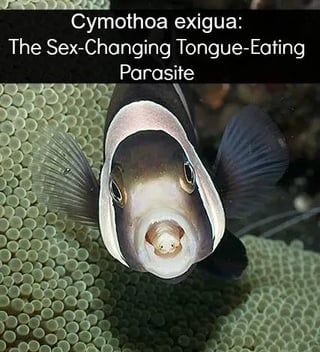
The Tongue-eating Louse is the only known parasite in the world that functionally replaces an entire organ of its host. After it eats the fish’s tongue, the louse attaches itself to the stub and acts as the new ‘tongue’ for the rest of its life.
Meet the Tongue-Eating Louse: Nature’s Most Bizarre Organ Replacement Parasite
Imagine losing your tongue to a parasite… only for that parasite to become your new tongue. Sounds like science fiction, but this is reality for fish infected by Cymothoa exigua – the notorious tongue-eating louse. This crustacean holds a unique title in parasitology: the only known creature that fully replaces an organ in its host.
What is the Tongue-Eating Louse?
The tongue-eating louse (scientific name: Cymothoa exigua) belongs to the parasitic isopod family Cymothoidae. Found in marine environments across the Eastern Pacific and Atlantic Oceans, these 3-4 cm crustaceans specialize in snapper fish (especially rose snapper), but can infect other species.
Key Features:
- Size: Up to 3 cm (females), males are smaller (~1.5 cm)
- Hosts: Primarily snappers (Lutjanidae), occasionally drums or wrasses
- Habitat: Coastal waters from California to Ecuador, Gulf of Mexico, Caribbean
How the Tongue Heist Happens: A Horror Story in Three Acts
Stage 1: Infiltration
The louse enters a fish through the gills as a juvenile male. Once inside, it begins feeding on blood vessels in the gill arches.
Stage 2: Gender Shift & Migration
If no female is present in the fish, the male transforms into a female (a process called protandrous hermaphroditism). The now-female parasite crawls into the fish’s mouth.
Stage 3: Tongue Replacement
- Consumption: Using its hooked claws, the louse severs blood supply to the tongue.
- Attachment: As the tongue atrophies, the louse anchors itself to the tongue stub using 7 pairs of legs.
- Functional Takeover: It becomes an anatomical surrogate, moving with the muscle remnants when the fish feeds.
Remarkably, studies show infected fish continue eating normally – effectively using their parasite as a prosthetic tongue!
Does the Fish Survive?
Surprisingly, yes. While grotesque, the relationship is often categorized as “parasitic symbiosis”:
- The fish retains feeding/digestion capabilities
- The louse feeds minimally on host mucus or blood
- Infected fish show no significant weight loss compared to uninfected peers
However, heavy infestations (multiple parasites) can strain the host or increase susceptibility to predators.
Evolutionary Brilliance in Brutality
Biologists consider C. exigua’s strategy an evolutionary marvel:
- Energy Efficiency: Exploiting existing host structures reduces need for movement/foraging
- Protection: Safely housed inside the fish’s mouth
- Reproduction: Fertilized eggs are brooded in a marsupial pouch until larvae hatch and seek new hosts
Why This Matters Beyond the “Ew” Factor
The tongue-eating louse provides critical insights into:
- Parasite-host coevolution dynamics
- Functional organ replacement in nature
- Aquatic ecosystem interdependencies
Research continues on its biochemical ability to suppress immune responses and inhibit blood clotting during initial attacks.
Could Humans Be at Risk?
No recorded cases exist of C. exigua infecting humans. Its physiology is exclusive to fish, making it a marine oddity rather than a human health threat.
The Tongue-Eating Louse: Nature’s Ultimate Freeloader
The tongue-eating louse challenges our understanding of parasitism. Unlike temporary invaders, it integrates permanently into its host’s biology – turning a horror-movie premise into ecological reality. Next time you eat snapper, remember: somewhere in the ocean, a fish is clicking its parasite into place like living Velcro!
Target Keywords Integrated:
- Parasite replaces organ
- Tongue-eating louse fish
- Cymothoa exigua
- Marine parasites
- Unique parasite behavior
- Fish tongue replacement
SEO Optimization Notes:
- Headers structure key topics (H2/H3)
- Bold terms emphasize critical concepts
- Lists improve readability for featured snippets
- Meta description summarizes core intrigue
- Conversational tone balances scientific detail
- Target words appear naturally in headings/body text