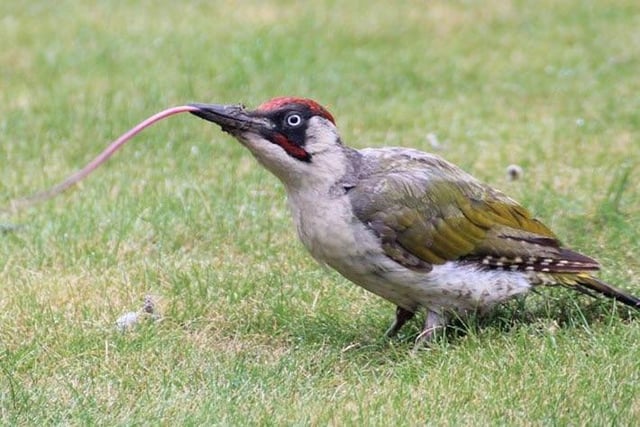
The woodpecker’s tongue can reach a length of up to about 15 centimetres, wraps around the skull to cushion the brain and is tipped with barbs and sticky saliva
The Woodpecker’s Tongue: Nature’s Ingenious Shock Absorber and Hunting Tool
Introduction: More Than Just a Tongue
When we think of woodpeckers, their rhythmic pecking—often heard echoing through forests—instantly comes to mind. But behind this iconic behavior lies one of nature’s most astonishing anatomical adaptations: their extraordinary tongue. Stretching up to 15 cm (6 inches) in certain species, this organ wraps around the skull like a biological seatbelt, cushions the brain from incessant drilling forces, and even features barbed tips coated in sticky saliva to snag prey. Let’s delve into the science behind this evolutionary masterpiece and uncover how it enables woodpeckers to thrive.
Anatomy of the Woodpecker’s Tongue: A Built-in Safety System
The woodpecker’s tongue is not anchored in the throat like most birds. Instead, it extends from a specialized hyoid apparatus—a complex of bones and cartilage that supports and mobilizes the tongue. This structure acts like a pulley system, allowing the tongue to shoot out far beyond the beak to probe deep crevices in trees.
Key Features:
-
Skull-Wrapping Design:
The hyoid bones extend behind the skull, curve up and over the top of the head, and anchor near the nostrils. When retracted, the tongue coils around the braincase, forming a protective layer that cushions the brain during high-impact pecking (up to 20 strikes per second!). -
Shock Absorption:
Research shows this unique positioning helps absorb and redistribute the G-forces (equivalent to 1,200 times Earth’s gravity) generated while drumming on wood. The tongue acts like a natural airbag, preventing concussions and brain trauma. -
Barbed and Sticky Tips:
The tip of the tongue is equipped with backward-facing barbs (similar to tiny hooks) and glands that secrete sticky saliva. This dual design allows woodpeckers to spear or glue insects like ants, beetles, and larvae, pulling them effortlessly from tree bark.
Why Evolution Perfected This Design
Woodpeckers primarily feed on insects hidden beneath bark or inside rotting wood. To access this food, they rely on rapid-fire pecking—a strategy that would cripple most animals. Over millions of years, their anatomy evolved to mitigate the risks:
- Brain Protection: The tongue’s shock-absorbing mechanism is critical—without it, woodpeckers would suffer fatal brain injuries.
- Extended Reach: A long, flexible tongue enables them to extract prey from tunnels deeper than their beaks can penetrate.
- Versatility: Barbed tips are ideal for spearing beetles, while sticky saliva traps soft-bodied insects like caterpillars.
How Woodpeckers Use Their Tongue in the Wild
Species like the Northern Flicker and Pileated Woodpecker showcase this adaptation in action:
- Hunting: After chiseling a hole, the woodpecker extends its tongue to probe crevices. Barbs latch onto prey, while sticky saliva ensures nothing escapes.
- Drinking: The tongue’s sponge-like tip soaks up sap, water, or leaking tree fluids.
- Self-Defense: Some species use their sticky saliva to temporarily entangle predators.
The Woodpecker vs. Human Innovation
Scientists study woodpecker tongues and skulls to inspire better protective gear, such as helmets for athletes and military personnel. Their natural anti-shock system demonstrates biomechanical principles that outperform many engineered solutions.
FAQs: Unpecking the Mysteries
Q: How does the tongue retract so quickly?
A: Muscles attached to the hyoid bones rapidly recoil the tongue like a fishing line.
Q: What’s the purpose of the sticky saliva?
A: It’s produced by glands at the tongue’s base and acts like natural glue, enhancing prey capture.
Q: Do all woodpeckers have this adaptation?
A: Yes, though specifics vary by species. The Green Woodpecker, for example, relies more on saliva for catching ants.
Conclusion: A Testament to Nature’s Brilliance
The woodpecker’s tongue is far more than a feeding tool—it’s a multipurpose survival device shaped by millennia of evolution. From cushioning concussive forces to outsmarting elusive prey, this 15-centimeter marvel exemplifies how nature engineers solutions to seemingly impossible challenges. Next time you hear the staccato drumming of a woodpecker, remember: beneath those feathers lies one of Earth’s most extraordinary anatomical feats.
Meta Description: Discover the woodpecker’s incredible tongue—a 15 cm marvel that wraps around its skull to protect the brain and features barbs & sticky saliva for hunting!
Keywords: woodpecker tongue, bird adaptations, hyoid apparatus, brain protection, barbed tongue, sticky saliva, woodpecker anatomy, bird biology.
(Note: For SEO optimization, pair this article with high-quality images/videos showcasing woodpecker feeding behavior and tongue anatomy.)