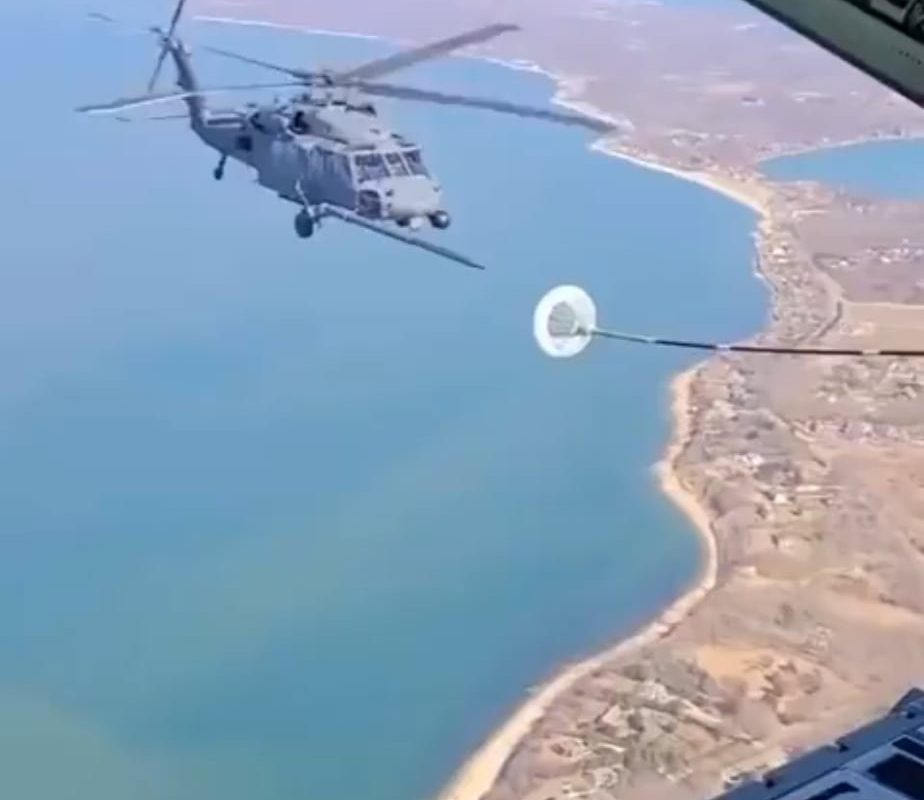
This is how helicopters refuel in midair.
Title: This Is How Helicopters Refuel in Midair: A High-Stakes Aerial Ballet
Introduction
While midair refueling is often associated with fighter jets and cargo planes, helicopters also perform this gravity-defying feat—though the process requires precision, skill, and specialized technology. Midair refueling extends a helicopter’s operational range, enables rescue missions in remote areas, and supports military operations without landing. In this article, we unveil the science and skill behind helicopter aerial refueling, exploring the methods, challenges, and real-world applications of this high-risk maneuver.
How Midair Refueling Works for Helicopters
Unlike fixed-wing aircraft, helicopters face unique challenges during refueling due to their slower speeds, rotor wash turbulence, and instability in midair. The most common method is the probe-and-drogue system, adapted for rotary-wing aircraft. Here’s how it works:
-
The Tanker Aircraft:
A tanker (like the KC-130 Hercules) flies at a steady speed, trailing a drogue, a funnel-shaped basket stabilized by parachute-like fabric. This drogue acts as a receiver for the helicopter’s fuel probe. -
The Helicopter’s Role:
The helicopter (e.g., the MH-47 Chinook or MH-60 Black Hawk) approaches the tanker from behind, aligning its retractable probe (a rigid metal tube) with the drogue. The pilot must maintain exact altitude, speed, and position—often just 20–50 feet from the tanker! -
Connection & Fuel Transfer:
Once the probe locks into the drogue, a secure seal forms, and fuel flows via pressurized hoses. Helicopters typically receive fuel at 300–600 gallons per minute. The entire process requires flawless coordination, with communication between pilots a critical factor.
Key Equipment Enabling the Feat
- Aerial Refueling Probes: Mounted on the helicopter’s nose or fuselage, these extendable probes latch onto drogues.
- Drogue Stabilization Systems: Modern drogues use gyros or motors to reduce oscillation, aiding precision.
- Hovering Refueling Systems (HOST): For helicopters that hover near ships or ground stations (like the V-22 Osprey), HOST employs a weighted hose lowered to the aircraft.
Why It’s So Difficult
Helicopter aerial refueling is an elite skill, mastered by only a handful of military units worldwide. Key hurdles include:
- Rotor Downwash: Turbulence from rotors destabilizes both aircraft.
- Speed Mismatch: Helicopters fly slower than tankers, requiring the tanker to operate at near-stall speeds (~120 knots).
- Human Precision: Pilots must maintain position for minutes at a time despite wind gusts and fatigue.
Real-World Applications
-
Military Operations:
- The U.S. Army’s 160th Special Operations Aviation Regiment (SOAR) uses midair refueling to conduct covert, long-range missions.
- NATO forces refuel helicopters like the NH90 to patrol vast maritime zones.
-
Search and Rescue:
Agencies like the U.S. Coast Guard extend the range of helicopters like the MH-60T Jayhawk to reach disaster zones or rescue sailors offshore. -
Firefighting:
Heavy-lift helicopters such as the CH-47 Chinook can refuel midair to combat wildfires without returning to base.
Training: Where Seconds Count
Military pilots undergo simulator sessions and hundreds of training hours to master aerial refueling. For example, U.S. Navy pilots practice “dry plugs” (connecting without fuel) before attempting live transfers. Mistakes can lead to collisions or fuel spills—rare but catastrophic risks.
Safety & Future Innovations
- Automated Systems: Future tech may use AI-assisted positioning to reduce pilot workload.
- Unmanned Refueling: Drones like Boeing’s MQ-25 could refuel helicopters in high-threat environments.
- Lightweight Probes: Advanced composites are making probes lighter and more aerodynamic.
Conclusion
Midair refueling transforms helicopters into long-endurance workhorses, enabling missions once thought impossible. While the process demands near-superhuman skill from pilots and crews, advances in technology promise to make it safer and more accessible. Whether rescuing lives at sea or supporting special forces behind enemy lines, this high-flying ballet remains one of aviation’s most awe-inspiring spectacles.
SEO Keywords: helicopter midair refueling, how helicopters refuel in air, aerial refueling process, probe-and-drogue system, military helicopter refueling, in-flight refueling, helicopter fuel transfer.
Meta Description: Discover how helicopters refuel midair using probe-and-drogue systems. Learn about the technology, challenges, and real-world uses of this elite aviation skill.