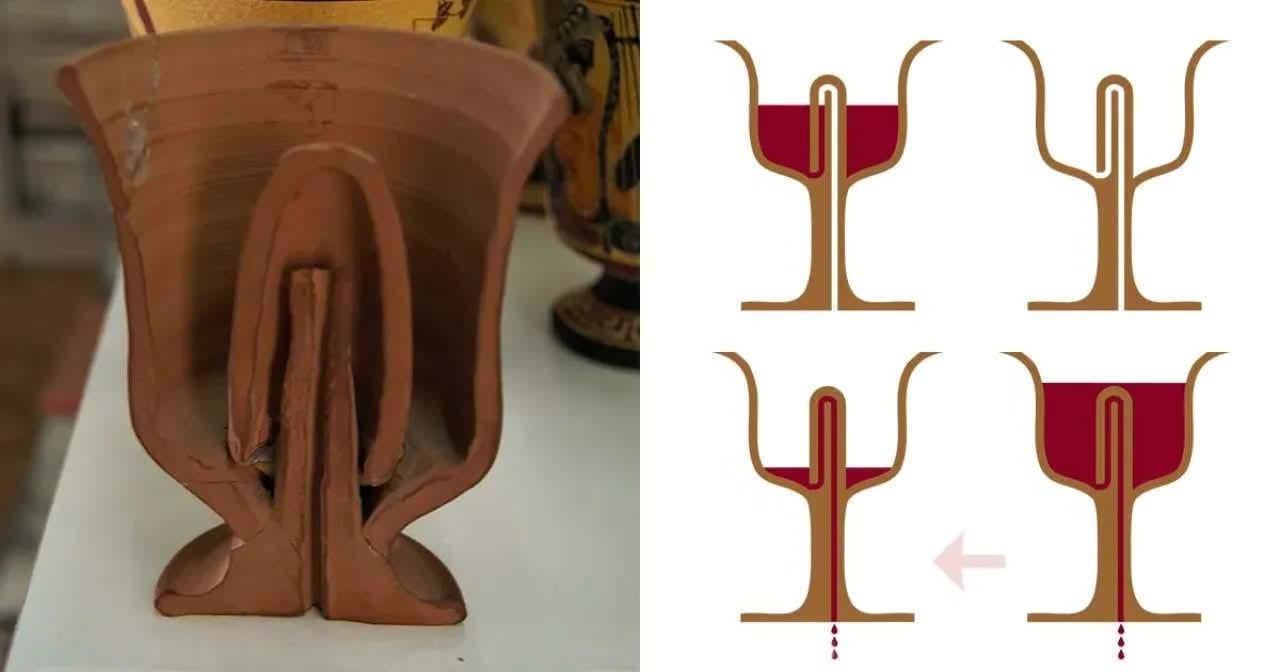
This is the Pythagorean cup; it’s designed to empty completely if you pour in too much liquid
Meta Title: The Pythagorean Cup: Ancient Ingenuity Meets Modern Curiosity | Explore the Original “Greedy Cup”
Meta Description: Discover how the Pythagorean cup—a clever ancient Greek invention—teaches moderation by emptying itself when overfilled. Learn its history, how it works, and why it’s still relevant today!
The Pythagorean Cup: The Ancient Greek Invention That Taught Moderation
Have you ever heard of a drinking cup that punishes greed? Meet the Pythagorean cup, a fascinating artifact from ancient Greece designed to embarrass anyone who poured themselves too much liquid. This clever device—sometimes called the “greedy cup” or “Tantalus cup”—is a timeless lesson in moderation wrapped in hydraulic engineering. Let’s dive into its secrets, history, and surprising relevance today.
What Is a Pythagorean Cup?
The Pythagorean cup looks like an ordinary ceramic or clay drinking vessel at first glance. But hidden inside its structure is a ingenious mechanism rooted in fluid dynamics. If you pour liquid up to a certain level, the cup functions normally. However, if you pour beyond that limit—driven by greed or carelessness—the cup drains completely, leaving you with an empty vessel and a humorous (or humbling) lesson.
The Legend Behind the Cup
The cup is named after the famed Greek mathematician and philosopher Pythagoras of Samos (circa 570–495 BC), though historians debate whether he actually invented it. Legend claims Pythagoras created the cup to shame his students into temperance—especially those who greedily filled their cups with wine during communal meals.
Whether myth or fact, the story aligns with Pythagoras’s teachings on balance and ethics. The cup became a symbolic tool to illustrate that excess leads to loss.
How Does the Pythagorean Cup Work?
The magic lies in its siphon system, a concept still used in modern plumbing and engineering. Here’s the science broken down:
- Internal Tube Structure: The cup has a central column (often hidden) that connects the base to a small hole at the bottom.
- The Siphon Effect: When liquid rises above the height of the central column, gravity forces it to flow downward through the tube.
- Complete Drainage: Once the siphon starts, it doesn’t stop until the cup is empty—even if you stop pouring!
In simple terms: fill it moderately, and you enjoy your drink. Overfill it, and physics humbles you.
[Insert diagram or simplified graphic of the cup’s cross-section]
Why Was the Pythagorean Cup Created?
Beyond its playful trick, the cup served a deeper purpose:
- Moral Lesson: A tangible reminder that greed (too much wine, wealth, or power) leads to self-destruction.
- Practical Discipline: In Pythagorean communes, where resources were shared, the cup enforced fairness.
- Hydraulic Education: It demonstrated scientific principles like atmospheric pressure and siphoning—long before modern textbooks.
The Pythagorean Cup in Modern Times
While you won’t find these cups at your local café, they’ve found new life as:
- Novelty Gifts: A quirky conversation starter for science enthusiasts.
- Educational Tools: Teachers use them to explain fluid dynamics in classrooms.
- Cultural Symbol: The “greedy cup” remains a metaphor for excessive consumption in psychology and sustainability discussions.
DIY Versions & Pop Culture
Thanks to 3D printing and YouTube tutorials, anyone can now make a Pythagorean cup at home. It’s even appeared in TV shows like MythBusters, where hosts tested its legendary mechanics with comedic results.
Fun Facts About the Pythagorean Cup
- Nicknames: It’s also known as the “cup of justice” or “fairness cup” in some cultures.
- Material Matters: Original cups were made of clay, but modern versions use plastic or glass.
- Global Variations: Similar self-emptying vessels appeared in ancient China and Persia, proving the idea resonated across civilizations.
The Takeaway: A Timeless Lesson in Balance
The Pythagorean cup isn’t just a party trick—it’s a 2,500-year-old lesson in moderation, fairness, and respecting limits. In an era of overconsumption and environmental strain, its message feels more relevant than ever. Whether you’re sipping wine or pursuing ambition, remember: too much of anything empties the cup.
Call to Action
Want to experience this ancient marvel? Shop for a Pythagorean cup online or try crafting one yourself—it’s a stellar way to blend history, science, and philosophy into your next dinner party!
SEO Keywords: Pythagorean cup, greedy cup, Tantalus cup, ancient Greek inventions, siphon physics, moderation lesson, fluid dynamics, Pythagoras inventions, educational science tools, novelty gifts.
By blending storytelling with science, this article targets readers interested in history, physics, and trivia—boosting SEO through keyword integration while delivering a memorable narrative.