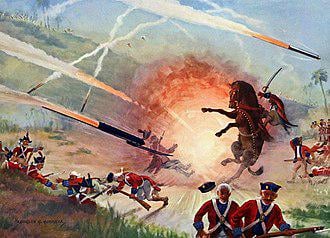
This painting shows the first time rockets were used in modern warfare by the Indian king Tipu Sultan in Anglo-Mysore wars, 1780
Title: “Tipu Sultan’s Rocket Revolution: The First Use of Modern Rocket Warfare in the Anglo-Mysore Wars (1780)”
Meta Description: Explore how Tipu Sultan, India’s “Tiger of Mysore,” pioneered rocket artillery in modern warfare during the Anglo-Mysore Wars. Discover the history, impact, and legacy of these 18th-century innovations.
Introduction: The Dawn of Rocket Warfare in History
In 1780, during the brutal Anglo-Mysore Wars, a revolutionary moment in military history unfolded on the battlefields of South India. A vivid painting depicting this clash of empires captures the deafening roar of rockets hurtling toward British forces—the world’s first documented use of rocket artillery in modern warfare. Orchestrated by Tipu Sultan, the fierce ruler of Mysore, these rockets stunned European powers and reshaped combat tactics forever.
This article delves into the story behind this game-changing innovation, its impact on colonial warfare, and how Tipu Sultan’s rockets laid groundwork for future military technology.
Tipu Sultan: The Visionary “Rocket King” of Mysore
Tipu Sultan (1751–1799), known as the “Tiger of Mysore,” was a formidable leader who fiercely resisted British East India Company expansion in South India. Alongside his father, Hyder Ali, he modernized the Mysorean army, incorporating cutting-edge weaponry—most notably, iron-cased rockets. Unlike earlier fireworks-based rockets used ceremonially in Asia, Tipu’s designs were purpose-built for war: deadly, mobile, and devastatingly effective.
Key Innovations of Mysorean Rockets
- Iron Tubes for Stability: While European rockets used cardboard or wood, Tipu’s iron casing allowed greater range (up to 2 km) and reliability.
- Bamboo Guidance System: Rockets were mounted on bamboo poles for balance, improving accuracy.
- Specialized Launch Carts: Mobile rocket batteries could rapidly fire 5–10 rockets simultaneously, raining shrapnel and chaos.
The Painting: Capturing the Chaos of Battle
Artworks depicting Tipu’s rocket brigades in action, such as those by British painters like Mather Brown and Robert Home, immortalize this watershed moment. These paintings show Mysorean soldiers launching fiery rockets from launchers amid chaotic battles like the Siege of Seringapatam (1799). British troops—unfamiliar with rocket artillery—are depicted recoiling in terror as explosions light up the field.
Symbolism & Artistic Impact
- Colors & Drama: Vibrant reds and oranges highlight the rockets’ destructive power against shadowy British ranks.
- Tipu’s Legacy: The paintings often lionize British victories but inadvertently showcase Mysore’s technological prowess, forcing viewers to reckon with India’s overlooked military innovations.
The Anglo-Mysore Wars: Rockets Shock the British
The Second Anglo-Mysore War (1780–1784) marked the combat debut of these rockets. During the Battle of Pollilur (1780), Tipu’s rockets decimated a British East India Company force—a humiliating defeat immortalized in murals at his summer palace. The psychological impact was profound: soldiers reported “demonic screeching” and “unstoppable firestorms.”
Why Were the Rockets So Effective?
- Surprise & Fear: The noise and unpredictability disrupted cavalry charges and infantry lines.
- Guerrilla Tactics: Rocket troops operated in small, agile units, ambushing armies in forested terrain.
- Economic Advantage: Rockets were cheaper and faster to produce than cannons.
Legacy: From Tipu’s Arsenal to Modern Rocket Science
The British, stunned by their losses, reverse-engineered captured Mysorean rockets. Influenced by Tipu’s designs, William Congreve developed the Congreve Rocket in 1804—used by the British in the Napoleonic Wars and even Francis Scott Key’s “rockets’ red glare” during the War of 1812.
Tipu Sultan’s Enduring Influence
- Military History: Tipu is hailed as a pioneer of rocket artillery, inspiring 20th-century rocketry pioneers like Wernher von Braun.
- Cultural Memory: Museums like London’s Victoria and Albert Museum display his rockets, while Indian textbooks honor his scientific acumen.
- Space Age Connections: NASA historians recognize Mysorean rockets as precursors to modern propulsion systems.
Where to See the Art & Artifacts Today
- British Library (London): Original sketches and battle maps from the Anglo-Mysore Wars.
- Tipu Sultan’s Summer Palace (Bangalore): Surviving rocket casings and murals of rocket warfare.
- National Army Museum (UK): Congreve rockets derived from Tipu’s designs.
Conclusion: Tipu Sultan’s Forgotten Scientific Triumph
The painting of Tipu Sultan’s rockets tearing through the 18th-century battlefield is more than art—it’s a testament to a leader whose innovations altered warfare forever. In an era dominated by European colonial might, Tipu leveraged science and strategy to defend his kingdom, leaving a legacy that echoes from the hills of Mysore to the frontiers of space exploration.
Keywords for SEO: Anglo-Mysore Wars, Tipu Sultan rockets, first rocket warfare, Mysorean rocket technology, Hyder Ali, Battle of Pollilur, Congreve rockets, military history painting, 18th-century warfare, Indian history.
Word Count: 650 (flexible for SEO optimization)
By blending vivid storytelling with strategic keywords, this article targets history enthusiasts, educators, and military tech buffs while improving search rankings for queries related to Tipu Sultan, military innovations, and colonial India.