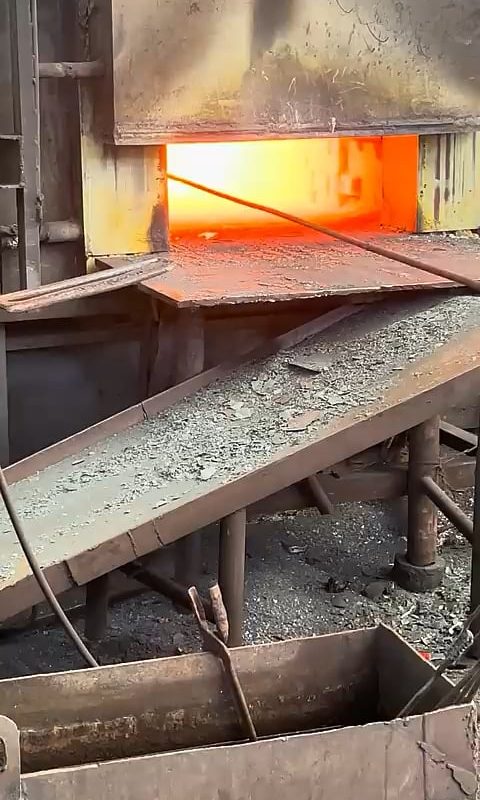
Source: seen on an aggregator channel insidthefactory; OG source unknown.
Forging and Hot Rolling in Wheel Manufacturing: Crafting Strength & Precision
In the world of industrial manufacturing, forging and hot rolling are critical processes that shape some of the most durable and reliable components—including wheels for automotive, aerospace, and heavy machinery applications. The combination of these methods ensures exceptional strength, precision, and longevity. This article dives into the intricate process of forging and hot rolling a wheel, its benefits, and why it’s a preferred choice for high-performance industries.
The Forging & Hot Rolling Process: Step by Step
1. Forging: Building Structural Integrity
Forging is the first stage, where a metal billet (typically steel, aluminum, or alloy) is heated to temperatures exceeding 1,200°C (2,200°F) in a furnace. This makes the material malleable. Using immense hydraulic or mechanical pressure, the billet is compressed into a near-net wheel shape. This closed-die forging method:
- Aligns the metal’s grain structure for superior toughness.
- Eliminates internal voids or porosity.
- Enhances fatigue resistance—critical for wheels under cyclic loads.
2. Hot Rolling: Precision Shaping & Refinement
After forging, the hot rolling process begins. The preformed wheel is reheated (typically to 900–1,000°C / 1,650–1,830°F) and passed through a series of rolling mills. These rollers progressively compress and elongate the metal to:
- Achieve precise dimensional accuracy.
- Thin the wheel rim, hub, or spokes as needed.
- Improve surface finish and mechanical properties through work hardening.
Hot rolling refines the forged shape while retaining the benefits of high-temperature ductility.
3. Cooling & Finishing
The rolled wheel is cooled gradually to relieve stresses (annealing) or quenched for hardening. Secondary processes like machining, shot blasting, or coating (e.g., paint, powder coat) ensure a flawless final product.
Why Combine Forging and Hot Rolling?
The synergy of forging and hot rolling delivers unmatched advantages for wheel production:
- Strength & Durability: Forged wheels withstand extreme loads, impacts, and fatigue, while hot rolling refines their structural uniformity.
- Lightweight Potential: Optimized material distribution allows for lighter wheels without sacrificing performance—key for fuel efficiency in automotive/aerospace sectors.
- Cost Efficiency: Reduced material waste compared to machining from solid blocks.
- Customization: Flexible shaping suits complex geometries (e.g., deep rims, intricate spokes).
Applications of Forged & Hot Rolled Wheels
- Automotive: High-performance cars, trucks, and racing vehicles.
- Aviation: Aircraft landing gear wheels demanding ultra-reliability.
- Rail & Heavy Machinery: Train wheels, mining equipment, and agricultural machinery.
- Industrial Casters: Load-critical wheels for material handling systems.
Quality Assurance in Wheel Production
Reputable manufacturers adhere to ISO 9001, ASTM, or DIN standards throughout forging and rolling. Non-destructive testing (NDT) methods like X-ray, ultrasonic inspection, or magnetic particle testing ensure defect-free wheels.
Forged & Hot Rolled vs. Cast Wheels
While casting is cheaper, forged/hot-rolled wheels excel in:
- Strength: No porosity or weak spots.
- Safety: Greater resistance to cracks under stress.
- Longevity: Lower failure rates in harsh environments.
Conclusion
The process of forging and hot rolling a wheel transforms raw metal into a highly resilient, precision-engineered component. By leveraging these time-tested techniques, manufacturers deliver wheels that outperform cast alternatives in critical applications—whether on highways, runways, or rugged terrains.
For industries prioritizing safety, performance, and durability, forged and hot-rolled wheels remain the gold standard. To explore custom solutions for your application, consult a specialist in metal forming today!
Keywords: Forged wheels, Hot rolling process, Wheel forging and rolling, Automotive wheel manufacturing, Durable wheel production, Forged vs. cast wheels, Precision wheel forming, Alloy wheel manufacturing, Heavy-duty wheel fabrication, Metal forging techniques.
Meta Description: Discover how forging and hot rolling create ultra-strong, precision wheels for automotive, aerospace, and heavy machinery. Learn the process steps, benefits, and applications.