Wet towel in space
Title: What Happens If You Wring Out a Wet Towel in Space? The Surprising Science Explained
Meta Description: Discover the weird and wonderful physics behind wringing a wet towel in space—how microgravity changes water behavior and why astronauts perform this bizarre experiment.
Introduction: Everyday Tasks Turn Extraterrestrial
Imagine performing a simple chore like wringing out a wet towel… but in zero gravity. In space, even mundane activities become extraordinary science experiments. From floating water droplets to self-contained bubbles, the laws of physics behave wildly differently beyond Earth’s atmosphere. In this article, we’ll unravel what happens when you squeeze a wet towel in space, why it fascinates scientists, and what it teaches us about surviving in microgravity.
The Physics of Water in Space: No Gravity, No Problem?
On Earth, gravity pulls fluids downward. When you wring out a towel, water drips straight into the sink. But in the microgravity environment of the International Space Station (ISS), there’s no “down.” Liquids rely on surface tension—the cohesive force holding molecules together—to form spheres, cling to surfaces, or create floating blobs.
Key Concepts at Play:
- Surface Tension Dominates: Without gravity, water molecules stick together tightly, forming bubbles or coating objects like a gel.
- Capillary Action: Water moves along surfaces (like cloth fibers) due to adhesion, not gravity.
- Containment Challenges: Fluids float freely, posing risks to equipment and astronauts if unmanaged.
Wringing a Wet Towel in Space: What Actually Happens?
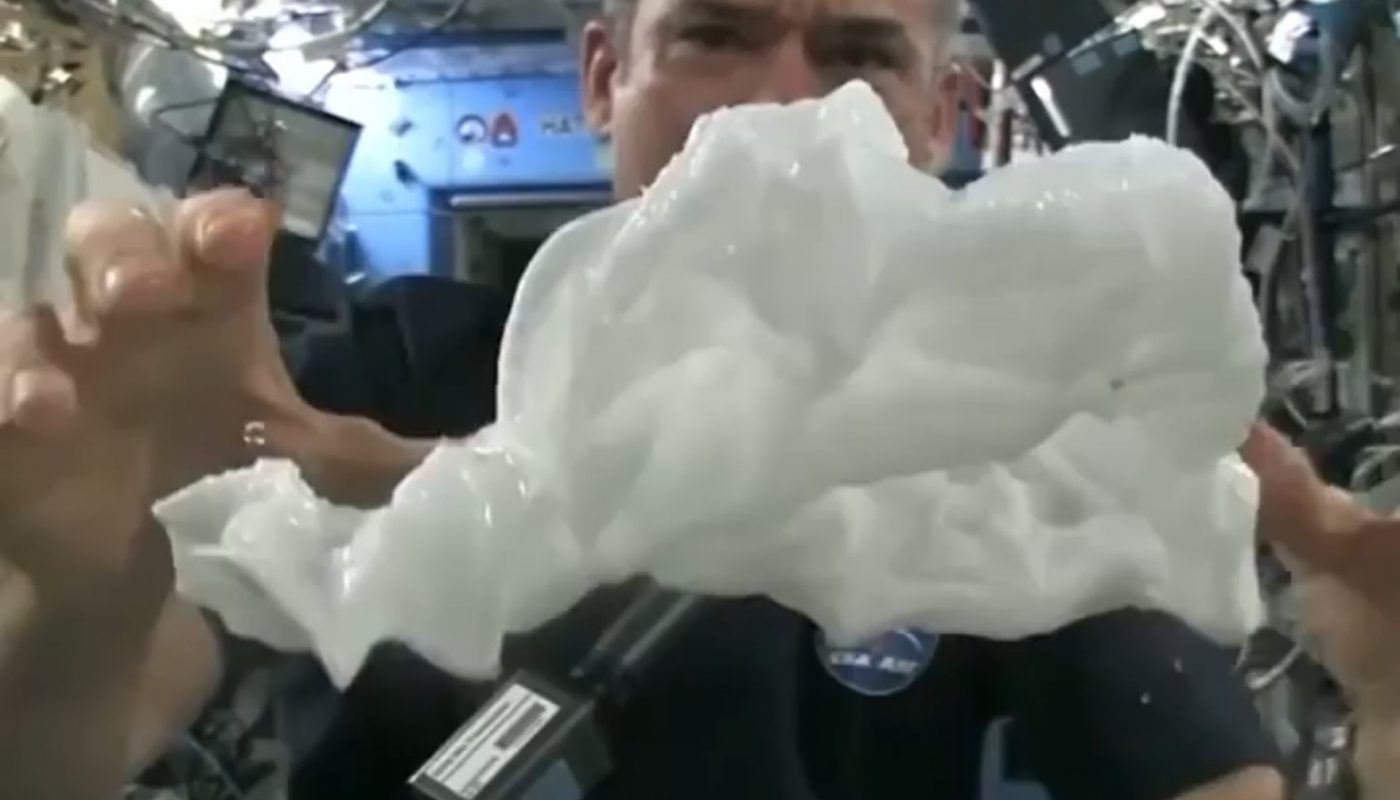
In 2013, Canadian astronaut Chris Hadfield performed a viral experiment aboard the ISS. With a soaked towel in hand, he squeezed it—and instead of dripping, the water coated the towel and his hands, forming a shimmering tube around the fabric. Slowly, the water layer crept up his arms, driven by surface tension. Eventually, he released a floating water bubble, which he contained using airflow to avoid damaging electronics.
Why Does This Happen?
- No Gravity, No Drips: Water can’t “fall,” so it clings to the towel and spreads.
- Surface Tension Creates Structures: The water forms a cylindrical sleeve around the fabric.
- Airflow Is Critical: Astronauts use ventilation systems to direct floating liquids into collection filters.
Why This Experiment Matters for Space Exploration
Understanding fluid dynamics in space isn’t just a quirky demo—it’s vital for:
- Life Support Systems: Managing water recycling and humidity aboard spacecraft.
- Spacesuit Design: Preventing leakage during repairs or lunar walks.
- Future Missions: How will astronauts wash clothes or clean surfaces on Mars?
Real Astronaut Insights: Daily Life with Floating Fluids
Astronauts train rigorously to handle liquids in space:
- Drinking: Using straws from sealed pouches.
- Hygiene: “Showering” involves rinsing with water-filled bags and no-rinse shampoo.
Jemison, the first African American woman in space, described brushing her teeth as a balancing act: “You swallow the toothpaste or chase the glob!”
Space vs. Earth: How Fluids Behave Differently
| Scenario | On Earth | In Space |
|---|---|---|
| Wringing a towel | Water drips downward. | Water coats surfaces, floats as blobs. |
| Pouring a drink | Liquid flows into a cup. | Liquid clumps into spheres mid-air. |
| Sweating or crying | Fluids fall or evaporate. | Tears form bubbles on eyes. |
FAQs About Water in Space
Q: Can astronauts wash clothes in space?
A: No—laundry machines don’t work in zero-g. Astronauts wear clothes for days, then dispose of them.
Q: Does water freeze or boil instantly in space?
A: In a vacuum, water boils rapidly due to low pressure, then freezes into ice crystals.
Q: How do we simulate space fluid dynamics on Earth?
A: Scientists use drop towers, parabolic flights, or the ISS’s controlled microgravity labs.
Conclusion: The Universe in a Water Bubble
Wringing a towel in space isn’t just a fun experiment—it’s a window into the invisible forces governing our universe. From futuristic life support to the art of brushing teeth in zero-g, the interplay of water and microgravity reshapes how we live, explore, and innovate. Next time you squeeze out a sponge, imagine the cosmic ballet of droplets floating hundreds of miles above Earth.
Target Keywords: Wet towel in space, space experiments, microgravity, water in space, astronaut daily life, Chris Hadfield, surface tension in space.
Optimized for: Space enthusiasts, physics students, educators, science communicators.
Boost your space curiosity! Share this article and tag someone who loves galaxy-sized science. 🌌🧑🚀