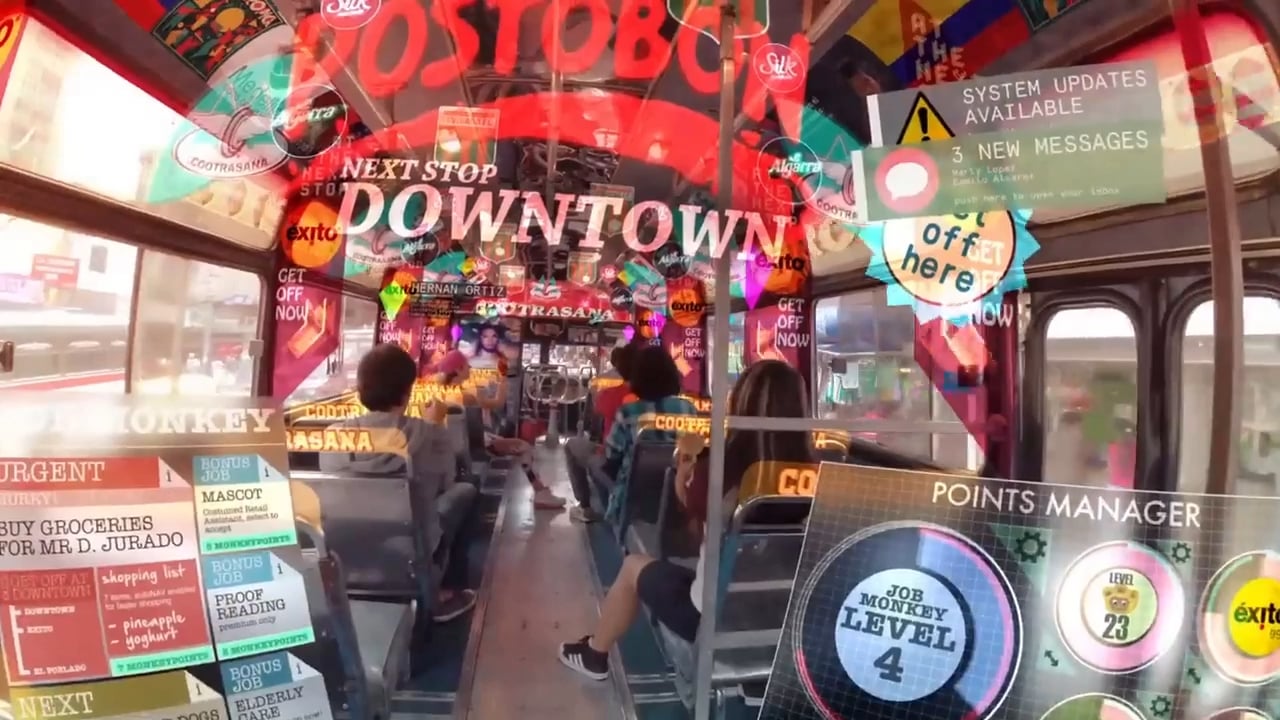
What an Augmented Reality dystopia might actually look like. (HYPER-REALITY by
Keiichi Matsuda)
Title: An Augmented Reality Dystopia Unveiled: Dissecting Keiichi Matsuda’s HYPER-REALITY Nightmare
Meta Description: What happens when augmented reality devours reality? Explore Keiichi Matsuda’s “HYPER-REALITY” vision—a chaotic, ad-soaked dystopia where digital overload rewires humanity.
Introduction: When AR Stops Being “Augmented”
Imagine walking through a city where billboards scream your name, virtual loot boxes float beside trash cans, and your identity is a flickering avatar battling for attention. This isn’t science fiction—it’s Keiichi Matsuda’s HYPER-REALITY, a provocative short film that envisions an augmented reality (AR) dystopia so immersive, it consumes reality itself. As tech giants push AR glasses and metaverse platforms, Matsuda’s 2016 project feels less like fantasy and more like a feverish cautionary tale. Here’s what a hyper-digitized future actually looks like—and why we should fear it.
HYPER-REALITY Unveiled: Chaos as a Design Principle
Japanese designer and filmmaker Keiichi Matsuda crafted HYPER-REALITY as a sensory onslaught. Set in Medellín, Colombia, the film drowns viewers in a world where physical and digital layers collide violently. The protagonist, Juliana, navigates a supermarket under cyberattack, dodges AR advertisements for Jesus, and battles virtual foes—all while her reality fractures into pixelated debris.
Matsuda’s intent? To critique the “techno-utopian” narratives peddled by Silicon Valley. In interviews, he warns of a future where AR isn’t a tool but a totalizing environment: “We’re entering an era where interface design is as important as urban planning.”
Dystopia Layer by Layer: The Nightmare Scaffolding
1. The Physical-Digital Merge: Ads That Hunt You
In HYPER-REALITY, the city is a weaponized attention economy. Ads don’t just pop up—they stalk. One scene shows Juliana bombarded by promotions for pineapple juice simply because she glanced at a fruit stand. This isn’t passive advertising; it’s behavioral warfare, where algorithms mine biometric data (pupil dilation, heartbeat) to trigger hyper-targeted content.
Real-World Parallel: Projects like Google’s AR ads in Search already let users “place” 3D products in their living rooms. HYPER-REALITY amplifies this into a landscape where refusing engagement isn’t an option.
2. Data as Bloodsport: Gamification Gone Feral
Matsuda’s world runs on “Uber-for-X” logic: every action—walking, breathing, blinking—earns points, coupons, or penalties. Protagonist Juliana fights virtual thieves to protect her “reward points,” blurring survival and subscription models. When she “levels up,” her avatar gilds itself in capitalist divinity.
Here, gamification isn’t playful—it’s coercive. Life becomes a never-ending side quest, where corporations weaponize dopamine hits to enslave users.
3. Algorithmic Castes: The Digitally Dispossessed
Not everyone thrives in HYPER-REALITY. Juliana’s low-income neighborhood is a “digital desert,” starved of bandwidth and overrun by glitching ads for payday loans. Contrast this with the sleek, tech-saturated downtown where elites manipulate AR layers like feudal lords.
The dystopia isn’t just chaotic—it’s engineered for inequality. As Matsuda told Dezeen: “The danger is that technology will exacerbate segregation instead of democratizing access.”
The Human Cost: Identity, Solitude, and the Death of Nuance
A. Avatars Replace Souls
In HYPER-REALITY, Juliana’s “identity” is a fragmented collage of avatars—Catholic saint, gamer girl, corporate mascot. She swaps masks like outfits, desperate to fit algorithmic templates. Matsuda mirrors a terrifying reality: when AR personalization runs unchecked, authenticity becomes obsolete.
B. Isolation in a “Connected” World
Juliana is constantly “connected”—to brands, to bots, to viral trends—but utterly alone. Human interactions are transactional. Even her therapist is an AI hologram urging her to “buy calm.” This bleak irony underpins Matsuda’s thesis: absolute connectivity breeds absolute loneliness.
C. The Erosion of Reality
The film’s climax shows reality itself glitching. Walls dissolve into static, the ground liquefies, and Juliana’s mind fractures beneath digital noise. At its core, HYPER-REALITY argues that when the virtual layer overpowers the physical, we lose the capacity to experience life unmediated.
Beyond Dystopia: Can We Avoid This Future?
Matsuda insists HYPER-REALITY isn’t a prophecy—it’s a provocation. To sidestep this timeline, he advocates for:
- Ethical Interface Design: AR that empowers, not addicts.
- Data Autonomy: Laws barring biometric surveillance.
- Analog Sanctuaries: Cities mandating tech-free zones.
Tech critics like Douglas Rushkoff echo this: “We must design for human agency, not corporate capture.”
Conclusion: The AR Tightrope
HYPER-REALITY forces a brutal question: Do we control technology, or does it control us? As Apple Vision Pro and Meta’s AR glasses blur digital and physical worlds, Matsuda’s dystopia feels unnervingly plausible. Yet the film’s chaos isn’t inevitable—it’s a warning. By demanding transparency, rejecting exploitative design, and cherishing unmediated human moments, we can build AR that augments life instead of devouring it.
The future remains unwritten. But if we ignore Matsuda’s screaming neon omen, we risk living inside it.
Keywords for SEO: Augmented reality dystopia, HYPER-REALITY Keiichi Matsuda, AR future risks, digital overload, privacy erosion, technology inequality, AR advertising ethics, digital addiction, techno-capitalism, virtual-physical merge.