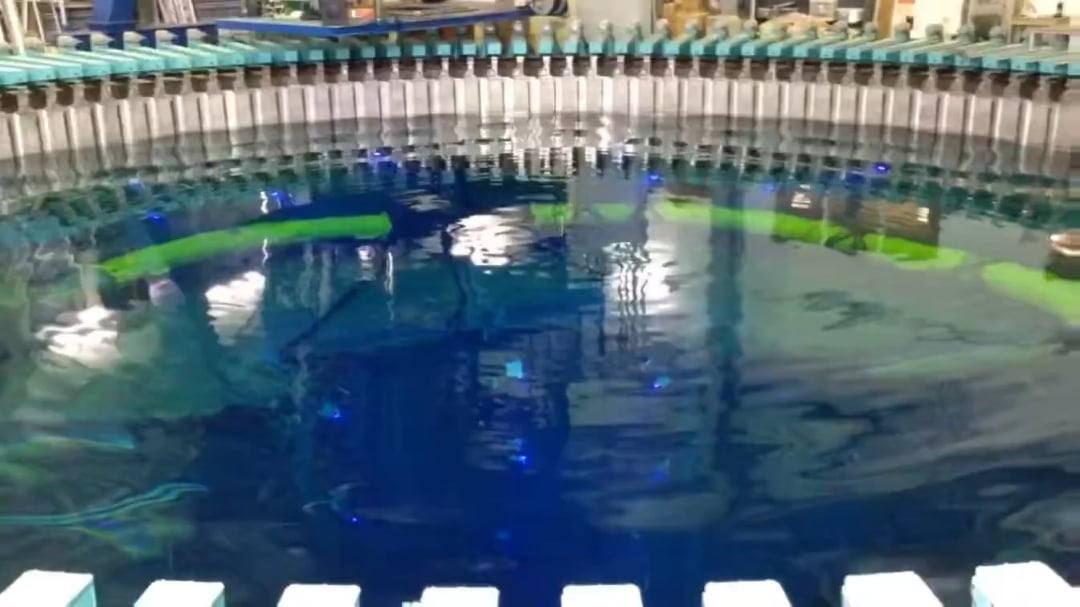
When a shallow pool is vibrated just right, the surface blossoms into mesmerizing Faraday waves
Title: Mesmerizing Faraday Waves: When Vibration Turns Liquid into Art
Meta Description: Discover the captivating science behind Faraday waves — the intricate patterns that emerge when a shallow pool of liquid is vibrated just right. Learn how they form, why they matter, and where to see them.
Introduction
Imagine dipping your finger into a shallow puddle and watching ripples spread outward. Now picture that same liquid suddenly erupting into intricate geometric patterns—hexagons, stripes, or even star-like shapes—as if the water itself is dancing. This breathtaking phenomenon, known as Faraday waves, occurs when a liquid is vibrated at just the right frequency and amplitude. Named after the pioneering 19th-century scientist Michael Faraday, these waves transform ordinary pools of fluid into hypnotic living art. In this article, we’ll dive into the science behind Faraday waves, explore how they form, and uncover their surprising real-world significance.
What Are Faraday Waves?
Faraday waves are surface patterns that emerge when a liquid is subjected to vertical vibrations. Unlike ordinary gravity waves (like those in a pond), Faraday waves arise from a parametric instability—a delicate balance between the liquid’s inertia, surface tension, and the external forcing from vibrations. When the vibration frequency matches the liquid’s natural oscillatory modes, the flat surface destabilizes, creating stable, standing wave patterns.
Key characteristics of Faraday waves include:
- Symmetry: Patterns often form grids of hexagons, squares, or stripes.
- Standing Waves: Unlike traveling waves, Faraday waves oscillate in place.
- Threshold Dependency: They only appear above specific vibration amplitudes and frequencies.
The Science Behind the Magic: How Do Faraday Waves Form?
The formation of Faraday waves hinges on a fascinating interplay of physics:
- Vibration Input: A container of shallow liquid (water, oil, or even non-Newtonian fluids) is placed on a vibrating platform. The vertical oscillations transfer energy to the liquid.
- Instability Threshold: At low vibrations, the surface remains flat. But past a critical amplitude, gravity and surface tension can no longer stabilize the liquid. Tiny perturbations grow exponentially.
- Pattern Selection: The liquid “chooses” a pattern based on the vibration frequency and fluid properties. For example, higher frequencies favor smaller wavelengths (denser grids), while lower frequencies create larger cells.
- Nonlinear Effects: Beyond the initial instability, complex interactions—like wave collisions and droplet ejection—can occur, leading to chaotic or fractal-like designs.
Michael Faraday first documented this phenomenon in 1831, noting that “the fluid puts on the appearance of a richly embossed surface.” Today, high-speed cameras and advanced modelling reveal even more intricate details.
Conditions to Create Faraday Waves
Not every shake creates art! To generate Faraday waves, you need precise conditions:
- Shallow Liquid Depth: Deep pools suppress pattern formation.
- Optimal Frequency: Typically 10–200 Hz, depending on the fluid (e.g., water vibrates best around 20–60 Hz).
- Adequate Amplitude: Vibrations must be strong enough to overcome damping forces like viscosity.
- Uniform Vibration: The container must move vertically without tilt or horizontal shaking.
DIY enthusiasts can recreate this with a subwoofer, a shallow tray of water, and a frequency generator. Add food coloring or glitter for a dazzling display!
Parameters That Shape the Patterns
Faraday waves are impressively responsive to their environment:
- Frequency: Higher frequencies = smaller patterns (e.g., 50 Hz might make 5mm-wide hexagons in water).
- Amplitude: Increasing vibration strength leads to sharper, taller waves and can trigger transitions between patterns (e.g., hexagons → stripes).
- Fluid Properties: Thicker liquids (like oil) favor lower frequencies; surface tension-dominated fluids (e.g., water with soap) create finer patterns.
Researchers even use these waves to study universal pattern formation—similar principles govern sand dunes, animal coat markings, and galaxy spirals!
Why Faraday Waves Matter Beyond Beauty
These mesmerizing waves aren’t just eye candy—they’re tools for scientific and industrial innovation:
- Fluid Dynamics Research: Helps model ocean waves, cloud formation, and plasma turbulence.
- Materials Science: Guides the design of textured coatings or microfluidic devices.
- Astrophysics Analogs: Simulate star-forming gas clouds in controlled lab settings.
- Droplet Ejection Studies: Faraday waves can spray microdroplets—useful for inkjet printing or drug delivery systems.
Conclusion: Where Art Meets Physics
Faraday waves are a stunning reminder that science hides beauty in the most unexpected places. Whether you’re a physicist probing chaos theory or a hobbyist experimenting with speakers and water, these patterns bridge curiosity and discovery. Next time you stir a drink or watch rain hit a puddle, remember: with the perfect vibration, liquid transforms into a canvas, painting nature’s hidden mathematics before your eyes.
FAQ About Faraday Waves
Q: Can I see Faraday waves at home?
A: Yes! Use a speaker covered with a waterproof membrane, add water, and play sine wave tones (20–60 Hz).
Q: Why do Faraday waves form hexagons?
A: Hexagons are energy-efficient—they pack tightly while balancing surface tension and inertia.
Q: Are Faraday waves dangerous?
A: Not at all! They’re safe to recreate, though vibrating platforms should be secured.
Q: Do Faraday waves occur in nature?
A: Rarely—most natural vibrations (e.g., earthquakes) aren’t steady enough. But they’ve inspired models for earthquake liquefaction.
Target Keywords: Faraday waves, vibrating liquid patterns, parametric instability, standing waves, fluid dynamics experiments, wave pattern formation, DIY science projects.
Optimize your content further by embedding high-quality videos of Faraday waves and linking to research papers or DIY tutorials!