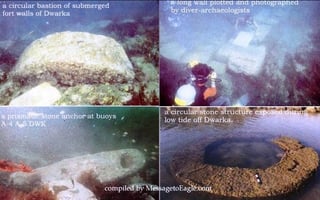
Dwarka the sunken city rediscovered dated 9500 years old
Title: Dwarka: The Sunken City Rediscovered – A 9,500-Year-Old Marvel of Ancient India
Meta Description: Explore the rediscovery of Dwarka, the legendary sunken city of Lord Krishna, now dated to 9,500 years old. Uncover its mythological roots, archaeological evidence, and groundbreaking implications for ancient history.
Introduction
The city of Dwarka, long shrouded in myth and revered in Hindu scriptures, has captivated historians and archaeologists for centuries. Recent discoveries, however, have transformed legend into reality: Dwarka is not just a story but a real, submerged city dating back an astonishing 9,500 years. This revelation challenges conventional timelines of ancient civilizations and offers tangible proof of India’s deep-rooted cultural heritage.
The Mythological Roots of Dwarka
According to Hindu texts like the Mahabharata, Vishnu Purana, and Harivamsa, Dwarka was a prosperous kingdom built by Lord Krishna himself. Described as a utopian city of gold, palaces, and advanced infrastructure, it was said to have submerged into the Arabian Sea after Krishna’s death, marking the end of the Dvapara Yuga (an epoch in Hindu cosmology).
For millennia, Dwarka was dismissed as a symbolic allegory—until marine archaeology revealed its physical remnants off the coast of modern-day Gujarat, India.
Rediscovery: Bridging Myth and Science
In the 1980s, marine archaeologists from India’s National Institute of Oceanography (NIO) began exploring the Gulf of Khambhat (Cambay) and the waters near Dwarka. Using sonar imaging, sub-bottom profiling, and underwater excavations, they uncovered:
- Massive stone structures resembling city walls, gates, and fortifications.
- Pillars, pottery shards, and sculptures dating to the Indus Valley era and earlier.
- Anchors and ancient harbor remnants, suggesting Dwarka was a bustling port city.
These findings aligned perfectly with descriptions in the Mahabharata, which details Dwarka’s construction and eventual submersion.
The Evidence: Dating Dwarka to 9,500 Years Ago
In 2002, carbon dating of organic material (wood and pottery) from the site revealed a shocking timeline: the artifacts were approximately 9,500 years old—predating the Indus Valley Civilization by millennia.
- Geological studies confirmed the city sank due to rising sea levels around 3000 BCE, likely linked to glacial melt after the last Ice Age.
- Marine sediment analysis further validated the city’s age, placing Dwarka firmly in the pre-Harappan period (circa 7500 BCE).
This makes Dwarka older than Mesopotamia, Egypt, and the Pyramids of Giza, rewriting the narrative of early human urbanization.
Why Dwarka Changes Ancient History
The discovery of Dwarka has seismic implications:
- Proof of Advanced Ancient Civilizations: Its urban planning, harbor, and artifacts suggest sophisticated pre-Harappan societies.
- Validation of Hindu Texts: The city’s existence corroborates oral and written traditions preserved for thousands of years.
- Climate Change Parallels: Dwarka’s submersion mirrors modern concerns about coastal cities facing rising seas—a timeless lesson.
The Atlantis of the East?
Like Atlantis, Dwarka’s submerged ruins ignite debates about ancient global civilizations. Some theorists link its demise to the Younger Dryas cataclysm (12,900–11,700 years ago), a period of abrupt climate shifts. Could Dwarka be part of a lost network of Ice Age cities? While research continues, its age alone makes it a keystone in understanding humanity’s forgotten past.
Unanswered Questions & Ongoing Research
Despite breakthroughs, mysteries linger:
- How did a city thrive 9,500 years ago, during a time historians once considered “primitive”?
- What caused its sudden inundation? Was it gradual climate change, or a catastrophic event?
Modern technologies like 3D mapping and AI-assisted archaeology aim to reconstruct Dwarka’s full layout and cultural significance.
Conclusion: Dwarka’s Legacy Resurfaces
The sunken city of Dwarka is no longer a myth—it’s a testament to humanity’s enduring ingenuity and a bridge between faith and science. As excavations continue, this 9,500-year-old marvel promises to unlock secrets of our ancient past while inspiring awe for India’s spiritual and historical heritage.
Explore Further: Visit the ancient coastal town of Dwarka in Gujarat to see its modern counterpart and the Dwarkadhish Temple, said to stand where Krishna’s kingdom once began.
Keywords: Dwarka sunken city, Lord Krishna city, 9500-year-old Dwarka, ancient Indian civilization, marine archaeology, lost city of Dwarka, Hindu mythology history
Meta Tags:
- Focus Keyphrase: Dwarka sunken city 9500 years old
- SEO Title: Dwarka: The 9,500-Year-Old Sunken City of Lord Krishna
- Slug: /dwarka-sunken-city-9500-years-old
Let history and wonder collide—share your thoughts on Dwarka’s rediscovery below! 🌊🔍