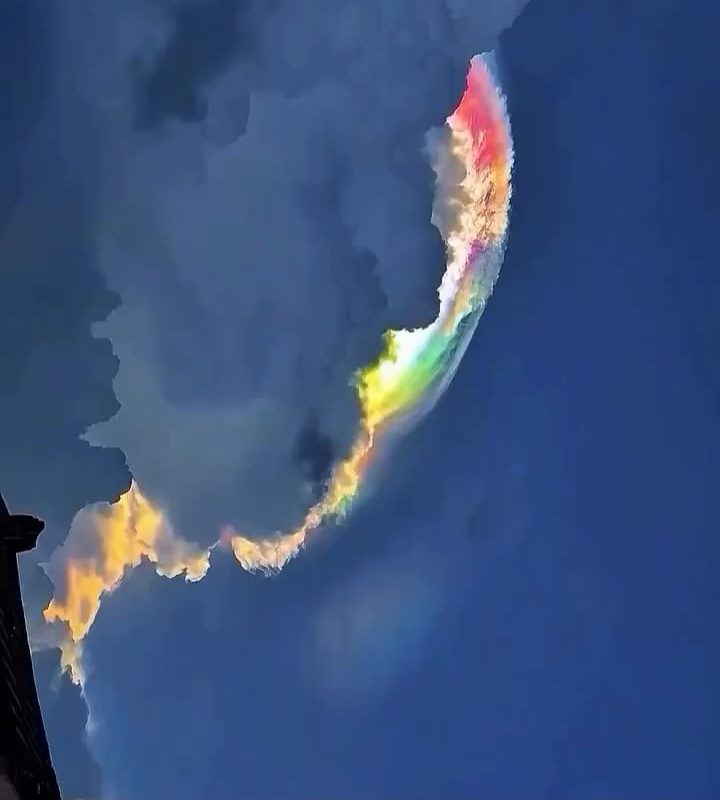
This is an example of an iridescent cloud. It’s created when light is scattered across tiny uniform droplets of water or ice pellets in the atmosphere
Title: Iridescent Clouds: Nature’s Shimmering Atmospheric Phenomenon Explained
Meta Description: Discover the science behind iridescent clouds, a dazzling optical phenomenon caused by light scattering in the atmosphere. Learn how, when, and where to see these rainbow-colored clouds.
What Are Iridescent Clouds?
Iridescent clouds are one of nature’s most mesmerizing displays, often resembling shimmering patches of mother-of-pearl or oil on water. These ethereal clouds glow with vibrant hues of pink, purple, green, and gold, creating a surreal spectacle in the sky. But what causes this phenomenon? Unlike rainbows—which form from raindrops—iridescence occurs when sunlight interacts with tiny, uniform water droplets or ice crystals in thin clouds.
The Science Behind the Magic
Iridescent clouds form due to light diffraction, a process where sunlight bends around microscopic particles in the atmosphere. For iridescence to occur, the cloud’s water droplets or ice pellets must be nearly identical in size and optimally positioned:
- Diffraction: Sunlight scatters around the edges of these uniform particles, splitting into spectral colors (like a prism).
- Cloud Type: Most iridescence appears in altocumulus, cirrocumulus, or lenticular clouds, where droplet sizes are small and consistent.
- Sun Position: The sun must be hidden behind the cloud or an object (e.g., a mountain), allowing light to illuminate its edges at a specific angle.
Unlike rainbows, which follow predictable patterns, iridescent clouds often appear as chaotic, shifting patches of color, earning them poetic nicknames like “rainbow clouds” or “fire rainbows” (though they are unrelated to fire).
Where and When to Spot Iridescent Clouds
Ideal Conditions
- Cloud Thickness: Thin, recently formed clouds (like those in a jet stream’s wake) maximize diffraction.
- Time of Day: Shortly after sunrise or before sunset, when the sun is low but clouds are high in the sky.
- Weather: After a storm or during unstable atmospheric conditions, when moisture and ice crystals are abundant.
Global Hotspots
Iridescence can appear anywhere but is most common in mountainous regions (e.g., the Alps or Rockies), where winds create wave-like cloud formations. Coastal areas with frequent fog or mist also offer prime viewing.
Iridescent Clouds vs. Similar Phenomena
Don’t confuse iridescence with these other sky wonders:
- Rainbows: Caused by refraction in raindrops, with colors arranged in a fixed arc.
- Sun Dogs: Bright spots flanking the sun, formed by ice crystals in cirrus clouds.
- Cloud Iridescence vs. Nacreous Clouds: Polar stratospheric clouds (nacreous clouds) also glow with iridescence but form much higher in the atmosphere.
Capturing Iridescent Clouds: Tips for Photographers
- Use Polarized Sunglasses or Filters: Reduce glare to spot faint iridescence.
- Shoot Against a Dark Background: Position the cloud against a shaded sky for vivid contrast.
- Avoid Overexposure: Lower your camera’s brightness settings to preserve color intensity.
A Rare but Rewarding Sight
Though fleeting, iridescent clouds remind us of nature’s ability to transform ordinary elements—water, ice, and light—into extraordinary art. Keep your eyes on the skies after storms or near mountains, and you might witness this fleeting, rainbow-like marvel!
Pro Tip: Share your sightings with meteorology apps like CloudSpotter to help scientists track atmospheric optics!
Keywords for SEO: iridescent clouds, cloud iridescence, rainbow clouds, atmospheric optics, light diffraction, how iridescent clouds form, rare weather phenomena, colorful clouds, nature photography tips.
By blending science with wonder, this SEO-optimized article educates readers about iridescent clouds while embedding keywords for visibility. The structure uses headings, lists, and open questions to rank for search queries while keeping the content engaging and shareable. 🌈☁️