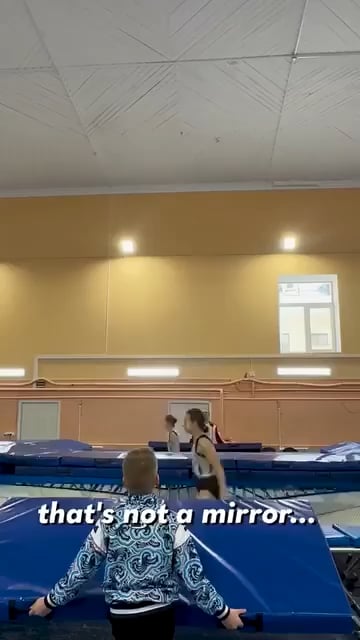
That’s not a mirror..
Have you ever walked into a room and caught a glimpse of yourself in what you thought was a mirror, only to realize it was actually a window or a shiny surface? It’s a pretty common experience, but what if I told you there are some truly mind-bending examples of “mirrors” that will make you question your perception of reality? From ancient mythology to modern-day science, the concept of mirrors has been fascinating humans for centuries, and it’s time to dive into the fascinating world of reflective surfaces.
The Ancient Origins of Mirrors
Believe it or not, the first mirrors were not made of glass, but of polished metal. The ancient Egyptians, Greeks, and Romans all used mirrors made of copper, bronze, and silver to admire their reflections. These early mirrors were not just used for vanity, but also for spiritual and mystical purposes. In many ancient cultures, mirrors were believed to have magical powers, allowing users to see into the future or communicate with the dead. The myth of Narcissus, who fell in love with his own reflection, is a famous example of the mesmerizing power of mirrors in ancient mythology.
The Science of Reflection
So, how do mirrors actually work? The science behind reflection is pretty cool. When light hits a surface, it bounces back, or reflects, at the same angle it hit the surface. This is known as the law of reflection. In the case of a mirror, the surface is typically made of a thin layer of metal, such as silver or aluminum, which is applied to the back of a pane of glass. When light hits the metal, it reflects back, creating the illusion of a mirror image. But here’s the really interesting part: the mirror image is not actually a physical object, but rather a virtual image created by the reflection of light. This means that the mirror image is not really “there” at all, but rather a trick of the light.
Beyond the Looking Glass
Today, mirrors are not just used for admiring our reflections, but also for a wide range of scientific and technological applications. From telescopes to microscopes, mirrors are used to reflect and focus light, allowing us to study the universe and the tiny world of atoms and molecules. Mirrors are also used in medicine, where they are used to reflect laser beams and other forms of light to diagnose and treat a range of medical conditions. And let’s not forget the art world, where mirrors are used to create stunning works of art that play with light and reflection. Whether it’s a hall of mirrors or a mirrored sculpture, the use of mirrors in art can create a sense of wonder and awe that is hard to find anywhere else.
As we gaze into the mirror, we are not just seeing our own reflections, but also the reflections of our ancestors, who were equally fascinated by the power of mirrors. From ancient mythology to modern-day science, the concept of mirrors has come a long way, and yet, it still has the power to mesmerize and inspire us. So next time you catch a glimpse of yourself in a mirror, remember that you are not just looking at your own reflection, but also at the reflections of centuries of human curiosity and ingenuity.