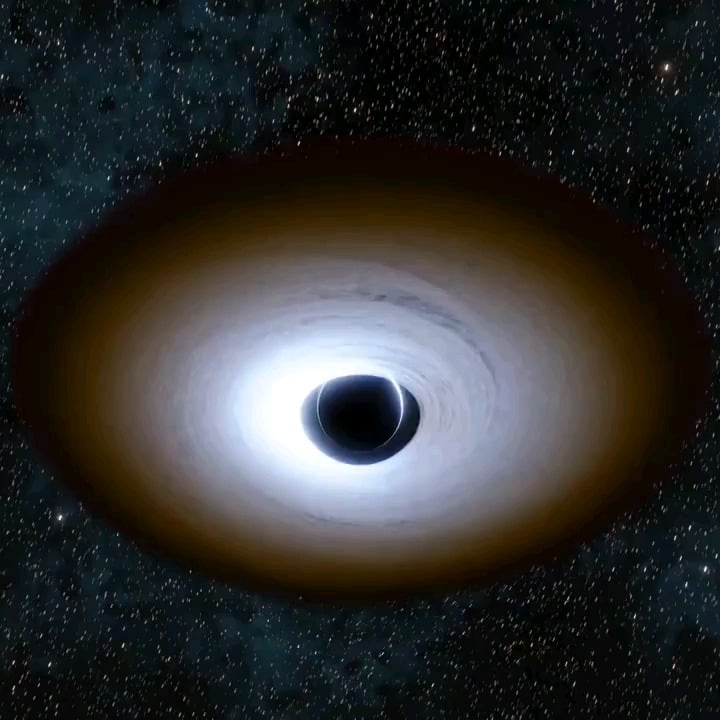
Fascinating visualization of a black hole surrounded by an accretion disk, illustrating how light is warped by its intense gravitational fields.
Imagine being an astronaut floating in the vastness of space, approaching a black hole that’s so dense and has such a strong gravitational pull, not even light can escape once it gets too close. As you get nearer, you notice a swirling disk of hot, glowing gas surrounding the black hole, and the way the light from this disk behaves is nothing short of mesmerizing. The intense gravity of the black hole warps the light in extreme ways, creating a dazzling display that challenges our understanding of space and time. This phenomenon is not just a product of science fiction, but a real cosmic wonder that has captivated the imagination of scientists and space enthusiasts alike.
Unveiling the Accretion Disk
The accretion disk is a crucial component in the black hole system, consisting of material such as gas and dust that’s being pulled towards the black hole. As this material spirals inward, it heats up due to friction and releases a tremendous amount of energy across the entire electromagnetic spectrum, from radio waves to X-rays. The disk’s temperature can reach millions of degrees, making it glow brightly and providing a visible sign of the black hole’s presence. The way matter behaves in the accretion disk, under the influence of the black hole’s gravity, is a complex dance that scientists are still working to fully understand.
Gravitational Lensing and Frame-Dragging
The extreme gravity of the black hole causes light to bend and follow curved paths, a phenomenon known as gravitational lensing. This effect is a consequence of Einstein’s theory of general relativity, which predicts that massive objects warp the fabric of spacetime. Around a black hole, this warping is so pronounced that it creates a kind of cosmic lens, magnifying and distorting the light from the accretion disk in astonishing ways. Additionally, the rotation of the black hole creates a “drag” effect on spacetime, known as frame-dragging, which further complicates the motion of light and matter in its vicinity.
Observing the Unobservable
Despite the challenges, scientists have made significant progress in observing and studying black holes, including those with accretion disks. By using advanced telescopes and computational models, researchers can simulate and predict the behavior of light around these cosmic monsters. The first-ever image of a black hole, captured in 2019 by the Event Horizon Telescope project, marked a historic milestone in astrophysics and opened a new window into the study of black holes. This achievement not only confirmed theoretical predictions but also provided a visually stunning confirmation of the extreme gravitational effects that occur in these environments.
As we continue to explore and understand the mysteries of black holes and their accretion disks, we’re reminded of the awe-inspiring complexity and beauty of the universe. The dance of light and matter around these cosmic phenomena is a testament to the power of gravity and the boundless wonders that await us in the depths of space. Whether through observations, simulations, or theoretical work, unraveling the secrets of black holes promises to reveal more about the fundamental laws of physics and our place within the grand tapestry of the cosmos.