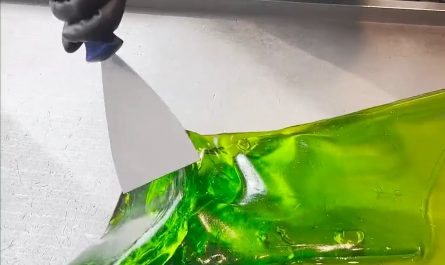
Belousov–Zhabotinsky reaction
Imagine a world where chemistry is not just about mixing substances and waiting for a reaction, but an art form that can create mesmerizing patterns and colors. Welcome to the fascinating realm of the Belousov-Zhabotinsky reaction, a phenomenon that has captivated scientists and artists alike for decades. This reaction is a perfect example of how chemistry can be both beautiful and complex, making it a favorite among those who love to explore the intricacies of the natural world. The story behind this reaction is just as intriguing as the reaction itself, involving a series of discoveries and experiments that have shed light on the underlying chemistry.
The Discovery
The Belousov-Zhabotinsky reaction was first discovered in the 1950s by Russian chemist Boris Belousov, who was trying to understand the process of glycolysis, a series of chemical reactions that occur within living cells. Belousov was experimenting with a mixture of malonic acid, bromate, and cerium sulfate, when he noticed something strange – the solution began to oscillate between a clear and a colored state, creating a mesmerizing pattern of colors. This discovery sparked a wave of interest among chemists, who were eager to understand the underlying mechanisms behind this phenomenon. Later, Anatol Zhabotinsky, another Russian chemist, expanded on Belousov’s work and discovered that the reaction could be sustained for a long period of time, creating a continuous cycle of color changes.
The Science Behind the Reaction
So, what exactly is happening in the Belousov-Zhabotinsky reaction? The reaction involves a complex interplay of chemical species, including bromate, malonic acid, and cerium ions. When these substances are mixed together, they trigger a series of chemical reactions that involve the oxidation and reduction of the cerium ions. This process creates a feedback loop, where the reaction oscillates between different states, resulting in the characteristic color changes. The reaction is often referred to as a “chemical oscillator,” because it can sustain itself for a long period of time, creating a continuous cycle of color changes. The Belousov-Zhabotinsky reaction has also been used to study the phenomenon of chaos theory, where small changes in the initial conditions can result in drastically different outcomes.
Artistic and Practical Applications
The Belousov-Zhabotinsky reaction has not only fascinated scientists, but also artists and designers, who have used it to create stunning visual effects. The reaction has been used in installations, performances, and even in the creation of interactive exhibits. The reaction’s ability to create complex patterns and colors has also inspired new areas of research, such as the study of pattern formation and self-organization. In addition to its artistic applications, the Belousov-Zhabotinsky reaction has also been used to study the behavior of complex systems, and to develop new technologies, such as chemical sensors and oscillating reactors.
As we continue to explore the wonders of the Belousov-Zhabotinsky reaction, we are reminded of the beauty and complexity of the natural world. This reaction is a perfect example of how chemistry can be both an art and a science, inspiring us to think creatively about the world around us. Whether you are a scientist, an artist, or simply someone who loves to explore the intricacies of the natural world, the Belousov-Zhabotinsky reaction is sure to captivate and inspire, offering a glimpse into the fascinating world of chemical reactions and pattern formation.