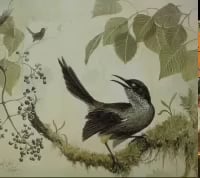
The last Kauai ‘O’o bird ‘s mating call recorded in 1987 before going extinct
The hauntingly beautiful call of the Kauai ‘O’o bird still echoes in the minds of conservationists and bird enthusiasts, even decades after its extinction. In 1987, a team of dedicated researchers recorded the last known mating call of this elusive species, a sound that would be forever etched in the annals of ornithological history. The Kauai ‘O’o, a member of the honeyeater family, was once a thriving species on the island of Kauai in Hawaii, but its population began to decline drastically in the 20th century due to habitat loss, disease, and the introduction of invasive species. The recording of its mating call is a poignant reminder of the transience of life and the importance of preserving our planet’s precious biodiversity.
The Science Behind the Call
The Kauai ‘O’o’s mating call was a unique and complex series of whistles and trills, a true marvel of evolutionary adaptation. Scientists believe that the call played a crucial role in the bird’s mating rituals, allowing individuals to establish territory and attract potential mates. The recording, made by a team of researchers from the Cornell Lab of Ornithology, is a remarkable example of the power of bioacoustics in understanding animal behavior. By analyzing the call’s frequency, pitch, and pattern, researchers can gain valuable insights into the bird’s social structure, habitat preferences, and even its emotional state. The Kauai ‘O’o’s call is a testament to the incredible diversity of bird vocalizations, which range from the simple chirps of sparrows to the complex songs of thrushes and mockingbirds.
A Conservation Tragedy
The extinction of the Kauai ‘O’o is a sobering reminder of the devastating impact of human activities on the natural world. The introduction of invasive species such as rats, cats, and mosquitoes, which carried diseases like avian malaria, decimated the bird’s population. Habitat destruction and fragmentation, largely due to agriculture and urbanization, further reduced the bird’s range and made it vulnerable to extinction. The last confirmed sighting of a Kauai ‘O’o was in 1985, and despite concerted conservation efforts, the species was declared extinct in 2000. The recording of its mating call is a bittersweet reminder of what we have lost, and a call to action to protect the remaining biodiversity on our planet.
A Legacy Lives On
Although the Kauai ‘O’o is gone, its legacy lives on in the form of the recorded mating call, which continues to inspire scientists, conservationists, and bird enthusiasts alike. The call has been used in various conservation efforts, including the development of acoustic monitoring systems to track bird populations and the creation of artificial nests to support endangered species. The story of the Kauai ‘O’o also serves as a powerful reminder of the importance of preserving our planet’s natural heritage, and the need for sustained conservation efforts to protect the world’s most vulnerable species. As we listen to the hauntingly beautiful call of the Kauai ‘O’o, we are reminded of the beauty, wonder, and fragility of life on Earth, and the need to act with compassion, wisdom, and urgency to preserve it for future generations.
The Kauai ‘O’o’s mating call may be a sound from the past, but its significance resonates deeply in the present. As we reflect on the story of this remarkable bird, we are reminded of the intricate web of life that binds us to the natural world, and the responsibility that comes with being stewards of the Earth. The call of the Kauai ‘O’o is a haunting reminder of what we have lost, but it is also a powerful symbol of hope and resilience, inspiring us to work towards a future where the beauty and diversity of nature are preserved for all to enjoy.