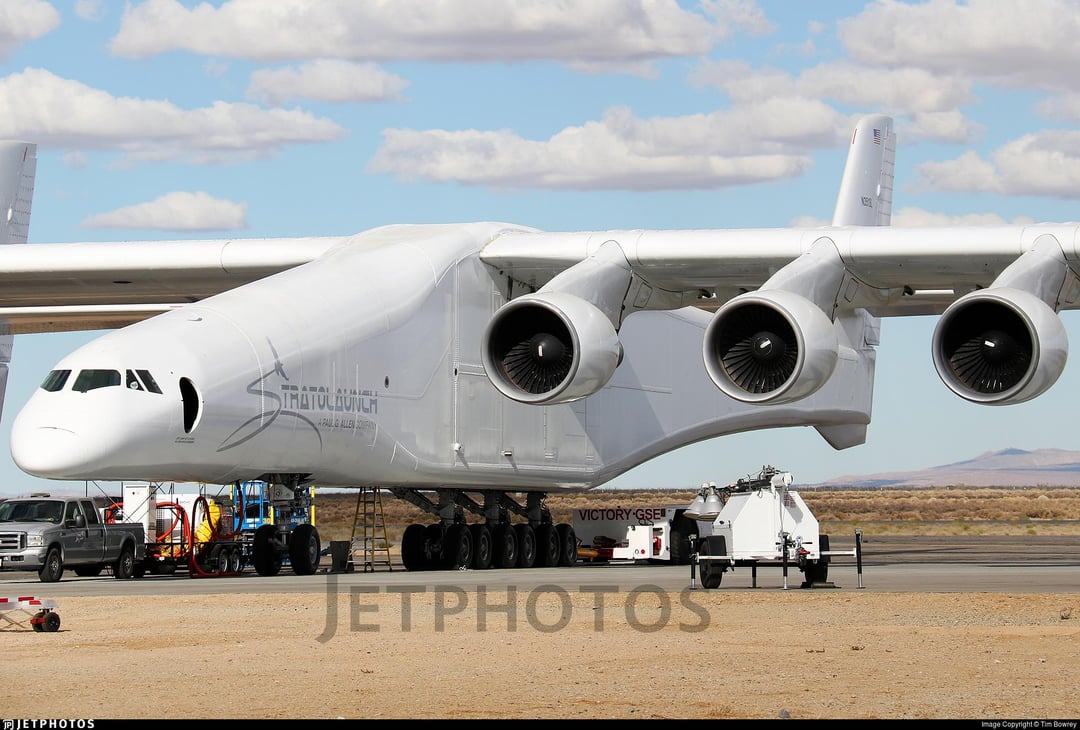
The Stratolaunch “Roc” is the world’s largest aircraft by wingspan (385 ft—longer than a football field). Designed as an airborne launch pad, the massive twin-fuselage plane is powered by six Boeing 747 engines and can carry up to 500,000 lbs under its center wing. Credit:Photos from JetPhotos
Imagine a plane so massive that it dwarfs a football field, with a wingspan that stretches an astonishing 385 feet from tip to tip. Meet the Stratolaunch “Roc”, the world’s largest aircraft, designed to take the concept of airborne launch pads to unprecedented heights. This gargantuan twin-fuselage plane is not just an engineering marvel, but a testament to human ingenuity and the relentless pursuit of innovation. With six Boeing 747 engines powering its massive frame, the Stratolaunch “Roc” can carry an impressive 500,000 pounds of payload under its center wing, making it an ideal platform for launching satellites, spacecraft, and even hypersonic vehicles into orbit.
Aircraft Design and Capabilities
The Stratolaunch “Roc” is a behemoth of an aircraft, with a unique design that features two fuselages connected by a central wing. This configuration allows for an enormous amount of payload capacity, making it an attractive option for companies looking to launch large satellites or spacecraft into orbit. The plane’s six Boeing 747 engines provide the necessary power to lift off the ground and reach the required altitude for launch, while its advanced avionics and flight control systems ensure a stable and smooth flight. With a maximum takeoff weight of over 1.3 million pounds, the Stratolaunch “Roc” is truly a heavyweight in the world of aviation.
Launch Platform and Future Applications
The Stratolaunch “Roc” is designed to serve as an airborne launch pad, providing a flexible and efficient way to launch payloads into space. By taking off from a conventional runway and climbing to high altitude, the plane can release its payload, which then ignites its own rocket engine to reach orbit. This approach offers several advantages over traditional launch methods, including reduced infrastructure costs, increased flexibility, and improved safety. The Stratolaunch “Roc” has the potential to play a significant role in the development of space technology, enabling the launch of satellites, spacecraft, and even hypersonic vehicles into orbit. With its impressive payload capacity and advanced design, this massive aircraft is poised to revolutionize the space industry.
Implications and Future Developments
The Stratolaunch “Roc” represents a major milestone in the development of airborne launch technology, and its implications are far-reaching. By providing a flexible and efficient way to launch payloads into space, this massive aircraft has the potential to reduce the cost and complexity of space access, making it more accessible to a wider range of companies and organizations. As the space industry continues to evolve, we can expect to see the Stratolaunch “Roc” play an increasingly important role in the launch of satellites, spacecraft, and other payloads into orbit. With its impressive capabilities and advanced design, this incredible aircraft is sure to inspire a new generation of engineers, scientists, and innovators, and will undoubtedly leave a lasting impact on the world of aviation and space exploration.
As we marvel at the sheer scale and complexity of the Stratolaunch “Roc”, we are reminded of the incredible power of human ingenuity and the importance of pushing the boundaries of what is thought possible. This incredible aircraft is a testament to the innovative spirit that drives us to explore, to discover, and to push the limits of what we can achieve. As we look to the future of space exploration and development, the Stratolaunch “Roc” is sure to play a significant role, inspiring us to reach for the stars and to never stop exploring the vast expanse of our universe.