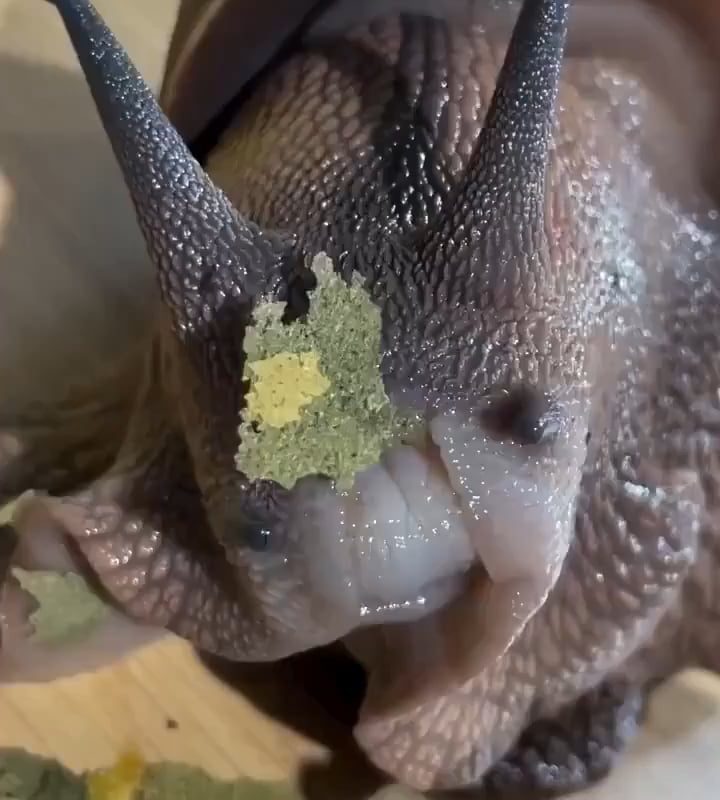
A perfectly ordinary snail in close-up while eating.
Title: The Secret World of Snails: A Stunning Close-Up Look at an Ordinary Snail Eating
Meta Description: Discover the mesmerizing details of a common garden snail feeding up close. Explore its unique anatomy, slow-motion dining habits, and the unexpected beauty hidden in everyday nature.
Introduction: Beyond the Shell
At first glance, a snail nibbling on a leaf seems mundane—a slow-moving blip in the garden’s background noise. But zoom in, and this humble creature transforms into a miniature marvel of biology. In this article, we’ll explore the surprisingly intricate world of an ordinary snail captured in extreme close-up while it eats, revealing secrets of its anatomy, behavior, and ecological importance.
Anatomy in Action: The Snail’s Feeding Toolkit
1. The Radula: Nature’s Rasp
When a snail eats, its radula—a tongue-like organ lined with thousands of microscopic, razor-sharp “teeth”—takes center stage. In close-up footage, you’ll see this ribbon-like structure scrape and shred food like a biological file, a process both alien and fascinating.
2. Tentacles at Work
Two pairs of tentacles dominate the snail’s face. The longer upper pair houses light-sensitive eyes (though their vision is rudimentary), while the shorter lower pair senses smells and textures, guiding the snail toward its meal.
3. The Mouth’s Quiet Precision
The snail’s mouth, located just beneath the tentacles, opens wide enough to envelop tiny bits of foliage. A close-up reveals rhythmic contractions as it methodically breaks down its food.
The Slow-Motion Ballet of Snail Dining
Step 1: Finding Food
Snails rely on their keen sense of smell to locate tender leaves, algae, or decaying matter. Their herbivorous diet makes them garden recyclers, though not all gardeners appreciate their appetite!
Step 2: The “Taste Test”
Before committing, a snail gently taps its food with its tentacles and mouth. Close-ups show this cautious inspection—a dance of survival to avoid toxic plants.
Step 3: Rasping Away
Once satisfied, the snail anchors itself with its muscular foot and scrapes the leaf’s surface using its radula. Time-lapse photography reveals a lace-like pattern left behind—a signature of snail feeding.
Step 4: Slow and Steady Digestion
A snail can spend hours consuming a single leaf. Its leisurely pace conserves energy—a trait perfected over 500 million years of evolution.
Why Close-Ups Reveal Hidden Wonders
Macro photography transforms this routine act into art:
- Iridescent Trails: The snail’s shimmering mucus, vital for movement, glistens under magnification.
- Textured Skin: Wrinkles and pores on its foot and body resemble an otherworldly landscape.
- Micro-Movements: Tentacle twitches and subtle mouth adjustments become a captivating slow-motion ballet.
The Ecological Role of the “Ordinary” Snail
While often overlooked, snails are vital decomposers. By breaking down plant matter, they enrich soil nutrients and support healthy ecosystems. They’re also food for birds, beetles, and frogs—making them a humble linchpin in the garden’s food web.
How to Capture Your Own Snail Close-Up
- Timing: Film snails at dawn or after rain when they’re most active.
- Lighting: Use soft natural light to highlight textures without harsh shadows.
- Patience: Let the snail acclimate to avoid retracting into its shell.
- Props: Place snails on glass or plexiglass for dramatic underbelly shots.
Conclusion: A Reminder to Notice the Small Things
A perfectly ordinary snail, magnified while eating, becomes a testament to nature’s hidden complexity. In a world obsessed with speed, it reminds us that beauty thrives in slowness—one deliberate bite at a time.
Next time you spot a snail in your garden, pause and imagine the microscopic universe bustling beneath its shell. You might just find wonders where you least expect them.
Keywords for SEO: ordinary snail close-up, snail eating macro, radula function, snail anatomy, garden snail behavior, macro nature photography, slow-motion snail, backyard ecosystem, mollusk feeding habits.
Hashtags: #NatureUpClose #SlowMotionNature #GardenWildlife #MacroPhotography #SnailFacts
By blending science with awe, this glimpse into an everyday snail’s life invites readers to rediscover the extraordinary in the ordinary. 🌿🐌