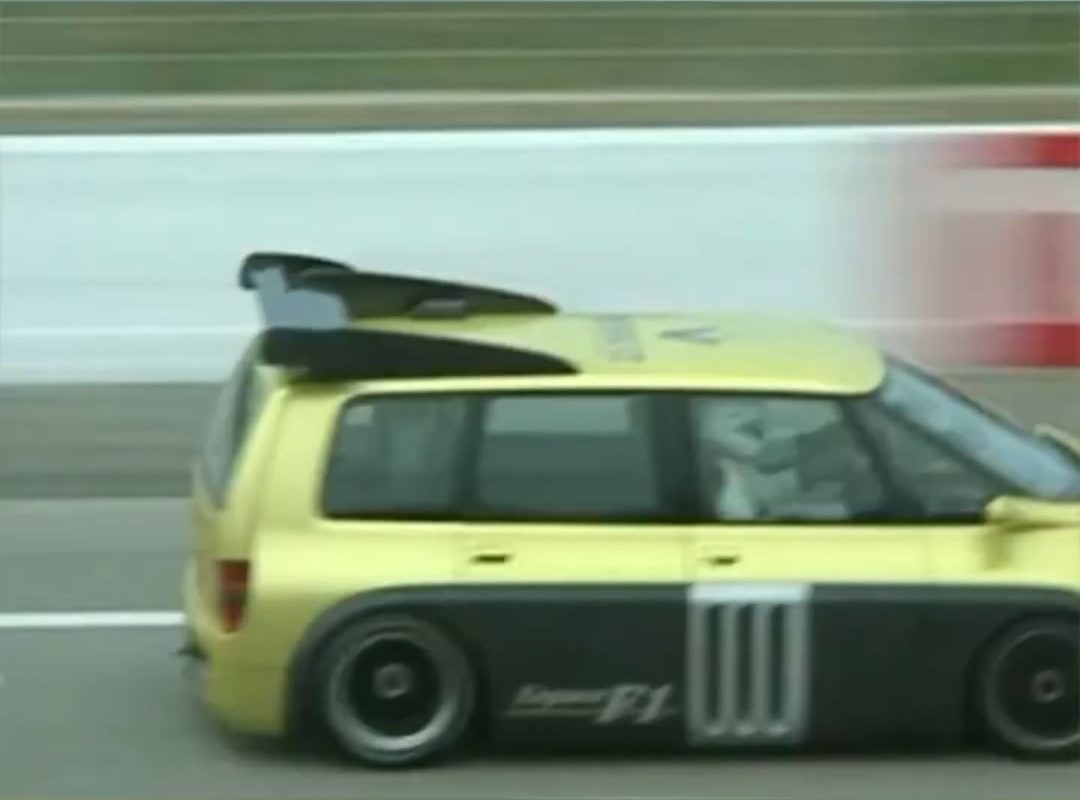
Renault Espace with an F1 V10.
Title: The Renault Espace F1: The Insane Minivan with a Formula 1 V10 Engine
Introduction
In the world of automotive oddities, few concepts are as mind-bending as the Renault Espace F1. Imagine a humble family minivan infused with the heart of a Formula 1 car—a screaming, naturally aspirated V10 engine capable of shattering speed records. This is not a fever dream; it’s a real prototype built by Renault in 1994 to push boundaries and prove that even the most practical vehicles could become track monsters.
In this article, we’ll dive into the engineering marvel that is the Renault Espace F1, its jaw-dropping specs, the legacy it left behind, and why it remains a cult hero among car enthusiasts.
What Is the Renault Espace F1?
The Renault Espace F1 was a one-off concept car created to celebrate the 10th anniversary of the Espace minivan and Renault’s success in Formula 1. Unveiled in 1994, it was designed to showcase Renault’s technical prowess by pairing the Espace’s practical body with a 3.5-liter V10 engine borrowed from the Williams-Renault FW15C—the same car that dominated F1 in 1993 with Alain Prost and Damon Hill.
While minivans are synonymous with school runs and grocery trips, the Espace F1 redefined what was possible, blending practicality with 800+ horsepower of pure racing pedigree.
Under the Hood: The F1 V10 Beast
At the core of the Espace F1 was its legendary powerplant:
- Engine: 3.5L Williams-Renault RS5 V10 (derived from the FW15C F1 car).
- Power Output: 820 horsepower at 12,800 RPM (detuned from F1’s 850+ hp for reliability).
- Torque: 320 lb-ft.
- Transmission: Six-speed sequential gearbox with paddle shifters.
- Weight: Just 1,300 kg (2,866 lbs) thanks to extensive carbon-fiber reinforcement.
The engine was mid-mounted (behind the front seats), turning the Espace into a rear-wheel-drive rocketship with a power-to-weight ratio rivaling supercars.
Performance: Faster Than Most Supercars
The Espace F1 wasn’t just a gimmick—it was frighteningly quick:
- 0–100 km/h (0–62 mph): 2.8 seconds (faster than a contemporary Ferrari F40).
- Top Speed: 312 km/h (194 mph).
- Braking: Formula 1-derived carbon-ceramic brakes able to stop from 300 km/h in under 10 seconds.
To put this in perspective, the Espace F1 could out-accelerate motorcycles and embarrass hypercars while carrying four passengers—assuming they didn’t mind ear-splitting noise or g-forces strong enough to blur vision.
Design & Engineering Madness
Converting a minivan into an F1-powered machine required drastic modifications:
- Chassis: The original Espace frame was gutted and replaced with a tubular steel chassis wrapped in carbon-fiber body panels.
- Aerodynamics: A massive rear diffuser, front splitter, and side skirts were added to manage airflow at high speeds.
- Interior: Recaro racing seats with six-point harnesses, an F1-style steering wheel, and a roll cage replaced family-friendly amenities.
- Suspension: Double-wishbone setup with inboard springs lifted directly from F1 technology.
The result? A minivan that looked like it had escaped from a racetrack—and acted like it, too.
Why Was It Built?
Renault never intended the Espace F1 for production. It served three key purposes:
- Marketing Genius: Highlight Renault’s F1 dominance and engineering capabilities.
- Technology Testbed: Experiment with materials like carbon fiber for future road cars.
- The Ultimate Flex: Prove that even a minivan could be transformed into a performance icon.
Legacy & Cultural Impact
The Espace F1 became an instant legend, appearing in motorsport events, car shows, and even a Top Gear segment (where Jeremy Clarkson called it “the craziest thing Renault ever built”). Its legacy lives on as:
- A Collector’s Holy Grail: Only one prototype exists, rarely seen outside Renault’s private collection.
- An Inspiration: It paved the way for high-performance minivans like the Mercedes-AMG R63 and Tesla Model X.
- A Symbol of 90s Audacity: A reminder of a time when carmakers dared to dream wilder.
FAQs About the Renault Espace F1
Q: How many were made?
A: Just one prototype—it remains priceless.
Q: Was it street-legal?
A: No. It lacked basic features like airbags or emissions controls and was purely a track toy.
Q: What did it sound like?
A: Like an F1 car on full throttle—a 12,000 RPM scream that could rattle windows a mile away.
Conclusion: The Ultimate Minivan Rebellion
The Renault Espace F1 stands as a monument to automotive insanity—a minivan that defied physics and logic. While you’ll never see one parked at a soccer game, its audacious spirit continues to inspire gearheads and remind us that innovation often starts with asking, “What if?”
For now, the Espace F1 remains a unicorn: a fusion of school-run practicality and Formula 1 insanity that will forever hold its place in the pantheon of automotive legends.
Keyword SEO Terms: Renault Espace F1, F1 V10 engine, Renault Williams F1 engine, fastest minivan, Renault Espace V10, Espace F1 specs, craziest concept cars.
Optimize your search for “Renault Espace F1 V10” to uncover videos, articles, and rare footage of this legendary machine in action!